Monday, July 14, 2014

Godzilla - Rampaging down Memory Lane

Me an' the big guy have a long and complex relationship. Godzilla's been a part of my sci-fi awareness for as long as I can remember, and, over the years, I've learned to take the good with the bad. He's been terrifying and awe-inspiring, campy and laughable, but never, ever boring.

Not until now, anyway.

In the beginning:

My first encounter with the King of Monsters was when I was around four years old. It was the middle of the afternoon, I think in the summer, and we were living in an Ontario suburb where the aerial towers on the houses (remember, this was the late 70s, so no cable yet) were able to pick up TV signals from Buffalo reasonably well (it had to be one of the US stations, because it was too early in the day for TV Ontario's old movie show, Magic Shadows), and one of the stations was running the Americanized version of the original Godzilla/Gojira. I was in awe. Completely terrified as I watched this unstoppable titan smashing through houses and buildings, but equally filled with wonder. I've always been a fan of dragons, and here, on the screen in our basement, was the ultimate dragon, complete with fiery breath, laying waste to whole cities. This guy was so big, so bad, he didn't have to concern himself with hoarding treasure or carrying off princesses — he was so big, the entire planet was his hoard to do with as he pleased. He was a force of nature... if one that was ultimately killed/driven off/whatever by a giant Alka Seltzer tablet.

That night, I had a nightmare that I was at my friend Cameron's birthday party, and Godzilla came storming through our neighbourhood and destroyed Cameron's house. I woke up screaming as the images of the house collapsing all around me, birthday party wreckage everywhere, all my friends gone, and a huge, green foot descending from so very, very high up, faded from my eyes. And here's where it gets weird: The next day, just before supper, Cameron came walking down the street with a stack of invitations and asked if I'd like to come to his birthday party that weekend! Now, I kept my poker face on, but inside I was going completely bonkers because I knew, I just knew that if I went to that party, that was it: Godzilla would come and kill us all.

Silly, yes. A total coincidence, yes. But I was four, and this shit was real to me. I politely declined without giving a reason, and Cameron went on to the next kid's place with a confused and slightly sad little frown. His mother called my mom later and asked if I'd reconsider. Again, I kept my poker face on, despite the mounting terror inside, and told Mom that I just didn't feel like it. How could I tell her I was doing everything I could to protect my family — my entire neighbourhood, dammit! — and that if I went to that party, Godzilla would come wading up the Grand River from Lake Erie or some damn place and we'd be toast? Parents would never believe something like that, so I couldn't explain, now could I? So I kept it simple and polite, and missed out on an afternoon of cake and hot dogs and junk food and noisemakers with my buddies.

Time went on, and I realized it was just a nightmare, and that Godzilla wasn't real, but the feeling of awe that I experienced when I saw that movie, of the big guy's unparalleled coolness, stayed with me.

Periodically, I'd get other Godzilla fixes that helped to maintain this fondness. I remember commercials on TV for a toy Godzilla that would fight samurai warrior robots (they had ejectable hands and missiles, he had plastic fire coming out of his mouth). I didn't have that cool toy, but what I did have (for a while anyway) was a little metal wind-up Godzilla toy that would march across the tabletop spitting sparks. It had been in my Christmas stocking in '77 or '78, I think, and was one of my favourite toys at the time. Sadly, it was lost after just a couple of months. Should I blame the vacuum cleaner, my little brother, or my dad's drinking buddies? Tough choice.

Then there was another afternoon where one of the TV stations ran Godzilla vs Mothra... I have a vivid memory of watching Godzilla struggle as the Mothra larvae hosed him down with layers of heavy webbing.

On another occasion (I think it was on TV Ontario this time), I was introduced to Marv Newland's hilarious 1969 short Bambi meets Godzilla


These days, you'd never see something this harsh put on TV where kids could see it, but back then we were tougher, and I didn't know a single kid who didn't laugh his or her head off at the inevitable outcome of this meeting. Twenty years or so later, I remember seeing this again when I went to Spike & Mike's Sick and Twisted Animation Festival with a friend in Vancouver. Everyone in the audience laughed then too, although I think it was the copious amounts of pot being passed around, as much as it was the nostalgia or the humour of the film.

But back to the old days... In 1979, Hanna Barbera's Godzilla cartoon exploded onto our Saturday morning TV screen (yeah, I know, in some markets it was aired as early as the fall of '78 as part of a longer, co-branded package with other shows, but I don't remember it being packaged in our area - it was just run solo, amongst the other shows in the various networks' Saturday morning lineups).


This time, Godzilla was a good guy, he was a lot bigger than his movie predecessor ("30 storeys hiiiiiiiiiiigh!"); he now had laser vision (in addition to his fire breath); he had a son or little buddy, Godzuki; and he was someone's bitch.

That's right, Godzilla, King of all Monsters, was, in this cartoon, always at the beck and call of a gaggle of puny humans. This Scooby Doo-esque gang of self-styled adventurers travelled the globe in their tramp steamer and used a remote control to signal to the big guy to bail them out whenever they got into trouble. Which was every week. Each Saturday, Godzilla would knock heads with cyclopean crab monsters, animated giant statues, creatures of legend, over-sized dinosaurs, or whatever the foe de jour happened to be. After he took a few knocks and beat the bad guys, the humans would dismiss Godzilla, and he'd give a farewell roar and then disappear back into the sea. No trips to gorge at the local nuclear power station as a thank you. No offer of industrial-sized dental work to fix whatever teeth had been knocked loose in the tussle with the gargantuan Aztec monkey robot or whatever. Not even a truckload of fish. The big guy didn't really get much more of a thank you than some servant in a British period piece would.

Even as a little kid, part of me was waiting for the day when Godzilla would get some self respect and ignore the signal, and leave the humans to deal with the giant space blob (or angry pizza delivery guy demanding a tip, or whatever) themselves. That day never came.

And there was the other difference from the movies: the roar. In the films, Godzilla's battle cry is that weird screeching-trumpeting-honk-growl, like an elephant in serious intestinal distress. But in the cartoon, he sounds like a college football player puking his guts out after a night of hard partying. Watch a few clips on Youtube and you'll hear that I'm right.

But I loved the show anyway. After all, what could you not love about Godzilla battling other super monsters every week?

The middle years:


Eventually the cartoon went off the air, and there were a couple of dead years before Godzilla experienced a bit of a Renaissance

In 1985, the appropriately — if unimaginatively named — Godzilla 1985 attacked the big screen. This Godzilla film was more restrained than the over-the-top monster slugfest sequels of the 1960s and 70s, focussing solely on the big guy, the mystery of why he'd returned, the tragedy of this attack, and what could be done to stop him. Periodically, a grim-looking Raymond Burr (reprising the newsman role he'd played in the scenes added to the original 1954 Gojira when it was released in North America in '56 as Godzilla: King of the Monsters!) would lumber onscreen, comment on the devastation, and try to give the movie some gravitas, and even challenging the audience to feel a bit of pity for Godzilla when he eventually met his apparent demise in the depths of Mount Fuji. I also remember this movie for getting a little weird and goofy when the TV promos ran Blue Oyster Cult's "Godzilla" under the trailer (although maybe I'm thinking of the promos for the VHS release — it's been so long, I'm not entirely sure). In any case, it was nice to have the big guy back in action, especially since the other movies in the franchise never got much play on the local stations.

Round about then, my friends and I were also spending an awful lot of money playing the "Rampage" arcade game at one of the local convenience stores in Tsawwassen. The clip I've linked to is a solo run by George (clearly modelled on King Kong), but I always enjoyed playing Lizzie because she was so obviously Godzilla. Sure there were other — and more specifically Godzilla-related — video games that came out before and after this one, but Rampage was the one I loved.

Then there was the hilarious, if idiotic, movie One Crazy Summer, where, at one point, Bobcat Goldthwait's character, Egg Stork, gets trapped in a Godzilla costume when he's supposed to be spying on the bad guys. Mayhem ensues. Not necessarily one of my favourite scenes from the film, but memorable none-the-less.

At this point, as I got into junior high and was starting to stay up until stupid-o'clock-in-the-morning, I was also getting into the late night "Sci Fi Friday" features offered by the local US cable stations. Ah, the late 80s and early 90s: the glorious final years of cable TV, before all the little independent stations were eaten up by the big cable networks, and where they'd run anything at any time of day just to get any kind of viewer watching... the years when Friday and Saturday nights belonged to geeks. On these stations, the Sci Fi Friday (or Saturday) feature was a kind of Russian roulette: they might show a vintage piece of the canon, like The Day the Earth Stood Still, or something more recent and cool like Close Encounters of the Third Kind or Alien. But they could just as easily inflict some cheestastic damage on a viewer in the form of Invasion of the Star Creatures or The Barbarians. Sprinkled in among all of this was the occasional instalment in the Godzilla franchise. My favourites were the 1968 supreme battle royale known as Destroy All Monsters, and 1962's King Kong vs. Godzilla, because any flick with a fight scene where Godzilla drop kicks King Kong is just... well, okay, maybe it isn't.

Recently:

As the years passed, Japanese filmmakers continued to pump out Godzilla instalments at a fairly regular rate, but I didn't have time in my university and college years to hunt around for them. The next time Godzilla came crashing into my awareness was in the spring of '98 when Hollywood took a run at the concept with Godzilla.

This time, it was New York, rather than Tokyo, in the monster's sights, and the menace in question was quite a bit different than its previous incarnation. First, there was the facelift (which I guess fits with Hollywood culture) which abandoned the big guy's traditional body design for something more like a gigantic, bipedal, lantern-jawed iguana. Second, there was the sex change, ignoring Godzilla's traditional identity of "it" or "he" and reimagining the creature as female (to facilitate the laying of eggs to pave the way for sequels that were never made because the film was received so poorly). Third: forget about the atomic fire breath. I seem to recall one scene where it looked like maybe Godzilla (or "Zilla" as she's now called in the franchise's canon) took out a helicopter with fire breath, but it wasn't completely clear and could just as easily have been rogue ordinance or a gas main explosion. Even if it was supposed to be fire breath, it was only used once and certainly wasn't as flashy as the traditional blast. Lastly, there was no thirst for energy. Instead, Zilla had a hankering for fish.

Throw in Matthew Broderick in the lead role, supported by Jean Reno and a squad of French commandos ("Croissant?" "Non. Donut."), and you've got a well-intentioned but ultimately weak attempt at rebooting the monster.

I'll admit that I was super eager to see this film. Again, lifetime Godzilla fan. And this was the first opportunity to get a fix in a long time, and one that was going to have slick Hollywood special effects and filmmaking. I also have no problems saying that I was disappointed when I came out of the theatre. Not gutted. Not really pissed off and feeling cheated and raging that they'd mutilated a thing I'd loved. But disappointed. There's a lot that was dumb or screwed up, but when a human character (in this case, Reno) steals the show and you're indifferent to the kaiju, then something's seriously wrong with the Godzilla movie you're watching.

But things started looking up after that.

There were other movies, not imitators, but films very much inspired by Godzilla, that came along and showed audiences that kaiju movies could move beyond their schlock property roots and could look good, be fun, and even be capable of creating a real emotional impact, and (sometimes) have something intelligent to say.

In 2006, there was the Korean film The Host, which some of you may remember I gushed over at length.

Then, in 2008, there was Cloverfield (I'm constantly amazed when I can reference this movie without saying "Cloverdale" — the name of a nearby village known for its rodeo, which has nothing to do with anything in the flick. "Coming this summer: a town at the mercy of a man... and a giant pickup truck!"), which I also enjoyed.

Last year, Guillermo Del Toro gave us Pacific Rim, which wasn't the least bit intelligent, but was ultra fun and everything a great kaiju movie should be, with the best Hollywood special effects, and the right actors to pull it off.

Even the Godzilla comics have been good for the past couple of years! Yeah, I know, Godzilla's been published in comic form off and on by different houses for a long, long time, but I never really paid much attention to them until this past year or so, when I started picking up the graphic novels from IDW. The best of these has been Godzilla: The Half-Century War, chronicling one man's efforts to stop the big guy and other monsters over the years since Godzilla's first rampage in 1954. Great story. Great art. Definitely worth picking this one up next time you're at your local comic shop.

The newest version: Godzilla.boring

Just when you thought it was safe for Hollywood to go back into the waters of Godzilla movies, you were wrong. For a flick that came on so strong in the trailers, the 2014 Godzilla turned out to be disappointing and boring. Worst of all, it was stingy with the big guy's screen time — I don't think the director/writers/special effects team let the audience see the titular King of Monsters for more than a minute and a half.

The problem lies in the fact that the writers and director are clearly trying to go for a Cloverfield approach to the movie — focussing entirely on the human characters, with the kaiju relegated to the background as shadowy, rarely seen, and barely understood causes of disaster. So, instead of 30, 40, or even 70 percent of the movie fixating on the battling monsters, Godzilla teases us with some offshore dorsal spines/fins in the opening credits, then a dark, distant shot of Godzilla fighting the flying Massive Unidentified Terrestrial Organism (MUTO) at the Oahu airport (a brawl that only lasts a minute or so before cutting away), then lastly the final battle against the MUTOs. Problem is, this is a Godzilla movie. We paid to see Godzilla. A lot of him. It's okay — and, dammit, even encouraged — to have a solid cast of human characters with a decent plot and dialogue, but those things can't get in the way of Godzilla's screen time! The whole point of the movie is to watch extended sequences of the King of Monsters laying down his authoritah in a Cartman-like temper tantrum that lays entire cities to waste in lengthy battles against equally destructive foes. So when the first 45 minutes or so had no Godzilla in it, and then the audience was teased with just a minute-long glimpse of his supposed Hawaiian rumble, and then there was another long wait before the final battle, you can imagine the disappointment of myself and other audience members. There's a vulgar comparison I could use here, but I'll exercise a little discretion and instead say it was like seeing an advertisement for delicious pie, going into the baker and laying down your money, and being given only a half-forkful of mostly crust with just a little filling on it, and then being told there was no more to be had. Not cool.

To make matters worse, the writers and director botched the job of focussing the film on the human characters. Brian Cranston does a good job of playing a nuclear technician who survives a terrible reactor accident that kills his wife. But his talents as an actor are ultimately wasted because he's killed off after 45 minutes just as the film is finally starting to get moving, and before the kaiju really start doing their stuff. If we could have watched him ride through the events of the entire film, watched him have to cope with his feelings of confronting the monsters that caused his wife's death, and the government agents who allowed it to happen, watched him weigh the options that could affect the lives of hundreds of thousands of others, that would have been a human-centred plot that would have been worth while. That would have been a role worthy of Bryan Cranston. Instead, his character is abruptly killed off, making it a role that could have been serviced by any middle-aged actor. Instead, we're left more or less drifting through the rest of the movie with his character's non-entity army guy son, Ford, who himself basically just drifts through the events around him (even drifting past his opportunity to use his bomb disposal skills at the end of the movie when they'd actually count for something). The other failed option is the character of Ford's wife, Elle, who's given just enough screen time to tell us that we're supposed to care about what happens to her, but not enough screen time to actually make us care whether she lives or gets pulverized in the falling rubble of San Francisco at the end. Beyond those two, there's only the Japanese scientist, Dr Ishiro Serizawa, who seems limited to cryptically muttering that Godzilla is a force of nature who should be left to do what he does, and who looks so incredibly hang-dog, so bent and constantly cringing, so utterly physically and emotionally broken, that you'd think he'd either been stepped on by Godzilla, or that between the movie's takes he'd had to use the toilet stall next to one occupied by the kaiju king and been forever altered by the horror of the experience. So, lame-duck human characters taking up too much screen time that should have gone to the monsters.

On the positive side, Godzilla himself looks terrific. Sure, the special effects designers have made a few alterations here and there, but they're okay. Firstly, he's much bigger than his cinematic predecessors, standing at around 150 metres, compared to the modest 50 metre height of 1954's original. Apparently, the director and special effects guys took to heart the tag line from the '98 version, that "size does matter". Next, he's hunched forward slightly, not standing erect like many godzillas of the past, but also not entirely horizontal like 1998's Zilla. This one also has smaller, round, compact feet like an elephant or sauropod dinosaur, rather than the big flappy dogs that the others had. And he's bulky. Hugely massive. As in no-neck big. Formidable in a sumo sort of way. And it looks good on him. I also have to give credit to the atomic fire breath: it's incredible. In fact, one of the only good parts in the movie is when Godzilla uses his fire for the second time, in a kiss of death blast that finishes-off the last MUTO.

But good looks aren't enough to carry a movie, and when my wife and I left the theatre after the show on opening night, I was bored. And disappointed. More disappointed than I'd been after the '98 version. And with Pacific Rim and Cloverfield and The Host to learn from, that's inexcusable. I can only hope that the next time Godzilla rises from the depths, it will be to destroy the real monsters — the people who would settle for boring mediocrity and ruin the chance to make a really good film.

But as much as 2014's failure has left a bad taste in my mouth, I haven't lost my love for Godzilla yet. He's been down before: savaged by other monsters, cheapened and made campy by greedy and overzealous studios, ridiculed by critics, and compelled by a gang of meddling kids. But he's never been beat. Whether he's thrown into a good movie or bad, Godzilla is still the King of Monsters.

Sunday, April 27, 2014

Mini-Review 3 - The Door to Lost Pages, The Alchemists of Kush, Burning Paradise, & Beyond the Rift


Time for another batch of mini book reviews! Some of the selections this time around are relatively new, while others are books read quite a while ago that I've been chewing over in my mind. We'll be looking at Claude Lalumiere's The Door to Lost Pages, Minister Faust's The Alchemists of Kush, Burning Paradise by Robert Charles Wilson, and Beyond the Rift by Peter Watts. They're a diverse group of authors, presenting a wide range of SF subject matter, writing in different styles (sometimes within the same book), and saying different things. All are extremely intelligent books that are definitely worth adding to your collection.

---------------------------

Claude Lalumiere's collection The Door to Lost Pages is very much like the titular bookstore featured in its stories: densely-packed with all manner of strange writings on different subjects, and if you're not paying attention, you'll miss intriguing and important details.

The Lost Pages bookstore (and its collection of resident dogs) is the constant that weaves in and out of the various stories and their different, sometimes interconnected, universes. Some of the tales feature characters who pull the same act, managing to squeeze between different reflections of reality, sometimes voluntarily. The store is alternately a mystery, a source of knowledge, and a refuge, and after reading this mosaic book, you get the feeling that for every story in it, there's probably a corresponding book crammed somewhere in the dusty back shelves of the store. My favourites among the bunch are "Let Evil Beware!" and "Dark Tendrils".

"Dark Tendrils" just simply scared the shit outta me. The reader is forced to watch the protagonist, Kurt — just as Kurt is forced to watch what's happening to himself — as he tries to resist the encroachment of a demonic force on his life, one that takes his spouse, and eventually, despite his best efforts, Kurt himself. It's the sense of awful inevitability that Lalumiere washes the story with that really got to me.

"Let Evil Beware!" is the story of Billy, an eight-year-old boy who comes into the store to buy research materials. See, Billy's no ordinary kid; he's a monster hunter. While his unaware parents buy him comics and carry on doing regular parent-kid things, Billy — who otherwise behaves like a normal kid — is also leading a secret life of slaying otherworldly fiends. On the surface, it's just a funny little story like a lot of the cartoons and comics many of us grew up with, featuring plucky young heroes (often young children) out there saving the world. My first impression of Billy was that he reminded me a lot of Simon from The Secret Railroad, without Mr Passenger, Melanie the cat, or Stella tagging along. You might just as well see Tom Sawyer, or Astroboy, or Johnny Quest, or one of a hundred other boy heroes though. But the thing about it is, after you've turned the last page and had your little chuckle, there's a bit of a chill that sets in, because this story is deadly serious: in its universe, the fate of the world really does rest on the narrow shoulders of this little kid. It made me think of kids who were in resistance groups in World War II. And then I had to wonder, how did this kid get this particular gig? Did Billy have a choice? I found myself wondering and wandering down a darker road as I thought about it... was this pushed on Billy by some outside agency? Was he coerced, even with some positive spin like "only you can save the world"? And if he was pressured, or denied a choice, is he different than a child soldier? And I had to wonder, what if this poor kid, as good-natured as he is, and as seriously as he takes his job, someday isn't up to the task of facing some supernatural horror that would turn most adults into a weeping mess? What happens to his world then? And what if some day he doesn't want the job anymore? That's what looking into the layers of a Lalumiere story will do to you.

That's why you've got to buy this book.

---------------------------

 In The Alchemists of Kush, author Minister Faust presents us with a three-fold bildungsroman — a novel of growth about two boys and a community.

It's the story of Raphael "Rap" "Supreme Raptor" Deng Garang, a teenage Sudanese-Somali refugee, aspiring hip-hop artist, and comic fan living in Edmonton with his widowed mother, trying to find his identity and place in the world, unknowingly desperate for a father figure, and just as desperately trying to lock-down unwanted memories of a childhood spent on the run and victimized by violence. Saved from thugs one night by local shop owner Yimunhotep "Brother Moon" Ani (a character who made me think of a hybrid between Avery Brooks' portrayal of the sensitive writer Benny [Sisko's alter-ego] from the Star Trek: Deep Space Nine episode "Far Beyond the Stars" and Charles S Dutton's spiritually earnest, two-fisted convict-monk in Alien 3), Rap finds the teacher and surrogate father he needs to open himself emotionally to others, and to his past, and throw aside his preconceptions, healing himself and growing into a stronger, better man.

It's also the story of Horus, a boy living thousands of years ago in an Africa of myth. Horus' life is told in segments parallel to Rap's, as he runs from the army that destroyed his village and killed his people, avoids monsters, and eventually finds a wizard-alchemist who can give him and his friends the knowledge and skills they need to survive, and to help Horus find his father Osiris in the underworld.

And, just as importantly, it's the story of a community's growth — of how people from different families and different African ethnicities come together in Edmonton, putting aside mistrust and cultural prejudices as they support a community centre for their children, recognizing shared experiences and a common desire for a stronger, more positive future.

Just because the story (stories) evolves towards a betterment of characters and community, doesn't mean for a minute that it sugar-coats life. Both boys experience horrific brutality, and the road towards a better life isn't an unwavering upwards glide: sometimes, like every teenager, Rap is an unlikeable dick. Sometimes Horus loses what he's struggled to build, sometimes the community turns on itself, and sometimes, even a teacher like Brother Moon, despite his wisdom and experience, hits his limits and loses his cool with tragic consequences. The Alchemists of Kush is not the zany action comedy/hero-coming-into-his-own story that The Coyote Kings of the Space Age Bachelor Pad was, it's far more introspective. Nor is it as caustic as the political satire in the guise of superhero adventure that From the Notebooks of Dr. Brain was — it's far more personal as it grapples with the issues it's trying to talk about. But all of that is what makes The Alchemists of Kush, despite its gods and alchemy, more real, and in many ways, more important as a novel. The cultures portrayed in it may be different from those of some readers, but its experiences are universal, and the importance of that, the ability to transform perspective and foster understanding, is where the real alchemy lies.

-------------------------


Burning Paradise is the latest novel from Robert Charles Wilson exploring one of his favourite topics: how individual people would deal with life when confronted with super-intelligent — though not necessarily conscious — alien artificial intelligences using the Earth for their own ends.

In this case, Wilson presents us with an alternate reality of relative global prosperity (if one with lower levels of technology) where the devastating conflicts of the 20th Century didn't happen due to the influence of the "hypercolony", an unseen alien intelligence existing as a cloud of microscopic particles high in the atmosphere that has been manipulating electronic communications since the dawn of the radio age. The hypercolony keeps the peace by instantly "editing" radio and television transmissions to ensure statements from world leaders, academics, or the media don't create international tension. It's all part of the entity's plan to quietly develop the resources it needs to continue its ages-long lifecycle — propagating itself virus-like from star system to star system across the cosmos by gentling intelligent civilizations and encouraging the development of the technologies it needs to beam its template to the next unsuspecting world. And it values its anonymity, so much so that it's willing to manufacture "simulants" to kill anyone who threatens to reveal its existence. Against this backdrop, we meet Cassie, who's parents were murdered by the hypercolony for being part of a secret society dedicated to studying and eventually overthrowing the alien entity. Cassie and her little brother have been living the quiet life with her aunt Nerissa (herself a former member of the conspiracy), until one evening when Cassie discovers she's being watched by one of the sims. This forces her to flee across the country with her brother and two other teenagers who are children of the conspiracy, while Nerissa desperately searches for them. Along the way, they're all drawn to the reclusive leader of the secret society, and they begin to discover that all may not be as it seems with the hypercolony, and a difficult choice may lie ahead.

Again, this isn't the first time Wilson's played with the idea of the Earth and its people getting caught-up as collateral damage in the effects of alien infrastructure projects: we saw it in his brilliant Spin trilogy, Darwinia, and to some degree in Blind Lake. In each case though, Wilson tries to examine different variations of the scenario. In Spin, there was very much an Arthur C. Clarke feel to the whole affair — the alien intelligence was more-or-less going about its own business, using the Earth (and the occasional human) as a resource, but there was really nothing personal in its machinations, no more than a construction supply company would give consideration to the insects displaced or killed during the digging of a gravel quarry. Blind Lake provided a slightly more human, though still Clarkean twist, with the idea that the observation and transport devices were meant to offer opportunities for exploration and understanding. Darwinia, on the other hand, was, in turns, Burroughs-like in its straight-forward old-timey adventure plot of exploring a strange frontier,  but later turned Lovecraftian as the story mutated into the need to confront a grand and ancient life-hating menace. Burning Paradise, however, goes very deep into Philip K. Dick country, with its ever-present paranoia about being watched and hounded by things that look human, but really aren't; of not being able to tell until it's too late what's real and what's merely a slick mask over something gross and strange that's operating its own agenda of manipulation for purposes that aren't necessarily beneficial to humanity; of grand conspiracies involving or at least manipulating governments and corporation; and of the ever-present dread that despite all of your choices, you've never really had a choice. And that's why it's okay for Wilson to explore this type of notion again, because every time he looks at a different angle, he does it so very well.

What's also key to the success of this novel is Wilson's attention to detail and believability with his characters. Cassie, Nerissa, and some of their cohort are well flushed-out people, likeable at times, annoying as hell at others, sometimes intelligent, at other times gullible, and wholly believable in how they try to come to terms with what's happening to them, and the hard choices they're forced to make and things they have to do to survive and, maybe, do what's best for humanity. More importantly, it's the choices the characters make with respect to each other that show Wilson really understands how real people work, and is a true master when it comes to the craft of writing character. Writing a convoluted, paranoid alien conspiracy story is one thing, but it's Wilson's characters who make his books — and in this case, Burning Paradise — so good.

----------------------

Peter Watts' new collection Beyond the Rift is hard science fiction. Hard, not just because its stories are rooted in very plausible modern science, but hard because of it's unflinching in its Hobbesian state-of-nature view of humanity and the universe, and thus also occasionally hard for a reader to bear with.

You have to be in the right mood to read a Watts short story, and especially a whole collection of them (or one of his novels). Watts is brutal with his stories. They are full of violence — even when acts of violence are not being committed in the present of the stories' settings, the plots are still haunted by the memories and after-effects of past violence. It lingers in the psyches of the characters, in their view of the world and themselves. It coats the world and everything in it like a toxic chemical spill that refuses to dissolve. And this violence is completely matter-of-fact. In Watts' dog-eat-dog (and extraterrestrial polymorph assimilate dog) view of the universe, all of this is just as things are, and the realization of this is very often what brings his characters to their breaking points. In fact, even a character's survival, if they do survive, is not an indication that things are going well or going to get better, because the definition of "survive" in a Watts story becomes highly mutable — the body may go on, in some fashion, but the mind is never the same after the experience of the story (or a memory of what's happened in the past) has pared away at them. In fact, the loss of one's humanity (and, in some characters, it isn't ever really there to begin with), is a common theme in his stories. You have to be ready to feel appalled, saddened, and hopeless when you open a Watts story, because that's all his characters can expect, at best.

Among the stories in this book, the ones that had the biggest effect on me (I won't say "favourites", because that doesn't seem the right word for things that inflict a psychological kneecapping on a reader) were "The Things", "Nimbus" and "A Niche".

The collection's closer, "A Niche", is the story Watts drew from to build his Rifters books (beginning with Starfish), one I'd read previously in another collection, and one that's stayed with me years later. It's the story of the transformation of two people aboard a deep-sea geothermal power station, one driven to become increasingly paranoid and hostile by the isolation and psychological pressure of the hostile environment outside, while the other, already psychologically scarred by abuse in her past, adapts to the situation by increasingly avoiding her colleague; staying outside amidst the heat of the rift, the cold of the sea, and among the area's gigantic carnivorous fish; and refusing to take off her dive skin, becoming, in effect, a creature of the sea. The question is, which one will the company (speaking of entities without humanity) decide is most fit for the job?

"The Things" has received a lot of attention over the past few years for being a retelling of John Carpenter's version of the movie The Thing that's perhaps even more chilling than the material that inspired it. In Watts' version, the story is told from the perspective of the alien, an organism that's colonized the galaxy over the millennia, and has difficulty figuring out why it's encountering so much resistance on Earth. If you want a succinct example of the brutality of life in a Watts universe, you only have to read the Thing's resolution in the story's last line.

"Nimbus" was frightening not for the idea of intelligent cloud storm systems deciding to wipe out humanity, but for the fact that they'd wiped out humanity by doing more than killing people, but also by causing children to be so scarred by the experience of watching their parents die, as to lose their emotional humanity.

Beyond the Rift is worth reading, if you're up to it.


Monday, March 03, 2014

Mini Review 2 - The Martian War, Red Planet Blues, Old Mars

It seems Mars has been getting a lot of attention over the past year or so. Every time I turn around, it's as though there's a new media headline from the Mars Rover or Curiosity robots, or updates about candidate selections for the much-hyped Mars One Project reality show/possible-colonization-attempt. Then there are the books.

Mars has been a staple of science fiction since the beginning, and, while there are occasional years that are dry spells where you don't see much on the shelves, it feels like there was a burst of stories focussing on the red planet recently. Or, at least, there were a bunch that caught my attention.

For that reason, I've decided to dedicate this edition of the Mini Review to a trio of books that I went through last year, starring Mars: Kevin J. Anderson's The Martian War, Robert J. Sawyer's Red Planet Blues, and the Old Mars anthology edited by George R. R. Martin and Gardner Dozois.

--------------------------

What if author H. G. Wells didn't completely invent The War of the Worlds as a work of fiction? Imagine a young Wells and a gang of real historical figures like Percival Lowell, along with fictional characters come to life - such as Dr. Moreau - racing against time and through space to thwart the Martian menace before it's too late for Earth.

That's the basis for Kevin J. Anderson's The Martian War, a rollicking mash-up that's reminiscent of Alan Moore and Kevin O'Neill's The League of Extraordinary Gentlemen - volume 2, without the dark overtones to the characters or plot; the explicitly, visceral brutality; or the gritty feel to the setting. Instead, Anderson just gives us a fun adventure that a reader can jog through fairly quickly without feeling unsettled - like a walk through an amusement park funhouse, rather than Moore & O'Neill's tour of a morgue.

You may remember the War of the Worlds - Global Dispatches anthology that Anderson edited back in '96, and, if so, The Martian War certainly makes a good companion piece to it, or, at least, a sort of solo retake on the idea that has a similar feel.

It's not a book I'll be rereading on a regular basis, but it's certainly worth keeping and I'll revisit it someday. And, it's a book that I'd recommend buying if you're looking for a quick read to take on a plane flight.

--------------------------

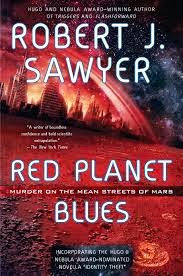
I really wanted to like Robert J. Sawyer's Red Planet Blues. I enjoy most of Sawyer's fare, including the novella "Identity Theft" that forms the basis of this book, but unfortunately, drawing it out into a longer form just didn't seem to work.

The noir-style story follows Alex Lomax, a private detective on a Mars colony where the only real industry left is fossil-hunting, and the population is a mix of those searching for the elusive motherlode of long-lost Martian life, and those trying to make money off of them - one way or another. Those with enough money get themselves uploaded into nearly impervious robot bodies, or buy flights home, while those who don't try to get their share any way they can. Lomax finds himself caught in a mystery involving the discovery of the biggest and best fossil bed in history, and dealing with people who are willing to kill to get their hands on it.

Problem is, as hard as the novel tried, it just wasn't as gripping as it wanted to be, and didn't have any real depth. Remember that line from The Lord of the Rings where Bilbo, having possessed the One Ring for too long, says he feels like butter that's been spread thin over too much bread? That's what Red Planet Blues felt like. And, no matter how many new twists and turns Sawyer tried to jam into it, the story just didn't get any more substantial - I never escaped the feeling that it just should have ended a lot sooner. I didn't really care about Lomax - he had the trappings of a classic gumshoe character, but there was no real depth to him or reason to care that he came out on top, instead of one of the secondary characters who occasionally throw their support behind him. It was like he was more of a caricature than a character. And even some of the supporting cast members weren't as believable as they needed to be... a big-time player on the fossil-dealing scene who's said to have connections with bad people, but who goes into a dangerous situation in the desert without bringing some hired muscle for support? I don't think so.

In the end, I think it would have been a better book if Sawyer had just started from scratch. Rather than trying to inflate an existing novella, he could have used his considerable talents to write an entirely new story with a different character in this setting. As it stands, the story that he has (re)written for us is one that I didn't hate, but, unfortunately, it's one that I can't recommend either.

--------------------------

Old Mars. Of the three books in this Mini Review, this is the one I liked the most. Liked? No. Loved.

This herd of stories that George R. R. Martin and Gardner Dozois managed to corral is just bursting hugely with so much energy and wild imagination that it needs its own soundtrack, and I'm not talking some safe, run-of-the-mill soundtrack from most films these days; I'm talking about something massive and intricate and brain-slapping, like the operatic tidal wave Basil Poledouris threw at us for the original Conan the Barbarian, or James Horner's raucous aural assault from Krull (as terrible as the movie was, you have to admit, the soundtrack kicked ass). But I digress. Old Mars is one fucking great collection.

These are stories in the vein of Wells, Burroughs, Brackett, Bradbury, Wollheim, Lewis, and others from the good old days of SF when the science was still sketchy and Mars and the rest of the universe were wide open to possibilities; where authors could share imaginations of ancient civilizations in the dust just one planet over. This is a collection of stories where, because the editors have given the writers and the readers permission to ignore the hard science of today, there is unbridled energy and a boundless potential for wonder.

And you needn't look any farther than Martin's introductory essay to find an expression of that wonder that SF used to have, and the deep longing for a return to it that's felt by so many of us. Hell, Martin's intro is so good, it deserves to be published and honoured on its own - one of the reasons why I nominated it for the "Best Related Work" Hugo this year.

The book pulls together stories from a range of talented authors, including Matthew Hughes, Ian McDonald, Allen M. Steele, Mike Resnick, Melinda M. Snodgrass, Michael Moorcock, and others, and nearly every one of them is really, really good. In fact, the only one of the bunch that I could have done without was Joe R. Lansdale's "King of the Cheap Romance", which felt like an overly-long and poorly-executed young adult piece. I think the collection would have been much stronger if it would have instead had a story like Camille Alexa's beautiful and heart-rending "Seeds of the Lotus" from Ace Jordyn, Calvin D. Jim, and Renee Bennett's Shanghai Steam anthology (which I would also highly recommend).

Go out and buy this book. If you can still get it in hardcover, it's worth every penny. If you've gotta take a softcover or e-book version instead, that's fine too. Just buy it, read it, and treasure it - treasure it the way you would if you managed to catch a half-understood glimpse of a Martian in the shadow of a ruined wall mostly buried by sand in some forgotten corner of the red planet.

Friday, February 28, 2014

Good Night to The Red Knight

I hate to give up on a book.

It means I've wasted time reading a few chapters or however many pages of something that wasn't interesting, entertaining or educational, when I could have been reading something else.

It means I've wasted money that could have been spent on something else.

It means that because I haven't finished it, I can't even add it to my What the bookworm just ate list.

And - sometimes, anyway - it leaves me with the nagging worry that if I'd persevered just a little longer, I would have got to the part in the story that would make it all worth while.

Only sometimes, though. Usually, it's pretty clear after a couple of chapters whether there's any hope for the thing, and, if a book hasn't been able to engage me by then, it's unlikely it ever will, and regret fizzles pretty quickly.

Miles Cameron's The Red Knight - Book 1 of the Traitor Son Cycle is just such a book.

On the surface, it had elements that should have worked: knights and mercenaries, deaths at the hands (or claws) of nasty critters, a land on the edge of a threatening magical wilderness, and dragons - my favourite mythical creature of all! - or, at least, their stunted cousins the wyverns. And it's written by a Canadian, and I like to support local authors when I can.

Unfortunately, The Red Knight was just too boring for me to be bothered finishing. After two chapters and 50-odd pages, nothing really happens except lengthy descriptions of clothing and armor, and a whole catalogue of characters exchanging typical and utterly forgettable dialogue. Sure, there's a brief bit about a bear-baiting session that goes wrong, and a subsequent tussle with the beast, but that's about it.

Even the opening scene, with the titular Red Knight's cursory investigation into a slaughter at a farm, is detached to the point of being offhand and blase. Sure, we're dealing with a character who's a sellsword with no real emotional involvement in what's happened to the victims, but if the author can't imbue the description of a killing ground with palpable menace and horror, then something's wrong. Ultimately, it's a scene where nothing much happens except mercenaries kind of looking around at stuff. But there's a huge difference between just looking and thinking about something that happened a while ago, and actually showing us the action as it happens. This rather passive passage is really not a great way to set the pace of a novel, much less an entire series.

This especially bodes ill when you consider the sheer size of this monster door-stopper of a book. If it can't engage the reader in the opening scene - a setting of violence - how can it possibly sustain interest throughout the rest of its bloated length (or its sequels). Consider other long books that launched heavy-weight series: the prologue of George RR Martin's A Game of Thrones kicks off immediately with urgency and a sense of men being hunted - even though they're only sitting around a campfire - as one of the rangers from the Night's Watch tries to get the rest of his band to abandon the wilderness for their fort - a prologue that ends with the rangers ambushed and fighting a losing battle against the White Walkers and their undead soldiers. Then there's the prologue to Robert Jordan's The Eye of the World: Lews Therin, having just killed everyone around him, blows the shit out of the top of the Dragonmount. Action. Big stakes. Characters who you're immediately drawn to. Stuff actually happening that compels the reader to keep reading. The Red Knight? Not so much.

So, The Red Knight will be chucked in my "to donate" box, unfinished and, ultimately, unremembered. Pity.

Tuesday, February 18, 2014

My Nominations for the 2014 Hugos

Ask any crowd of fanboys what they think about awards that are given for books/TV/movies/whatever, and you're liable to get at least a dozen answers about whether a trophy is useful to consider as a recommendation when buying a book or comic, or when deciding which show or flick to watch; or about the merits or flaws of judging or voting systems; what a year's win says about fans and fan culture; whether a work that's singled-out as a year's best will actually stand the test of time and become canon; or whether we should even have them.

For my part, in general, I like the idea of a community recognizing the top achievements of writers, artists and others in a given year. Sure, there can be flaws in selection systems, and yeah, it's not uncommon for people to be of the opinion that more deserving works have been overlooked, but no system is perfect, and, at the end of the day, I think we, as a community, should take every opportunity we can to applaud creative people who've done terrific work, and, along with reviews and recommendations, awards are a good way of doing that.

So, as part of my preparations for this summer's trip to the UK for Loncon3/Worldcon72, today I sent in my nominations for this year's Hugo Awards. While I certainly can't claim to have read or watched everything that was released in 2013, of those SF works that I have consumed, the ones I've nominated are ones that I feel strongly about.

Here are my nominations (in no particular order within their categories):

Best Novel:
  • Burning Paradise by Robert Charles Wilson
  • River of Stars by Guy Gavriel Kay
  • Son of Destruction by Kit Reed
  • The Ocean at the End of the Lane by Neil Gaiman
  • Fiddlehead by Cherie Priest
If I had to bet, I'd guess that given his world-wide stature, the intense buzz, and the effect of this year's reading/signing tour, Gaiman's probably got the inside track (at least of these books, but possibly compared to the entire genre's output last year as well). With good reason - TOATEOTL is one hell of a good read. But so are the others I've suggested for consideration. I've previously talked about how much I loved River of Stars and Son of Destruction here on the blog, and tweeted about Fiddlehead and Burning Paradise, both excellent reads as well. As much as I'd be happy if Gaiman makes it to the final ballot and wins, I think I'd be happier if one of the others secures a win without the benefit of a media juggernaut.


Best Novella:
Didn't nominate anything for this one. I don't read as many mags as I should, and, as far as short story anthologies go, I read for the enjoyment of the stories, not to sit there and do a word count. Sure, I could probably look up eligibility lists online, but that's really more effort than I want to go through. If I like a shorter work, I'll nominate it for the Short Story category and let the judges sort out whether it belongs in one of the longer-form categories or not.


Best Novelette:
Same as above.


Best Short Story:
This category is unfair - especially in a year when I've read a bunch of anthologies, in addition to whatever magazines I've picked up - because there are always so many good short stories out there. Five seems too few to nominate! Anyway, here goes:
  • "Nocturne" by E. L. Chen, from Masked Mosaic - Canadian Super Stories
  • "The Secret History of the Intrepids" by D. K. Latta, from Masked Mosaic - Canadian Super Stories
  • "The Creep" by Michael S. Chong, from Masked Mosaic - Canadian Super Stories
  • "The Queen of the Night's Aria" by Ian McDonald, from Old Mars
  • "The Ugly Duckling" by Matthew Hughes, from Old Mars

Best Related Work:
Just one nomination in this category, because this intro/essay was so truly exceptional, it's in a class by itself, in my opinion:
  • "Introduction: Red Planet Blues" by George R. R. Martin, from Old Mars

Best Graphic Story:
  • Kill Shakespeare volume 3 - The Tide of Blood by Anthony Del Col, Conor McCreery, and Andy Belanger
  • Nemo - Heart of Ice by Alan Moore and Kevin O'Neill

Best Dramatic Presentation (Long Form):
There was a lot of garbage on the big screen this year, and I'll be immensely disappointed if that enormous shitpile Star Trek - Into Darkness gets any love; same with the lame ducks Man of Steel and Iron Man 3. But there were a quartet of films that I found pretty entertaining that are worth of the Hugo nod:
  • This Is The End
  • The World's End
  • Pacific Rim
  • The Hobbit - The Desolation of Smaug

Best Dramatic Presentation (Short Form):
As usual with TV, there's a lot that flickers briefly on the radar, but, though entertaining, is ultimately forgettable. Here are some exceptions - stories that really stayed with me, especially because they were so very good:
  • An Adventure in Space and Time
  • Doctor Who - The Day of the Doctor
  • Game of Thrones - And Now His Watch Is Ended
  • Game of Thrones - The Rains of Castermere

Best Editor (Short Form):
  • Claude Lalumiere (for Masked Mosaic - Canadian Super Stories)
  • George R. R. Martin (for Old Mars)
  • Gardner Dozois (for Old Mars)

Best Editor (Long Form):
Sadly, I've gotta confess, I don't give the editors of novels nearly as much credit as they deserve. I've always just concentrated on the writers, so I can't really nominate anyone here.


Best Professional Artist:
  • Andy Belanger for Kill Shakespeare

Best Semiprozine:
Unfortunately, I just haven't read enough semiprozines this year to make any nominations.


Best Fanzine:
I would have nominated SF Signal in a heartbeat for this one, because, for years, it's been the number one go-to destination for all things related to speculative fiction. However, "the bagel overlord" and his gang have decided to abstain from consideration this year, in order to allow others to have a shot at the award - a truly classy move which makes SF Signal even more cool. But, the upshot is that I don't really have any other fanzine sites that I'd like to nominate, because I just haven't made enough time over the past year to read more of them. Big oversight on my part, I know, because the geek-o-verse is populated with a lot of interesting folks running their own cool sites, but time's at a premium, so, here we are.


Best Fancast:
  • The Three Hoarsemen (Sure, they're only got a couple of episodes under their belts, but Fred Kiesche, Jeff Patterson, and John Stevens are just so damn entertaining and knowledgable that they deserve this award. So much so, that I'm deliberately not going to nominate SF Signal's flagship podcast, the SF Signal Podcast - which is also pretty enjoyable - just to give the newcomers a better shot. Strategic nominating, people! Strategic nominating!)
  • Caustic Soda (They don't always talk about SF-related things, but when they do, they do it well. Sodajerks of the world, unite!)

Best Fan Writer:
When I've got time to read fan articles, as good as many of them are, I don't think I follow any one individual closely enough to really nominate one over the others, so I'm taking a pass on filling-in any names in this category.


Best Fan Artist:
Similar to the above excuse. I've seen stuff I've liked, but nothing specifically new to 2013 that's flat-out arrested me and stopped me in my tracks - probably because I simply haven't seen enough. Takin' a pass on this one too.


John W. Campbell Award:
I hate to admit it, but with the reading I've had time to do in the past year, I don't know of any new authors whose names have stuck with me. It's likely that I've read some, and it's likely their stuff has been good, but nothing that's floored me enough to make me remember this far down the road that there was a work by a newbie that I just had to nominate, so I'm goin' for a threefer, and taking yet another pass.

So those are my nominations for the 2014 Hugos. Hopefully some will make it to the final ballot.

If you're going to Loncon 3 this year, Sasquon next year, or if you were at Lone Star Con 3 last year, then you're eligible to nominate your favourites for the Hugos. Can't make the cons, but still want to interfere in the course of Hugo history? Get a supporting membership and then get your nomination in!

Good luck to everyone who's nominated by anyone! And, thanks to all the authors and artists who put stuff out there in 2013, making SF a more interesting place!

Saturday, January 11, 2014

Reunited

Happy New Year, everyone!

I hope you enjoyed the recent holiday season, whether you celebrated specific holidays or not.

For me, it was a great holiday season, especially for indulging my passion for speculative fiction. First: an early gift exchange with my wife (ahead of our trip back east to visit my folks), where she gave me a big stack of books, including new stuff from the likes of Claude Lalumiere and Peter Watts. Second: while prowling around in an antique store in the village of Almonte, Ontario, I found a first British edition (hardcover) of The Silmarillion. Third (and perhaps most important of all): I was finally reunited with the last stray remnants of my hoard.

If you're a book collector like I am, it's an old story you're probably familiar with: I began amassing my SF book and comic collection as a teen, but when it came time to leave for my second round of post-secondary studies in another province, I had to leave most of my babies behind. In the years that followed, I moved several times, following career opportunities; meanwhile, my parents moved as well, carrying the abandoned (Is "abandoned" even the right word? It seems far too negative and harsh a term for a decision that, while necessary, was so very reluctant.) portion of my collection even farther away. More time passed, and I continued to cultivate my book collection, but I always missed the ones that were still most of the way across the country with my folks. Every now and again, I'd go home for some holiday or other, or they'd come out for business or a visit, and I'd have a chance to recover a couple of the missing books (As many as I could stuff into my suitcase on the return trip if I was doing the travelling. Only one or two if it my folks agreed to play mule.), gladly welcoming them back into the fold.

But I always knew that there were still some missing. I just knew they were buried somewhere in the depths of my parents' basement, at risk of the old man tossing them into the donation pile if I didn't get them back soon. Always bugging me by their absence on my bookshelves - holes in the ranks of the titles, books missing singly or entire series not where they should be. What was worse, Dad - right up until this recent Christmas when I unearthed the evidence - always maintained that there were no books left, that he'd brought out all there were, and that there were no boxes left. But I knew he was wrong. One look at my shelves was proof of that. But more than that, it was that sense of the lack of completeness to the hoard, right down to exactly which items weren't there. It was like being Smaug in Tolkien's The Hobbit, when Bilbo steals a two-handled cup from the treasure pile. The dragon wakes up and instantly knows damn well knows that something's been taken from the collection. In fact, he knows exactly what's missing, and he's pretty pissed about it. Like that. Except, you know, I didn't fly around incinerating the outside of a mountain in my frustration. Not that I wouldn't have, mind you. It's just, you know, the absence of an ability to fly or breathe fire.

This Christmas though, was going to put an end to the years of longing for my missing treasures. This Christmas, we went to Ottawa to spend the holidays with my parents, and I was determined to stage a clandestine recovery of the last books that would have rivaled Indy's unearthing of the golden idol at the beginning of Raiders - if he hand't lost it to Belloq and the blowdart gang. After a lot of back-breaking shifting of boxes, I finally got to the bottom of the pile and found it [insert heavenly choir-sounding synth music and sfx-inserted golden glow] - the last box of books! Finally, I was reunited with Red Dwarf - Last Human, Timothy Zahn's Heir to the Empire books, missing installments from Jordan's Wheel of Time, a bunch of Asimov and Clarke books I hadn't seen in years, as well as a couple of favourites from my childhood. From there, it was a matter of finding room for the dozen or so hardcovers in our luggage (after the obligatory gloating to Dad about finding a stash he'd claimed didn't exist), packing and repacking each bag so they wouldn't be over the airline weight restrictions (because paying the overweight bag penalty fee would suck), and getting them home.

And I've gotta tell ya, it feels pretty good to finally have the hoard complete again. A Merry Christmas, indeed.

Tuesday, December 03, 2013

Finding a Dim, but Notable Star in the TV Christmas Special Sky: George and the Star

The other day when my wife and I were putting up our Christmas tree, we discovered the lights on the star weren't working anymore, sending us out on a hunt through three or four different stores to find the perfect star to replace it - or, at least a replacement that wasn't cheesy or too pricy.

Fitting, because the incident put me in mind of a scifi-ish TV holiday special about a search for a tree-topper that I really enjoyed as a kid back in the 80's: George and the Star (alternatively known as George and the Christmas Star).

This Canadian production didn't air that often (I can only remember seeing it once), then pretty much disappeared forever, so you probably won't see it in many lists of the greatest holiday specials of all time. But, for the few of us who did catch it, it made an impression.

The story is about a guy named George (obviously), who lives alone with his cat in a big house. One night, as he's decorating his Christmas tree, George decides he needs a new star for it (no, his old one wasn't broken like mine, it was a paper cutout and our understated hero just wanted something a little more flashy). He goes outside with his telescope, spots a little star glowing in the depths of the night sky, and decides he has to have it for his tree. Using a collection of odds and ends from his house, he builds a starship and heads off on his quest. Along the way, he befriends a robot named Ralph, an astronaut named Barbara, and runs into a troupe of robotic Mounties - er, space rangers (wearing Stetsons, blue serge instead of red, and cruising around in a giant horse-like spaceship). He also runs afoul of space pirates, and, if that wasn't enough, space bikers, before eventually finding his star. And let's not forget the cookie-cutter inspirational songs from Paul Anka.

Over the years, I've looked for it on the off chance that it might have come out on videotape or DVD, but no such luck - or, at least, I didn't have the luck to come across it when it was released. Finally though, I managed to track it down on Youtube, where someone out on the 'net has shown the Christmas spirit and put it up to share with everyone.

So grab your star-salvaging permit, and reserve a bed on the motel moon, it's time to watch George and the Christmas Star.


Monday, November 25, 2013

It's a Dog's Life

Is anyone else waiting for the other shoe to drop?

The death of Brian Griffin on Sunday night's episode of Family Guy seems to have ignited a fair amount of discussion about whether this is the right plot move or not, whether it's an act of desperation to draw in viewers, the sign of a long-running show possibly entering its death spiral, or just a mean trick on fans. Then there are the strong opinion's about Brian's replacement, Vito Vinnie.

What struck me the most about the episode, though, was the sense that this was a setup for something... I wasn't upset at Brian's death (despite his being one of my two favourite characters on the show), or the implications for the show or what the writers/producers may or may not be up to. Rather, I felt a detached sense of waiting, because the whole story had something familiar to it.

By familiar, I don't mean that I thought the writers were ripping anyone off - let's face it, too many primary characters have been killed on too many shows over the years (Henry Blake in M.A.S.H., Marcus in Babylon 5, Fry in Futurama - though he always bounces back) to make a sudden and arbitrary death in any way proprietary - rather, by familiar I mean that the entire episode arc had the feeling of a familiar refrain within the specific Family Guy style: the unrelated aside. The entire episode felt like one of Peter's references to ridiculous past incidents that are obligatory for each episode - "This is just like that time when I [insert your favourite bizarre or inappropriate reference]" - and now it's as though, we, the audience, are waiting for the characters to jump out of the aside, to revert back to the actual story in progress. The whole thing felt very meta in that respect. And maybe that's the point, and we just have to wait for Macfarlane and co. to decide that, having set the joke up adequately, it's time to get to the punchline.

What made the whole thing weird was that this sudden bit of genuine heart, of plain-served drama, is something that Family Guy doesn't do often, and doesn't necessarily do well. Sure, this is a series that'll serve up a bloodbath in any episode, or deliberately confront the audience with something uncomfortable and just plain wrong, but these incidents are always so over-the-top ridiculous or, though we may not want to admit it, funny, that they're in keeping with show's usual feel. In that way, Family Guy is like Southpark, even if it's main characters don't get slaughtered in every episode like poor Kenny was for so long (humiliated, yes, but rarely killed). But you'd probably be hard-pressed to remember one of Family Guy's genuinely dramatic moments. The only one that comes to mind for me is the season 8 episode "Brian & Stewie" where the boys get locked in a bank vault and Brian admits he keeps a gun in case he gets to a point where he feels the need to kill himself. This indicates that Family Guy's dramatic moments/scenes/episodes aren't done well enough, or the structure of the emotions the show evokes in general isn't varied or subtle enough to allow those dramatic moments to have any impact. This is unlike Futurama, which is equally wacky, but is not so obsessed with shrilly mocking things to extreme, and so is able to allow the audience to feel legitimate sadness, and to have that sadness feel like it has a legitimate place within a Futurama storyline. Think of the end of "Jurassic Bark" or "Luck of the Fryish" -  both deeply moving conclusions to funny episodes in a funny series, and endings that were meaningful to the audience because the writers know how to vary the tone, to let the audience know that they won't be made to feel stupid for feeling anything other than cruel amusement when the characters are put in painful situations. Because Family Guy episodes focus on playing just one note, the audience doesn't know how to react when the show changes its tone and tries to be serious.

If it's actually trying to be serious, that is. And again, with that vague meta feeling to the whole episode, I'm not sure that it is. I wouldn't put it past this crew to take us for a ride for a few episodes, then spring an 80s-style "it was all just a dream" reveal on us. We'll have to wait and see if there's another shoe that they'll drop for Brian to fetch, or if it's just a dog's life.


Wednesday, October 23, 2013

Anybody Remember This Story?

A little over a week ago, I was thinking about science fiction during our preparations for Thanksgiving dinner. As you do. I was pulling the turkey out of the oven, and I suddenly flashed back to a story that I haven't read in more than 25 years:

It was a short story - probably not more than a page or two - about a mother getting ready for a holiday meal. Lots of hustle and bustle of family throughout the house as she worked to set the dining table and get the baby into his high chair. Amidst all of this, she was thinking about how great it was to have the modern convenience of an  instant feast in a pill: a large turkey, stuffing, gravy, potatoes, side dishes, etc, all on plates, and all compacted down into one small tablet the size of an allergy capsule. All she had to do was add a drop of water, and in a minute the capsule would expand into the whole huge feast, all of it piping hot and ready to eat. She puts the pill onto the dining table, then gets distracted by something. When she turns back to the table, she realizes the capsule's gone missing, looks around, and, horrified, sees the baby (having leaned out of his high chair across the table) has popped the pill into his mouth. End of story.

Not the best SF piece ever, but it's one that's stuck with me over the years, and I think of it when the bird is ready to put on the serving platter and bring to our table.

What's bugging me though is that I can't remember the title of the story or the author's name.

Can anyone help jog my memory? Do you know what this story was called, and who wrote it?


Monday, October 07, 2013

VCon 38 - Day 3 - That's a Wrap

Sunday's always the toughest day to go to a con. Say what you will about the difficulties of getting out of work early to make it to Friday's programming, or that Fridays sometimes have the weaker sessions because programming committees might predict a lower attendance on opening day, but I've always found Sundays to be the toughest. By Sunday, I've put a couple of days of attending sessions under my belt, usually from noon through until mid-late evening, supplemented by trips to the dealers' room and art show, not to mention late night blogging, and my system's fighting off whatever con-crud I may have been exposed to among the crowds, and it's starting to wear on me. But I don't want to miss anything, and, hey, if I've paid for the full weekend, I want to get my money's worth, so I drag myself out of bed and make the effort anyway. How much worse it must be for the die-hards who stay onsite and rock the room party scene, or doggedly roll dice through the night in protracted gaming campaigns! Yeah, no matter who you are, Sundays are tough. But you go anyway. 'Cause for SF geeks, this is your scene, and that's what you do.

So. Sunday. VCon. I blasted up the highway late this morning in The Ol' Porkchop Express and got to the hotel in time to catch the last half-hour of the "Science Adventures" panel, which profiled some of the naval explorers of the past and their exploits. A good, solid, informative session, and I wish I'd been able to attend from the beginning, but I guess I missed the boat on that. Ha ha. Heh heh. Ugh. Feeble, I know, but I couldn't pass it up. Anyway, a good start to the day.

Then it was over to the "Exploring Worlds Far, Far Away - Without Hyperdrive", where UBC prof Jaymie Matthews gave an entertaining lecture on how exoplanets are found, how the search is going (something like 952 planets confirmed, as of this morning, he said, and many more waiting in the wings for verification), and the status of some of the satellites that've been launched to discover them. On that note, a big "Way to go!" to Canada's MOST satellite, nick-named "the humble telescope" for its very modest size (in the range of a suitcase) and budget (just a few million), and otherwise known as Spongebob Squarepants for its appearance, for continuing to operate and get the job done when bigger, more expensive platforms have experienced problems.

From there, it was up to the "Alternate Canada, Eh?" session, which wasn't bad, but wasn't great. There were two panelists and probably more audience participation than there needed to be. Enthusiastic crowds are great (heck, I made a couple of comments myself), but in this case, the audience started to take control of the session fairly quickly, and while there were a lot of alternate history ideas tossed around, the sheer volume of them, and the rapid-fire barrage of ideas coming from members of the audience (frequently from 5 or so of the same people) who wanted to get their two cents in, prevented any real, in-depth discussion of the ideas, or a separating of the wheat from the chaff. I enjoy alternate history panels (regardless of national or general themes) when they're done well, but to be done well, you need at least four panelists who have the depth of historic knowledge to really explore the possibilities raised, and to play off one-another, and you need a strong moderator who can set the panelists off in the right direction, and keep audience participation focussed, and limited, because this is a panel discussion, not a 30+ person random brainstorming session.

After that, I left the hotel to grab a late lunch at a local Chinese mall's food court, where I found myself eating just a table away from a guy who looked like an Asian version of Danny McBride in This Is The End - right down to the mullet. In fact, the resemblance was so uncanny, I began to worry that he was going to waste everybody's bottled water, and I didn't even want to think about what he might have done to the magazine rack around the corner. I finished my meal and fled as fast as I could before the winnebago full of post-apocalyptic minions could show up.

Back at the Con, a different kind of horror awaited me. After using a couple of "con scrip" dollars I'd found in the bottom of my registration bag to buy another nerdy button in the dealers' room, I went to the "Turkey Readings". The Turkey Readings are a VCon tradition where some of the guest panelists sit at the front of a room reading from pre-selected, old SF novels that are so poorly written that they're probably banned under the Geneva Convention, making it a miracle that the con hasn't been invaded by a UN peacekeeping force sent to dispose of these weapons of mass mental destruction and arrest those responsible for inflicting them on con members. But it gets worse. Members of the audience volunteer to act out the scenes from these "books" as they're being read. It's up to the seated members of the audience to then endure the madness that follows. Audience members can bid cash in an effort to make it all stop, but other sick individuals can counter-bid to keep the suffering going. When the "make it stop" side finally coughs up enough money to put an end to it, another panelist will crack open a different book, and the horror begins anew. Funds raised go to... well, at this point, given the lateness of the hour and the brain damage I sustained attending this session, I can't remember what worthy cause the funds go to, but the Turkey Readings do raise a reasonable chunk of change, which might be a redeeming virtue, but probably not, given the pain they inflict on the audience. Why do I keep going year after year? Sometimes the "performances" are worth a laugh, but if there's a reason beyond that, it's inaccessible behind the wall of psychological, emotional, and physical scarring the Turkey Readings have inflicted on me.

Reeling from that experience, I clutched at my chair when it was over, and waited for the Con's closing ceremonies to begin in the same room. The usual round of heart-felt thank-you's and see-you-next-years was enhanced this year with a cool announcement: VCon will be hosting Canada's national SF convention, Canvention, and the Aurora Awards (prizes for the best in Canadian SF) in October 2014! Congrats to VCon for landing this honour!

Maybe I'll volunteer at the Con next year - specifically, maybe I'll try to convince the organizing and programming committee to bring back the movie room. Things just weren't the same this year without the movie room. Don't know why they didn't have one, whether it was an issue of finding someone to man it, or of dealing with government regulations around using movies at a con, or if there's some other reason, but the movie room's absence this year just wasn't right. I'll have to send a note to the organizers to find out. If it means I have to step up to the plate next year to make it happen, then so be it. We'll see.

One of the great things about VCon, and cons in general, that I haven't talked about this year is the nice one-off conversations that strangers tend to have with each other. When I was leaving the hotel this afternoon and walking across the parking lot, I heard some strangely familiar music coming from another car... music I haven't heard in 25 years... It was a song (and video) I remember a DJ playing at one of our highschool or junior high dances back in '88 or '89 that once every few years flits like a ghost in the back of my mind, but I haven't heard it since school, and have never been able to remember the name of the band or the title of the song. Ditching my stuff in my car, I walked over and had a chat with the group standing around the other car, obviously enjoying themselves in the wash of nostalgic notes. The song was "Doctorin' the Tardis" by the Timelords (the Jams). A completely and utterly silly song, but fun as hell to listen and dance to. I downloaded it off of iTunes as soon as I got home. Many, many thanks to author Lisa Voisin for passing along the band name, song title, and YouTube link to the song! (Here's the  link to the original video)

So that's it for VCon 38. On the whole, it was fun, and time and money well-spent. Our local Con organizers know how to bring the geek community together and ensure there's something for everyone to enjoy. Thanks for putting it on, folks, and I'll see you next year!