So let's say you were watching the Battlestar Galactica spinoff movie Blood and Chrome recently, and you got nostalgic for the series that started it all (well, the remake of the series that started it all, because the old series sucked), and you started rewatching BSG, and you got it into your head that you'd like to visit the Colonies, or Kobol, or Earth, or the other Earth, or any of the pitstops along the way (not literally, of course, but the sometimes beautiful, sometimes grimy places where they were shot), how would you go about doing it? Why, you'd visit Battlestar Galactica Filming Locations, of course.
This cool site came to my attention a little while ago when one of its resident battlestar scouts got in touch with me to see about borrowing some of the photos my sister-in-law took of the set (photos in the posts Beach Blanket Battlestar and Look what else washed up on the beach) of the ruins of Earth (or Centennial Beach in the village of Tsawwassen, Corporation of Delta, as locals know it) back just before the beginning of the 2007-2008 Hollywood writers' strike. But aside from the potential bias involved in a relative's photos possibly getting reposted there, I'd still highly recommend the site to BSG fans, especially those with an interest in visiting set locations.
It's a nice looking site, and easy to navigate. Lots of pictures, both from the series and from the set pilgrimages of the site's authors, which are handy in helping you figure out exactly what to look for when you go there yourself, and to help you get your impression of your favourite character's in-scene pose just right when you take the obligatory fan-on-location photo. Even more important: maps, trip resource PDFs, and links to other sites with info - good to have, whether you're poking around the SFU campus, navigating the back alleys of Vancouver, or heading into the hills outside of Kamloops.
Now, get the frak over there and start planning your BSG trip!

babbling relentlessly about science fiction, fantasy, and all points in between
Tuesday, February 26, 2013


Monday, February 11, 2013
Star Wars Spinoff Movies?
To quote Princess Leia: "I've got a bad feeling about this."
No, I'm not referring to the announcement a couple of weeks ago that JJ Abrams had been chosen to helm Star Wars - Episode VII. Considering that Abrams Star Trek was really a Star Wars movie, and a pretty good Star Wars movie, that's encouraging news.
I'm referring to word that came out just a few days ago that in addition to the new trilogy, Disney's already working on Star Wars spinoff movies, about other characters in the story's universe, that will be released around the same time.
Spinoffs? While there's been a reasonably good track record with expanded universe books and comics over the past 20 years, starting with Timothy Zahn's Heir to the Empire books, and the Darkhorse Dark Empire comic series, but when it comes to moving pictures, the franchise's quality gets a bit spotty.
Let's wind the clock back to the 70s for first spinoff, the bad start of the trend: The holiday special. Say what you want about whether Lucas disowned it, the thing was made, it's a spinoff, and it sucks. I could stop there, and it's tempting, but there's a more complete case to be made.
Things didn't get much better in the 80s: remember the two Ewok made-for-TV movies? I remember the first being billed as The Ewok Adventure, but some might know it as Caravan of Courage or Cindel and the Ewoks. Whatever you called it, it wasn't very good - even for a made-for-kids flick. The sequel, Ewoks: The Battle for Endor wasn't much better, nor was the Ewoks cartoon (although the Droids cartoon had some cool moments). I'm not one of those haters that tries to claim the Ewoks dragged down Return of the Jedi, but looking back on these two sappy offerings, I almost wish the Empire had won the battle for the green moon.
In the early 2000s the Star Wars machine churned out the first animated Clone Wars series, comprised of a bunch of 5-10 minute shorts that were actually pretty cool. The animated Clone Wars film that assaulted movie theatres a few years later to suck people into watching the new animated series (still currently running, I think) did, in fact, suck. Stinky the Hutt? Really? That takes us to the current Clone Wars TV series, which people seem to enjoy, but I've pointedly ignored because of its poor movie lead-in.
So you can see why I'm looking at this word of new spinoff movies as a possible trick of the Dark Side, rather than welcome additions to the franchise.
Sure, there are plenty of fanboys out there who are probably concentrating as hard as they can, trying to use the Jedi Mind Trick to get The Mouse to make a feature-length Boba Fett movie. Why? So he can stand around looking menacing for a while and then take another nose-dive into an immobile hole in the ground like a punk? Some may be hoping for an adaptation of an expanded universe book or comic. Others may even be crossing their fingers, praying for the Wolfman to get a shot.
I say go for broke. If spinoff movies and shows have a high chance of being lame, then let's wantonly embrace the ridiculousness in the franchise, in hopes of the lame becoming cool. Let's defrost Noa Briqualon from his carbonite slumber in the Lucasfilm vaults, dust the Quaker Oats crumbs from his shirt, and follow the further adventures of Wilford Brimley's character in the sad years after his flight from Endor, when Cindel has grown into an ungrateful and cruel teenager who steals his starcruiser and leaves him penniless on the streets of Tatooine, where he has to sell Teek to an exotic foods restaurant in exchange for passage on a spice freighter, which then is beset by space pirates, which Briqualon has to join, eventually becoming their janitor. How about young Ackmena's adventures as a courtesan on Coruscant before taking over as proprietor of the Cantina on Tatooine? Or the life and times of the droid GNK/Gonk?
Better yet, let's turn the spinoff series over to that mad genius Sean Cullen, who's currently doing a hysterical feature in the closing minutes of recent episodes of his podcast (epis 26-28), the Seanpod, called "Things that are taking place in the Star Wars universe, yet are not in the Star Wars movies" (or variations thereof). You might not see many of the franchise's signature laser blasts or lightsaber battles, but the silly bickering of Cullen's talk-radio hosts on Coruscant or stormtroopers on Tatooine would be worth every penny.
But really, wouldn't the best idea be to shelve the notion of spinoff movies - flicks that would just end up diverting attention from the new trilogy, especially if the spinoffs are bad - and just let the new trilogy do its thing? If it works out, then look at the option of spinoffs for TV, or maybe the movies. But for now, simplicity and focussing just on the trilogy might be the best course if Disney really wants to do a good job with this new hope for the Star Wars franchise.
The Wheel of Time Stops Turning - A Memory of Light

When I read Robert Jordan's The Eye of the World, I had no idea it would be the beginning of a more than 22-year literary journey.
I was in high school and looking for something new to read, so I dropped into Albany Books, the neighbourhood bookstore in Tsawwassen, where I fed my SF addiction in those days. That was back before Chapters (never mind Amazon) rampaged across the country and stamped-out most of the smaller competition, the days when independent stores had well-stocked science fiction and fantasy shelves, the days before media tie-ins began to take up all the room (with the exception of the Robotech novels), when Asimov and Bradbury and Clarke were still alive and spinning good yarns. I don't know how much SF the owner read, but she had a good eye for ordering intelligent and entertaining stock, and I never had trouble finding something good at her place. On this particular day, I'd only been browsing for a minute or two, when she asked if I was interested in trying something new that she'd just got in. She'd never been one to make recommendations before, so I figured I'd see what she had up her sleeve.
It was The Eye of the World.
The teaser on the back was enough to get me. Add the fact that, for a softcover, it was pretty hefty, and this read boded well. After all, at a time when most SF books were 250-450 pages, a fat 782-pager (800 if you count the glossary) seemed to indicate that the story had to be pretty good if the publishers were going to let the author get away with that kind of substantial investment in paper. The cover art was cool too, and, as a bonus, the store owner was giving away promotional bookmarks - as you can see in the photo above, I've still got mine.
When I got home, cracked it open, and started to read the opener about a madman who realizes he's just murdered his family and friends, and then proceeds to tap into some serious magic to not only kill himself and level his castle, but drag a volcano up from the bowels of the world - a story which then cuts to a farmboy who's most likely about to fall into something big (because that's how these stories go), I was hooked. After all, what wasn't to like? A grand adventure, interesting characters, deep-level world-building (down to the intricacies of the clothing fashions), a well-thought-out magic system, monsters, a challenge to defeat evil that is nearly overwhelming but leaves a hope that it's not completely impossible (thanks to the repetitive nature of history driven by the wheel of time), and, unlike many male authors, Jordon seemed to be able to write believable, three-dimensional female characters. Mostly. For the first couple of books, it seemed like he was only able to create two or three different types of women, but at least they were whole individuals, and, over time, he was able to diversify. For my female friends who were SF fans, this was a big deal. As a guy, it wasn't quite as important for me, but it certainly made the characters and story more interesting.
Since then, it's been a long, exciting, and sometimes tiresome quest, following Rand, Perrin, Mat and the others on their adventures, tackling each new gigantic book, and wondering when the whole thing would finally end. Along the way, some of the personal stories about the series have been as memorable for me as the books themselves:
I remember when I moved to Winnipeg, during university, when I was part of a group of friends devouring the Wheel of Time series, I knew a young married couple who could not share. There was no doubt they loved each other, and they certainly shared everything else in their lives, but not the WOT books. They couldn't buy just one book for their household, because neither was willing to let the other go first and wait for him or her to finish. Each had to have their own copy so they could start reading immediately. This continued even when they moved overseas for a couple of years - friends in the group had to mail two copies (and hardcovers, mind you) to them as soon as the newest book in the series came out.
Then there was the winter of 2000, when Winter's Heart and George RR Martin's A Storm of Swords came out at pretty much the same time. I was working as a reporter/anchor at a small radio station on northern Vancouver Island at the time, and as any of you who have worked in the news business know, you don't make a lot of money doing that kind of gig - just enough to pay your rent, fill the gas tank, and eat Kraft Dinner. My then-girlfriend-now-wife and I had driven down to Nanaimo for a little shopping, and before heading home, we went into Chapters so I could grab another book. The first thing I saw, perched high atop the SF shelves, were Jordan and Martin's newest brick-sized tomes, each demanding in excess of $30. Not fair! So, I did what any fanboy would do. I bucked-up, bought both hardcovers, and fought like hell to use the company van at work for the next few weeks so I wouldn't have to fill my own car's gas tank. Which one did I read first when we got home to Courtenay? Martin's A Song of Ice and Fire installment, of course. Save the indignation, WOT fanboys. Jordan was good. Very good. But Martin is genius. And that's a debate for another time.
Along the way, The Wheel of Time books began to drag. Jordan seemed to be losing his steam - he seemed to be dwelling on too many details and spinning too many new plot threads to keep the beast moving at the pace he should have. I began to wonder if the series would ever end, and if it was even possible - or advisable - for him to take it all the way to the Last Battle. I've said it before and I'll say it again: Jordan could have made a reasonable, solid, and satisfying ending if he'd cut things off with the cleansing of the male half of the power at the end of Winter's Heart. That was the single greatest obstacle, and the single greatest achievement in the entire series; second only to Rand's final showdown with the Shadow in A Memory of Light. In fact, I'm even tempted to argue that cleansing the Power was a greater achievement, because with the Wheel being what it is, you pretty much know the outcome of any "last" battle between the forces of good and evil - good will triumph, if perhaps not entirely; cleansing the Power, though, that isn't guaranteed. Not at all. Anyway, it would have been entirely fair to end the series saying now that saidin has been cleansed, Rand et all had some stability in their lives, leaving us secure in the knowledge that they'd use this opportunity to build towards confronting the darkness. It would have made a good ending. Really.
But Jordan kept trundling forward. For a while anyway. Until the sad news of his death. Luckily, he'd known it was coming and planned accordingly for the care of his series. For fans, it wasn't a question of whether The Wheel of Time would be completed - Brandon Sanderson had been brought in to do it, so it would get done. It was a question of whether Sanderson, though accomplished in his own right, could carry Jordan's legacy well. Luckily, for all concerned, he did. In typical Jordan fashion, Sanderson has taken three massive books to get to the point, but he's done a good job with those stories. In fact, at the risk of incurring the wrath of purists, I'll go as far as to say that Sanderson has done a better job with the last three books than Jordan had been doing for a while before his demise. Sanderson has been able to reinvigorate the characters without making them different from the people we've come to know, and he's cracked the whip behind the plot's ass to get it moving at a decent pace again. The end was coming, but it looked like it was going to be the end we'd all been waiting for.

The one good thing I'll say about being off work due to an absolutely brutal case of the flu for two weeks in mid January is that after snagging AMOL while buying more medicine, I was able to devote several days to doing nothing more than plowing through, cover to cover (amidst all the sneezing and coughing and suffering and attendant goo). And it was worth it.
The novel opens with a chapter-long montage: men discarding old allegiances, one of Mat's lieutenants in a desperate fight amidst the fall of Caemlyn, the life of a drudge in the shadow of Shayul Ghul, the Aiel Wise Ones pondering the possible extinction of their people, and so on. From there, a fairly significant portion of the book is devoted to Rand gathering all of his pieces for the final match against the forces of evil. Armies are moved north (even the Ogier come out to fight), the leaders of every nation west of the Aiel Waste (including the Sea Folk, Seanchan, and even the Aiel themselves) sign a pre-emptive post-war peace treaty, the good Asha'man overthrow those who have been corrupted by evil in the Black Tower, Perrin learns some new tricks to use in the dreamtime, and Rand and Egwene finally come to an agreement about the seals on the Dark One's prison. Then, despite the bloodbath that's already been washing across the continent on a tide of Trollocs and Myrddraal, the Last Battle (the actual chapter, The Last Battle, running nearly 200 pages) really begins - across the fields of the north, at the foot of Shayol Ghul, in the dreamtime, and in the minds of Rand and the Dark One themselves.
In general, Brandon Sanderson has given us the spectacular ending to The Wheel of Time that, as a fan, I was hoping for: a gigantic, no-holds-barred, all-in portrayal of the Last Battle, the main characters giving their finest performances, and good triumphs over evil. As though we didn't see that coming.
Like the rest of the series, AMOL takes its time building to its protracted climax. Even though just about everyone has come to the party with (at least deep down) the realization of what has to be done, there's still all kinds of last-minute dickering over details. There are extended moments of reflection. There are a myriad of armed skirmishes and pitched battles on the side before the main event. And Rand has to take the opportunity - about 20 or 30 times - to remind himself, and anyone who'll listen, that he's going to die. Then we're finally ready for the big show. But once it gets there, the book doesn't disappoint. Mostly.
I enjoyed the fact that Rand was finally able to forge an alliance of all parties, and get a commitment to his plan to defeat the Shadow - something that the previous book, Towers of Midnight, for all of its personal triumph in finally giving Rand peace of mind, had very much left in doubt. Getting this support allowed Rand to succeed in a way that Lews Therin couldn't in ages past, proving that while the Wheel turns and ages repeat themselves, there is the possibility for change and improvement - the Pattern can be altered somewhat here and there. As a reader, what made Rand's success in bringing everyone on-side most satisfying was that it wasn't just a simple chorus of "you betcha, boss!" from a bunch of diverse leaders suddenly turned into toadies. Rather, the alliance is built on compromise, and Rand doesn't get things done exactly the way he'd envisioned - he doesn't go into this fight with all the answers, or even the best ones.
This even extends to the climax of the Last Battle itself, where Rand realizes that his plan to utterly destroy the Shadow (rather than re-imprison him) can't work. More importantly, that it shouldn't work - that a world without evil would be as imperfect and unpalatable as a world under a victorious Shadow. Through his extended faceoff of imaginations, Rand has to learn that the best solution is not to seize total victory, but to settle for re-imprisoning the Dark One. And yet here we see the possibility of changing the Pattern just a little, but just enough, when Rand imagines a bigger and better way of sealing the prison than Lews Therin ever did using just saidin. Instead, he embraces all aspects of magic (and symbolically, all of the world - good and evil) by reforging the seals in a new way through the use of saidin and saidar - and the Dark One's own "true power". His plan changes, getting him a better result, and the fact that Rand realizes he has to make the change shows that he's continuing to grow as a person.
If I have a problem with Rand's showdown with the Shadow, it's that it probably went on a little too long. The Dark One tries to break Rand's very essence apart - the first time that's explained, it's probably good enough. No need to keep repeating it. They also repeatedly thrust and parry with imaginations of what could be, but the scenarios seem to drag a bit. Remember, there's not much action taking place here, it's an imagination-off, not a sword fight - it's really just two guys staring at each other, thinking hard. "Did you see the way he thought at that guy?! That was awesome!" So, it's a lot harder to keep momentum going. While I did enjoy this end of the battle, I think Sanderson could have written it a lot tighter.
Getting back to Rand's pre-emptive post-war peace treaty though, I have to say I just loved the solution to the question of the Aiel. I don't know if Sanderson is a Babylon 5 fan, but using the warriors of the Waste as peackeepers to keep the nations from fighting one-another (rather than employing them as anyone's personal, conquering army, like Frank Herbert did with the Fremen in Dune) was a lot like Sheridan's idea to use the Rangers as a police force to keep the members of the Interstellar Alliance peaceable.
Elsewhere on the field of battle, I enjoyed how Sanderson brought back old friends that the series has ignored for a while. How long has it been since we last heard from Loial the Ogier? Bringing him back for a more substantial role than just a cameo, and having his non-human kin join the fight, was a smart way to reinforce how this was a battle for the future of the entire world, not just a threat to the human way of life. It was also nice to see Juilin Sandar the thief-taker again, if only for a minute.
And speaking of people returning, let's not forget the comeback by Artur Hawkwing and his army of dead heroes when the Horn is sounded. One of the scenes that really made me smile in the book was when Mat asks Hawkwing to go and have a word with his wife Tuon (or Fortuona as she's now known), empress of the Seanchan. We have no idea what exactly Mat asks Hawkwing to say to Tuon, who's the hero's many-times removed successor, but given Mat's feelings about the Seanchan superiority complex and the strange and brutal culture they've evolved, you can just imagine. It's equally funny to think about how Tuon would greet Mat after receiving a talking-to from her ancestor, and learning that it was Mat who sent him. It's a sign of Sanderson's confidence and ability that he can give readers just enough to intrigue us, but then leave the questions of what exactly would happen unanswered, without disappointing.
Another testament to Sanderson's skill is a scene about midway through the book, before the Last Battle begins, where Rand and Mat engage in a bit of banter in Tuon's palace garden. One thing I've noticed over the years reading this series is that while Jordan was capable of writing some good dialogue for a variety of types of scenes, there wasn't any banter - no quick, informal, careless, humorous ribbing between two friends. Jordan had his characters confide in one-another, discuss things, complain, threaten, and even fight, but it's taken Sanderson to bring in the good-natured verbal horseplay of banter that has to happen once in a while between two characters for their friendship to be real and believable.
There's also a moment near the end of the Last Battle that shows just how smart this series can be, and how much thought has been put into not only what this world is like, but where it's going. It's what I like to think of as the peek-a-boo cannon scene. While the "dragons" have been effective in plastering the Trollocs on the open field during the fighting, one of the biggest problems faced by Rand's artillery (aside from running out of gunpowder and ammunition) is that they're sitting ducks for attacks by Dreadlords and Forsaken. The badguys ultimately figure out that they need only wait for the cannons to reveal themselves, and then raze them with fire, lightning and balefire. So it's then impressive when the gunners change their tactics and combine their science with magic - using the power to travel to a hidden cave where they won't be detected, then opening gateways into enemy formations and command posts just long enough to blast them before closing the gateways to protect themselves. Combine this with the use of the steamwagons for transporting supplies through the Power-generated gateways at the beginning of the battle, and you can see what direction this civilization is going to take in the years after the victory over the Shadow - places where the products of science and the powers of magic are used together in all manner of ways that will completely change life from what these people have previously known.
But there were a couple of plot points, aside from the afore-mentioned slow pace of Rand's duel with the Shadow, that didn't sit well with me.
One was the length of time that it took for the Seanchan to get into the fight. Sure, part of the delay was a deliberate attempt to make the badguys think Hawkwing's heirs were jamming out, making it all the more effective when they did finally join the fray; and yeah, part of it was cultural in nature: Tuon and the rest obsessing over their omens; and some of it was Tuon playing the court to keep herself on top; and, ultimately, all of this was a writing device to create tension for the reader; but, really, Sanderson dragged his heels a bit too long in deciding when to break out the Seanchan. Tapping them a little bit earlier would have been just as effective for creating the level of tension he was trying to achieve, while at the same time making their role in the battle more believable. Waiting as long as they did, allowing the rest of the armies to sustain such catastrophic losses, especially with the arrival of the Sharans on the side of evil, just wasn't believable. You can argue that Tuon might have done this deliberately, calculating that letting her allies take this kind of horrific loss would allow for the Seanchan to have an easier time breaking the peace treaty post-victory and rolling over hopelessly weakened nations in a bid to take over the world. Or you might say that she had to hold off that long to make her surprise attack truly effective. But that doesn't quite wash, because she'd also have to know that if she waited too long to join the fight, the enemy might gain too much momentum for her to overcome, and too many key assets could have been destroyed, and that having some allies with numbers and strength left to help her would be better than having allies that are nearly crippled, or wiped-out entirely. And as far as how effective the timing of the Seanchan surprise attack was, they only needed to wait for the Sharans to come in. Once that happened, the Seanchan could have effectively pounced on the Sharans from behind, throwing the new enemies into chaos. Waiting as long as the Seanchan did was not a means of enhancing their attack, it was a blunder that should have cost them the war. This seems to be a pattern across the entire series, under both Jordan and Sanderson, of pacing things out so carefully and deliberately, and slowly, that some plot points are ultimately too slow to be entirely satisfying or believable.
Then there's the issue of Egwene's death. How is it, with all the terrible forces poured into the crucible of two battlefields, with all of the showdowns between powerful characters, with all of the badguys outnumbering the goodguys and possessing superior strength, that Egwene was the only primary character to die? And don't give me any crap about Rhuarc or Elayne's brothers buying the farm. They were secondary characters, and on a stage like this, that's what secondary characters do: they die by the score to ratchet up the tension, to cause emotional pain to the primary characters, and to give the primary characters extra opportunities and emotional ammunition/inspiration to win. But killing-off primary characters, that shows how high the stakes really are. That shows that victory comes with a price. And considering how many primary characters we've got at this point, and how completely the odds are stacked against them in battles that leave hundreds of thousands dead, it's utterly shocking that, with the exception of Egewene, they all make it out. Let's run the numbers: Rand faces-off against the Shadow itself, and lives; Perrin battles Slayer in and out of the dreamtime and wins; Mat hacks his way through armies, then knifes Fain in the middle of his death cloud, and lives; Nynaeve's hunkered down at the edge of the Shadow himself, and she walks outta there; Moiraine pulls a Gandalf and comes back, also plays Occupy Shadow Street with Nynaeve, and walks outta there; Lan takes an abdominal wound fighting one of the Foresaken and somehow seems to survive out of sheer coolness; Elayne, massively pregnant, exhausted and drawing dangerously from the power, goes charging around the battlefield where any number of things should have killed her, and nearly gets carved open like a Christmas turkey, but manages to survive - and not suffer a miscarriage; Loial is axe-deep in Trollocs and Fades and who knows what else on the the front-lines of the battle, and survives - with a song on his lips and an obsession with recording things for posterity, no less; Aviendha fights all kinds of nastiness - including one of the Foresaken - with weapons and magic in front of Shayol Ghul, and, though she'll be on crutches for the rest of her life, she survives to look forward to sweatlodge stich-and-bitch sessions with the other Aiel Wise Ones, and dalliances with a Moridin-faced Rand; Faile fights through all kinds of foes, and gets buried under them, but somehow manages to survive; Min goes through the battle without getting killed; and Tuon escapes with nothing more than a stern talking-to from the ghost of her long dead ancestor Artur Paendrag Hawkwing (unless we consider the possibilities that arise from Jordon's penchant for spanking as a frequent punishment in the series). And we're supposed to believe that only Egwene dies? Really? And yet, miraculously, this seems to be the case. The decision to kill her off, instead of someone else, or several someones, seems pretty arbitrary. Arbitrary enough that, I hate to say it, I have to wonder if Sanderson just put a bunch of names in a hat and randomly drew one out as a means of deciding who would be the sacrificial lamb amongst the primary characters. Maybe I've become too cynical over the years, maybe I've become more inclined to the darker, more realistic rendering of battle and struggle and adventure that Martin gives in his Song of Ice and Fire series, but it just seems to me that you can't have this many characters face these kinds of odds, ta'veren or not, without the cast paying a higher, bloodier price. At least we can say that if Egwene is to be the sole sacrificial lamb, she died well. She died kicking ass and in a blaze of glory.
Then there's Rand. Did anyone else feel cheated by Rand surviving his final battle with the Dark One, then doing a body swap and skipping off down the road in Moridin's skin? Again, I'll admit to getting a little bloodthirsty in my old age, and coming to believe that if a character's going to take on a messianic role, than he's probably got to actually sacrifice his life - his actual life, not merely the role he's playing in life - to bring about the real and lasting change to the world that he's trying to accomplish. But there also seems to be something fundamentally wrong about having the guy who's led people to a conflict where most of them (except for the primary characters - 'cause it's okay for little people to suffer and die, but not the powerful, the titled, the important people) get slaughtered, somehow emerging essentially unscathed himself and getting the opportunity to flounce down the road and build a life where he can do whatever he wants to, rather than having to bear the burden of helping to rebuild a world that he played a hand in overturning. Yeah. Great. Sure, I'll be the first to admit there's no fairness in life, but the unfairness of it in this story certainly leaves a bit of a sour taste in my mouth. And don't tell me that Rand's already suffered enough and earned some respite, because hasn't everyone else? Precious few got a second chance in the Last Battle, and few will get it in the hard days of rebuilding to come. Aside from there being something unfair and irresponsible about Rand assuming a new face and quietly slipping away, there's also something deeply cruel about what he does. Think about what he's putting the people who care about him through - those who (unlike Elayne, Aviendha and Min) don't know about his little trick, and actually think he's dead. Perrin and Mat seem to be able to brush Rand's supposed death off fairly easily, but what about Tam and anyone else from the Two Rivers who liked the boy who grew up in their midst, who feel terrible about the loss their friend Tam has to endure? I've lived in small communities like that, and I'll tell you that whoever it is, when there's a death of someone, especially a young person, who's liked, and who's family is liked, the people in that community really hurt. Remember the funeral scene with Tam in tears? It was well-enough written that even though I knew what was going on (because just a few pages earlier, if you've ever seen E.T., you knew exactly what was afoot when the healers in the tent mentioned how Rand's condition was declining, but the stranger - Moridin - he'd been found with was improving at a corresponding rate), I felt really bad for Tam. And then I gave my head a shake and reminded myself that Rand had pulled the old switcheroo, swapped his consciousness into Moridin's body, and that he wasn't really dead. And then I felt pissed off on Tam's behalf, because Tam doesn't know Rand is alive. As far as Tam knows, his boy, who he raised and loved, is dead. Tam's mourning and pain are, really, for nothing. What a good son. It's a cheap shot for Rand to be punking his loving father like that. Makes him less of a hero, and more of a self-centred dick. And if the writing of the funeral scene didn't sucker you into feeling bad for Tam like I did, then it's a testament to the mistake in writing that Sanderson made by including that trick - you should feel bad for Tam, and if you didn't, it's because the knowledge that Rand was really alive completely robbed the scene of its emotional impact, thus making it a waste of time. Although, when you're already running in excess of 800 pages, what's a few more pages that don't have any effect?
And yet, for all of that, I certainly didn't hate the end of AMOL. It wasn't enough to make me dislike the book or the series. On the whole, I really enjoyed this book - I wouldn't have devoured it as quickly as I did unless it was largely well-written and an entertaining tale. Someday, I can see myself rereading the entire Wheel of Time series again. This certainly wasn't the best end that A Memory of Light could have, but, as the series so often reiterates, in a world yoked to a repeating cycle of events, it was an end.
Monday, January 07, 2013
A Tale of Two Empires - The Disney - Lucasfilm Marriage
 |
| Jedi Mickey - purchased at Disneyland in 2005 |
But then the initial shock wore off, and I've since spent the past few months chewing over what it all means... reading and listening to the opinions of others (check out the SF Signal Podcast - episode 163 for a really thoughtful and entertaining panel discussion on the subject), watching the movies and remembering the expanded universe stories I've read over the years, and generally reflecting on the presence and impact of both Star Wars and Disney in pop culture over the past few decades. It's a big deal, and there aren't necessarily simple answers for the questions that arise from the merger/takeover/marriage/whatever-you-want-to-call-it of these two mighty empires.
The first question is the broadest: is this union a good idea? On one hand, I'd be tempted to play the cynic and say "Who cares? It's a done deal anyway." While that's true, I think it is fair to discuss whether Lucas made the right decision in handing things over to Disney, as opposed to another company, or just hanging onto things himself for a while longer.
I think I'd agree with a lot of people that the time has certainly come for Lucas to hand over the reins. While I didn't hate the prequel films, I don't think they were Lucas' best work, and I've never supported his strange desire to continuously go back and tinker with the originals. Sure, touching-up the colours and re-releasing the Trilogy in theatres to attract a new generation of fans and, yes, make more money, is a good idea. I can even get behind maybe adding the odd extra shot here and there, like the tour of celebrations around the galaxy at the end of Return of the Jedi. But I got a bit concerned with some of the substitutions that probably didn't need to happen, like removing the wolfman from the cantina scene (Was he a bit cheezy? Yes. But he worked anyhow.). And when he started making serious changes, like having Greedo shoot first, which fundamentally altered Han's character, then I had a big problem. That's the point where I began to think it's time to start talking about bringing in some new blood, not just in the expanded universe, but in terms of how the existing and future core material will be dealt with.
Looking at ambition and money, it would seem that a merger with a bigger entity was in Lucasfilm's interests. A couple of years ago, I was watching a panel at a con where a Hollywood insider was talking about the supposed efforts by Lucas to get the long-discussed live action Star Wars TV series into production. He'd mentioned that, at the time, 20th Century Fox had allegedly balked when Lucas pitched the series - more specifically, balked at the $10 million price tag for each of the 20 episodes in the single season - and that the idea had to be put on hold until Lucas could find the money from other sources. So, in that respect, Disney, with its deep pockets that draw from a vast, diverse empire, makes a lot of sense to have in a sugardaddy role. From now on, as long as The Mouse thinks it'll sell, there's no Star Wars film, TV, or product dream that can't be realized.
And there's certainly a pre-existing relationship between the two organizations. For decades, Disney's licensed the rights to the Star Wars name for its Star Tours attraction, and all of the associated merchandise, including the Jedi Mickey pictured above, that my wife and I bought after taking the ride while at Disneyland on our honeymoon in 2005. It wouldn't make a lot of sense to have a long-standing business relationship like this in place, and then not sell to Disney. The two organizations also have a lesser connection through Pixar, which was originally a Lucas creation and is now owned by Disney. There's also the Muppet connection, with Disney currently owning the property, and Lucasfilm having drawn from its talents to produce Yoda and various other characters during the making of the original trilogy (never mind the hilarious episode of the old Muppet Show where Mark Hamill hosted and the Star Wars gang made an appearance).
And yet, I do have some reservations about Disney now having control over Star Wars. Disney doesn't always treat its acquired properties as well as it should. Witness the recent debacle with John Carter of Mars. The Pixar division produced a solid, entertaining film that was exactly what it was supposed to be. The marketing of the film, however, was a disaster, and the movie suffered at the box office in the US in its opening weeks, causing some to declare it a failure. Now, there's a lot of rumour about behind-the-scenes politics that caused the problem, but at the end of the day, Disney is a huge entertainment company with a track record of success in marketing big films, and to blow the ad campaign so seriously should make anyone think twice about its commitment to handling acquired properties. Really, do you think Disney would have botched the job that badly if it was marketing a new animated feature? Or the re-release of one of its classics? I was in the local Disney store before Christmas with my wife, and there wasn't even any John Carter merchandise available for sale. Plenty of Avengers stuff, but nothing Martian. It's like they're banishing this flick to the back of the vault - maybe not in the maximum security wing where Song of the South is under lockdown, but buried deep none-the-less. Then there's the strange fate of another of acquired property: the afore-mentioned Muppets. In the years after Jim Henson sold Kermit and co to The Mouse, there were a string of smaller Muppet productions, like their take on A Christmas Carol, or Muppets from Space, but again, the marketing always seemed half-hearted, like Disney was producing the movies out of some sort of obligation, or attempt to make back the money it shelled-out in buying the rights, but not as though it really, really wanted to be making them. This was especially true in the last decade, where there really wasn't much of a Muppet presence in kid or general pop culture at all, aside from a new Christmas special a few years ago, that, again, really wasn't marketed well (certainly not made into a classic, the way the old special with the late John Denver was, where CD's. and now downloadable tracks, of the music continue to be available). You may point out that Jason Segel's The Muppets in 2011 was a success and points to a renewed commitment by The Mouse to The Frog, and that another movie is currently in the works. Certainly true, but let's take a look at how they're treating the Muppets in another wing of their business. When my wife and I were at Disneyland in 2005, there was a Muppet Theater attraction in the California section of the park, where audiences could watch the Muppets putting on one of their shows. Go to the park now, and you won't find it. I asked a friend who's a Disney expert to double-check on one of his semi-annual pilgrimages down to the park near the end of 2012, and there's no trace of the attraction. It's been demolished or reformatted into a different brand - erased in the way the classic 20,000 Leagues under the Sea ride has been. Let's not forget, the Muppets were not a one-hit wonder; they were a serious pop culture force in the late 70s and the 80s, with enough lasting cache to make the 2011 movie a hit, and if they can be on rocky footing with Disney, you never know about other properties, even ones as big as Star Wars. It wouldn't take much for Disney to quietly retire Star Wars if it hits a low patch in a couple of years, the way it did in the 90s prior to Lucas' re-release of the originals. So I can't bring myself to wholeheartedly trust Disney with Star Wars over the long term.
That said, I can't argue with the fact that when Disney puts its mind to supporting a product, that product gets the best of everything money can buy. Something with the pop-cultural importance of Star Wars needs that kind of support. It's pretty obvious that Diseny's going to go to great lengths, further even than they went for the creation of the sequel to the cult classic Tron, in ensuring that the new Star Wars installment has everything it needs to succeed. So, at the end of the day, I'm cautiously coming down on the side of supporting Disney's takeover of Lucasfilm.
The next question, of course, is, with Disney immediately announcing it would begin development of Episode VII, what will it look like?
A block of fans was quick to jump up and insist that a reboot was needed, but I'm not in that camp. As much as the Ron Moore and David Eick's fresh look at Battlestar Galactica was the right move, and as successful as JJ Abrams' Star Trek was at the box office (though not successful at being a real Star Trek movie - it was fun, but too dumb for Trek... Star Wars dressed up in Trek's clothes), Star Wars doesn't need that treatment. Its universe is big enough, and there are enough stories to tell, and there's enough room for imagination and different ways of looking at cultures and technology, and the timeline (meaning that of the various characters we've already met, and the overall history of events that's constantly referenced) is long enough, that the story doesn't need to be retold. The expanded universe, with the legion of writers who have incorporated their visions through books, comics, and video games, is proof that the same set of instruments can be used to create individual pieces of music that are unique, but still capable of fitting into the overall symphony. That said, arguing about to reboot or not to reboot is also pointless, since Episode VII signifies clearly that it's going to be a new story that's part of the continuing legend, which means no reboot.
Other fans have pointed to the expanded universe (with many naming Timothy Zahn's Heir to the Empire series specifically as the right choice) as the place to draw a story (or stories) for the new installment. To be sure, there's a lot of good material to choose from in the expanded universe - Zahn's work included (I hope I still have the original hardcovers kicking around somewhere!) - that builds on the original and prequel trilogies, using known characters and introducing new ones. Lucas, on the other hand, has apparently made it known that he doesn't really consider the expanded universe to be canon, which means no ties to anything other than what we've seen in the movies (regardless of how much money the expanded universe has made him). I have to wonder if that includes both of the animated Clone Wars series? Or the Droids or Ewoks cartoons? What about the two Ewok TV movies? Is there no hope for Wilford Brimley's character to have his backstory told? What about the holiday special? Won't we hear about the adventures of a young Ackmena (Bea Arthur) or Saun Dann (Art Carney)? But I digress. As much as I've enjoyed some of the expanded universe material over the years, I have to agree with one of the panelists from the afore-mentioned episode of the SF Signal Podcast, who noted that the expanded universe - with its detailed continuity, sheer size, countless ranks of characters, and, let's face it, total irrelevance to the 95% of people in the theatre audience who would pay to buy a ticket to a new Star Wars movie but who have never picked up (and would probably never consider picking up) anything from the expanded universe - is probably something best ignored for the sake of writing a new installment in the movie franchise. Give the new writers/director/producers the freedom to write what they want, as long as it maintains the feel of the six movies that have been produced to date, and as long as it's done well.
Part and parcel of this debate is whether to bring back the characters from the original trilogy. Lots of people would love to see Han, Leia, Luke and the others back in the saddle again. I wouldn't. All of the actors are too old to reprise their roles if the story were to take place soon after 'Jedi (and there's nothing to say that it would or should, but again, let's give the writers the freedom to explore that option if they want to), which would mean other actors would have to step into the roles, and no matter how good those other actors were, we'd spend half the movie, and countless hours of debate afterward, comparing their performances to the original troupe. I don't want that kind of distraction. And yes, the new movie could take place many years after 'Jedi, which would allow the geriatric squad of Ford, Fisher and Hamill to believably reprise their roles, but I don't think that would work either. You'd still need "the next generation" of characters (because the average audience that's paying to watch a Star Wars flick is definitely not going to approve of a Cocoon approach, with a film entirely starring and about senior citizens), and the presence of the old cast would be constantly overshadowing the new characters. The entire film would be an effort to work out from under the presence of the old farts, er, heroes. If we're going to have to introduce newer, younger characters anyway, let's give them the entire movie. Have it take place far enough down the road, or on a distant enough frontier, that the old characters are either dead, or far, far away. That's one of the things that actually worked about the prequel series - the opportunity to meet new characters without the baggage of the ones we already knew. Sure, Obi Wan and Yoda were there (Vader doesn't count, because the various versions of Anakin were so different from the Darth Vader of the original series that we weren't really talking about the same character, except in a technical sense), but this was our chance to really get to know Obi Wan as a person, and the movies were successful in that regard. Yoda's age was the excuse for his presence, and the movies weren't really about him. I guess you could argue that the same touch could be used for Luke, Leia, Han, Lando, Chewie, or anyone else who lived through that final run-in with the Emperor and his gang, but I wouldn't want to see them in anything other than the briefest cameo. Forget about the founding of a new Jedi temple - let's see how it's functioning in a hundred or 200 years. Mopping-up the remains of the Imperial forces (a-la Zahn's work) would be interesting, but it would run afoul of the need for a heavy presence of the old characters, so how about something set in the future, where we see a galaxy that hasn't been united under a New Republic, but a New Republic that has to deal with a collection of diverse, independent states with no interest in being part of yet another hegemony where their interests might be lost in the shuffle for a third time (cause as bad as the Empire was, the prequels were proof that life wasn't a picnic for everyone in the Old Republic). How about a story about what appears to be the inevitable outcome of a civil war - yet more civil war, as various rebelling factions with entrenched ideologies of freedom - and plenty of combat experience - fight amongst themselves for dominance of the new order? Or what about an invasion from a powerful group from another galaxy? All of these are ideas that have probably been covered in the expanded universe, but the ideas, if not the expanded universe specifics, are worth the consideration of the new movie's writers, and none should have to carry the baggage of the old characters or actors.
Lastly, there's a lot of speculation about who's going to direct this beast. The latest gossip seems to put odds on Matthew Vaughn, but, like everything else about this film, it's all just a guessing game. No-one except the inner circle at Disney and its new Lucasfilm divison know who the frontrunner is. But, for the sake of playing the game, I'll put forward a couple of names I'd like to see:
How about Jon Favreau? The man's done a fantastic job with the two Iron Man movies. He's got an excellent head for action and comedy, but knows the importance of building character.
I'd also like to see what a Star Wars movie would be like with Ron Moore at the helm. While he didn't direct many episodes of BSG, as producer and one of the writers, he certainly showed a talent for putting together a story that was, at times, a work of genius. He also gets bonus points for his work on some of the episodes of the various Star Trek franchises.
It would also be interesting to see Guillermo del Toro take a crack at this flick, with serious action cred for the Hellboy movies and an understanding of character with Pan's Labyrinth.
If I could choose a writer for Episode VII, I'd probably go with J Michael Straczynski. It'd be tempting to go with Joss Whedon, but while Whedon can write snappy dialogue and gave us some great action in Firefly and Serenity, JMS is no slouch at dialogue either, and is far more consistent at writing far more intelligent and exciting scripts, as proven by Babylon 5.
In the end though, I don't care who manages this project, whether you want to think of this person as being a new hope for the franchise, or The Mouse's dark enforcer, and it doesn't matter whether that person draws from the expanded universe or not, as long as they have skill, daring, and imagination, and treat the material with the respect it deserves.
Tuesday, October 02, 2012
A Soundtrack for the End of the World - The Top 10 Songs for the Apocalypse
With all the talk of the end of the world and post-apocalyptic wastelands at VCon this past weekend, I started thinking about music where global cataclysm was a central theme. Two or three songs came to mind right away, and I decided to put the question to some friends to see if we could flush it out into a good Top 5 or Top 10 list, and they came through with flying colours (or musical missiles, if we want to stick with the focus).
Many of the following selections deal specifically with the end of the world, its approach, or aftermath, but a couple are more about personal end or metaphorical annihilation.
Submitted for a jukebox in the wasteland waystation of your choice, I give you:
The Top 10 Songs for the Apocalypse:
10) "Comfortably Numb" by Pink Floyd
9) "My City Was Gone" by The Pretenders
8) "Always Look on the Bright Side of Life" by Monty Python
7) "The End" by The Doors
6) "Mad, Mad World" by Tom Cochrane
5) "If" by Bread
4) "When the World Ends" by the Dave Matthews Band
3) "99 Red Balloons" by Nena
2) "It's the End of the World as We Know It (and I Feel Fine)" by R.E.M.
1) "Bad Moon on the Rise" by Credence Clearwater Revival
Honourable Mentions:
"Big Yellow Taxi" by Joni Mitchell. Yes, to many listeners, by all rights, this classic should be in the Top 10. But it didn't make the cut this time around because, over the decades, it's just been so massively overplayed. Besides, when it comes to songs about the destruction of the landscape and the loss of culture, I much prefer The Pretenders' "My City Was Gone". My list, my rules.
"Don't Drink the Water" by Dave Matthews Band. A great song about cultural annihilation, but there's already a DMB tune on this list - one that actually ends abruptly with "...When the world ends-" which just fits too perfectly to not make the list.
"Slime Creatures from Outer Space" by Weird Al Yankovic. How can you not love Weird Al's tribute to destruction at the hands of alien invaders? And I do - just not quite enough to make the list, when the suggestions from the rest of the gang have been factored-in.
Thanks to William (first to jump in!), Nicole, Phoebe, Colin G, Catherine, and Colin F for your nominations!
So what about the rest of you? What are your favourite songs of impending doom for the planet or our species that should be on the list?
Sunday, September 30, 2012
VCon 2012 - Day 3 - I Went to the Apocalyptic Wasteland and All I Got was this Lousy T-Shirt

But that's all beside the point.
Today, much to my sleep-deprived brain's chagrin, I hit the con earlier than the previous days, which is to say noon. Still not early enough to make it to a science panel I really wanted to see, "The Red Empire" (what a cool session title!), about the prevalence of red dwarf stars in the Milky Way, and the likelihood that alien life might evolve on planets orbiting them, and what that would mean. Woulda been cool, aside from the subject matter, because the panel included Gregory Benford, and UBC astrophysicist, VCon veteran, and all-around interesting and entertaining dude, Dr. Jaymie Matthews. Oh well. Can't see 'em all.
What I did arrive in time to see was the "Dealing with Your Clone or Doppleganger" session, which wandered off topic somewhat due to the presence of Benford on the panel. Seems Benford has an identical twin, so much of the discussion turned to questions about, and Benford's reflections on, life as a twin, rather than clones and dopplegangers (although both were mentioned off and on briefly).
The best line on cloning, and what would you do if you were cloned and you ever met your clone, came from panelist, and Artist Guest of Honour, James Ng, who said "If I met my clone, I think I would learn a lot about myself - before we fight."
On what it's like to be a twin, Benford got laughs with "Of course we're unique - there are just two of me!"
After the session was over, I went down to the art room to see if I could buy a print I've had my eye on for a while, but it was too late, they were already packing up most of the works and preparing for the final art auction. So I ducked out for a quick lunch.
When I returned, I hung around the art room for a bit waiting for the auction to start (it was running very late, and I decided not to stay, especially since there was nothing on the block I was much interested in bidding on), then thought about, and decided against, attending the "Elron & Faned Awards" session (the Elrons are a tradition at VCon - mock awards for stupidity in science fiction and science). I've seen that award session a few times in the past, and while it's fun, it's not a "must-attend". So, I headed up to Uncle Victor's Movie Room. Last year, I spent quite a lot of time in the movie room - there were a lot of films on the roster I was interested in watching, Uncle Victor is a fun host, and there were a lot of time blocks last year where I wasn't interested in the programming. This year, there was a lot of interesting programming, and most of the movies I could take or leave. This time, I watched most of an hour of 2001 before moving on to another session.
That session was called "You'll Get My Books When You Pry Them from My Cold, Dead Hands". The panel and audience debated the merits of paper books versus e-books, and the likely future of publishing. Nothing new at all in the discussion, but I can't say I was bored or wanted to leave. I won't criticize anyone for reading e-books (I keep a couple on my iPhone, in case I've got time to kill and I'm without something from my bookshelves at home), because in an age where it seems fewer people are reading books, reading them in any format is a good thing. That said, my preference is very much for paper books. I prefer the sensory experience of a physical book, and I like to have my collection. Smaug had his pile of gold; my treasure is shelves of books. I also prefer to know that when I pay for a book, I own it and no-one can take it or mess with it without breaking into my home and fighting their way past the cat, whereas it's been demonstrated that it's pretty easy for publishers to put limits on the usage of electronic files on e-readers, or withdraw them or alter them, when the mood suits the company. No thanks. Not when I'm handing over my money for. I also want to be able to leave my book collection to loved ones when the page is eventually turned on me. I'd like them to get the same enjoyment and intellectual stimulation from them that I have, and, perhaps, in taking-in my collection as a whole, they might gain a little more insight into me.
Next, it was over to "Grocery Store or Gun Shop" where the panel and audience discussed strategies for dealing with a number of different types of apocalypse. The consensus: get out of big cities where unattended infrastructure and runaway fires or floods as a result of that could be hazardous, and where decaying bodies would pose a threat of disease. Head for the countryside, but be sure to stock up on food and medicines, and small but important implements like needles and fish hooks that would be hard to make in the wasteland. As to the question of whether to hit the grocery store or the gun shop (not that there are many gun shops in Canada - unless you count hardware/outdoors stores, like Canadian Tire, where they can be purchased), well, food's more important, and you have to figure that the people who own and work at gun stores will know how to use guns, and be fairly vigorous about defending their turf, and those who would try to take down a gun store would probably be pretty rough themselves. Let the bad guys fight it out while you get the resources that'll let you survive the winter - and go to the bookstore while you're at it, for survival guides, medical texts, manuals for brewing and distilling (alcohol giving you safe drinking liquid, and, if made strong enough, good for sterilizing wounds and equipment), and any other how-to books you might need. Besides, as one of the panelists put it, a bookstore or library is the last place you'll run into violent gangs in the wasteland.
The downside to the Grocery Store/Gun Shop session was I fear I've exposed myself to con plague. The person next to me was coughing and sneezing through the whole thing, and stopped to talk to me, standing right in front of me not two paces away at one point (I held my breath the whole time), so if I come down with a bug this week - the week before Thanksgiving, no less, when we're going to be hosting the family next weekend - I'll know I brought more than a T-shirt home as a souvenir of the con.
Anyhow, after contagion roulette, it was time for the closing ceremony. Highlights of this year's goodbye (where Benford left us with a "So long, and thanks for all the fish!") included a late presentation of an Aurora Award (Canada's top honour for science fiction and fantasy). Turns out the winner couldn't make it to the con in Calgary earlier this year, which was hosting the awards ceremony, so they forwarded it on to our con committee for presentation. Congratulations to Tarol Hunt, for winning an Aurora for his graphic novel Goblins. Congratulations to the others present who were presented with Aurora nominee pins. Well deserved, everyone!
The other highlight of the closing ceremonies was an impromptu charity auction. For the last couple of years, VCon has been fundraising for a local non-profit, Aunt Leah's Charity that helps young, single mothers with young children. Usually money from the Turkey Readings session (where panelists read from a selection of some of the worst SF ever written, while audience volunteers act out the plots, and other audience members bid money to try to make the "performances" stop, or to out-bid the stoppers and keep the torture going) and a few other activities goes to the charity. This year, in addition to those efforts, Author Guest of Honour Connie Willis heard about the fundraising, and donated copies of five of her books to the con committee to auction off. Willis was pleasantly astonished, blushing, when she saw how quickly the closing ceremony audience members stepped up to the plate. A paperback copy of To Say Nothing of the Dog went for $80. When Blackout and All Clear were offered as a package, the bids went back and forth until one guy landed them for $100. In all, the five books raised $290 for the charity in just 10 minutes. Way to go audience!
With that, there were a few more closing remarks, and VCon 37 was all over except for the "dead dog" party for organizers and volunteers (and any other die-hards who were still able to stick around).
Next year's theme: Pirates & Piracy - sea, space & web. If the committee does the same kind of job with that theme as they did this year, it's going to be a top-notch event.
Until then, all we can do is fondly remember this year's get-together, and maybe scream:
"CONNNNNNNNNNNNNNNNNNNNNNNNNNN!!!!!!"
(sorry, couldn't help it)
VCon 2012 - Day 2 - Treasures from the Crash
Like any treasure-hunting expedition to the untouched ruins of a city hidden in some forgotten corner of a post-apocalyptic wasteland, it's a simple reality of going to a con that you're not going to get to everything. Sure, some try: die-hards, fueled on caffeine and willpower who pinball from panel to room party to bar to gaming room and so on in a desperate effort to take in EVERYTHING. And more power to them. Someone's gotta be the ultimate party animal. But even those intrepid souls can't do it all. Sooner or later, they choose one session over another, or crash from lack of energy. For the rest of us, there's resignation to the fact that you're going to pick and choose, and end up missing a bunch of potentially good stuff, and valuing the good experiences you do have, all the more, as a result.

Which is a long-winded way of saying that I was completely bagged from staying up until past 3 last night doing post-con blogging, and I ended up sleeping-in this morning, then grabbing a late lunch with my wife, thereby missing a whole bunch of really cool-sounding sessions this morning: Parallel Universes in Science and Science Fiction, the James Ng Slideshow, Aliens Among Us, the Connie Willis Interview, the Gregory Benford Interview, and so on. But, hey, everything in balance, right?
Arriving at the con around 2 though, I was in for a surprise - a pleasant one - right off the bat. Today, I'd decided to wear my Ghostbusters hockey jersey (courtesy of Dave's Geeky Hockey, which is perhaps the strangest, but most awesome mashup of nerdity and sportswear I've come across). While coming through the lobby, I exchanged friendly nods with another con-goer who I've seen, and occasionally chatted with, at VCons over the years - no-one I'd say I really know, but familiar and friendly enough. After a second though, he did a bit of a double-take, looking at the jersey again, and came striding over...
"I've got something to show you," he says. "Come with me!"
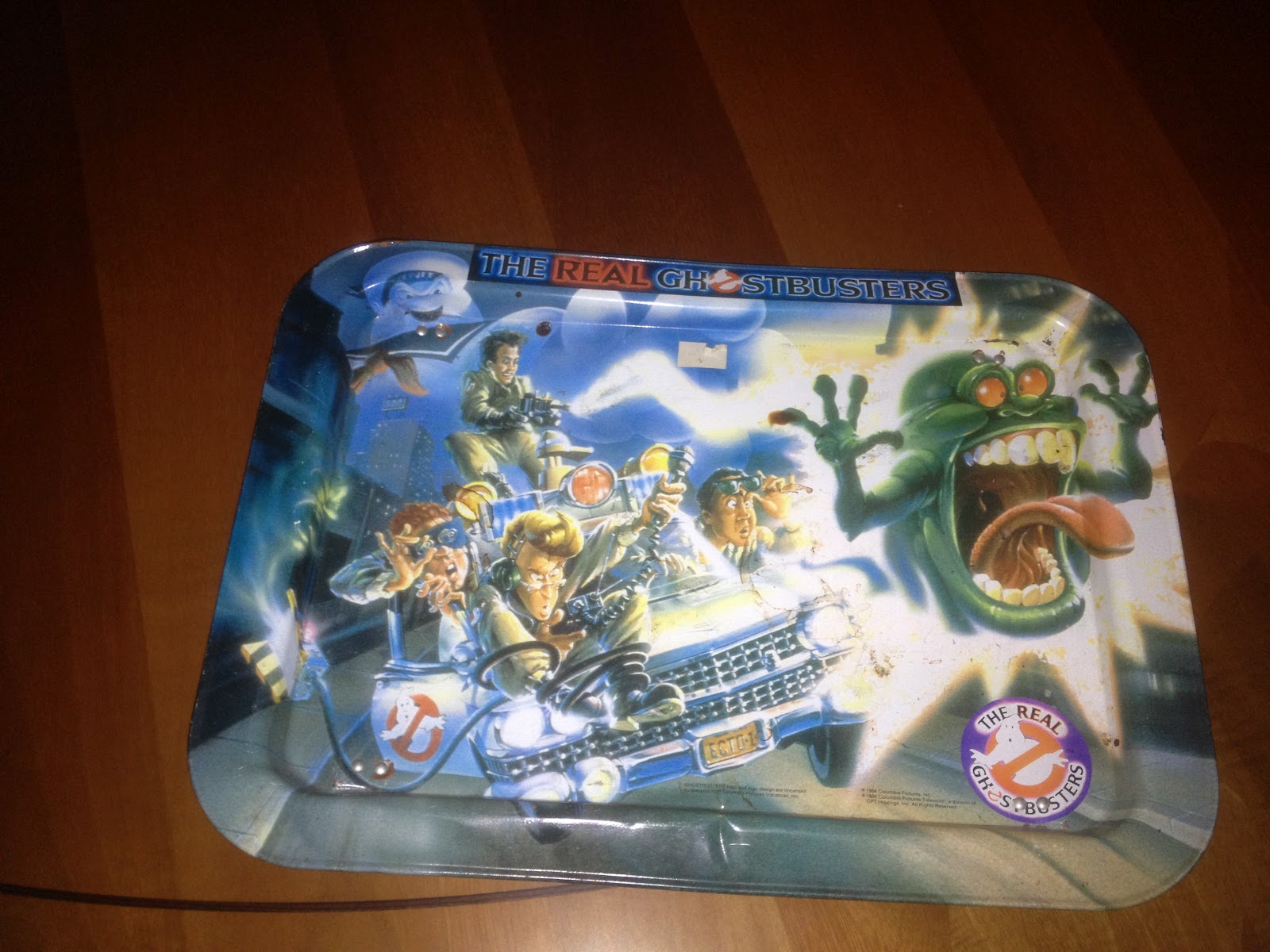
"Um. Okay," I replied, and followed him to the elevator, thinking that this was pretty weird. But then again, it's a science fiction convention. The whole joint's weird. And it's not like I was getting a bad feeling off of the dude, and I'm solid enough to hold my own, if need be, so up we went. I stood in the door as he rummaged around for a minute, then he turns around and presents me with a lap tray - like the kind you're served breakfast-in-bed on - branded with the old cartoon The Real Ghostbusters.
My brother and I used to watch the show (anyone remember that Arsenio Hall used to voice Winston Zeddimore before he landed his talkshow?), but I hadn't thought about since... well, since it was on 27-or-whatever years ago. Certainly not something I'd expected to be reminded of, and definitely not a piece of merchandising I even thought would have existed in the first place.
I made the appropriate appreciative noises for the pop culture relic and made to hand it back, but the guy said "No, it's for you." I said thanks, but I couldn't take his find. But he said that he'd got it from an uncle a while ago, but realized that while he likes Ghostbusters, he's not a huge fan, and with limited space to store the treasures he does love most, he figured he might as well bring it to the con and give it to someone who looked like a fan of the franchise. No charge. No trade. Just wanted to find a home for it. He saw my jersey, and figured he'd completed his quest.
So, with many thank-you's, we proceeded back to the lobby, and I brought the tray down to my car so I wouldn't have to lug it around the con all day.
But what a nice surprise! How often is it that someone singles you out, based on what you're wearing, and just gives you something because they think you'd like it? As geeks most of us, at some point in our lives, have probably been marked because of something we were wearing, or some possession we had with us, but we were probably picked-on for it. How many other circumstances are there, other than SF cons, when a relative stranger points at you in a crowd because of your attire, and, without bullying or guile, gives you something? A genuine, simple act of generosity from one fan to another, knowing that the other person might appreciate a collectible? Outside of a con, not very often, in my experience.
Now I'll have something to balance my sandwich and drink on, next time I'm eating in front of the tube.
After that, it was on to my watch my first panel of the day: the live recording of the Caustic Soda Podcast, with guests Willis and Benford. Now, admittedly, until this point, I haven't been a follower of this podcast. It's something I'd heard about in the periphery of my attention at cons in the past, but for some reason never paid attention to the talk, or didn't follow up on it. My mistake. Today, I decided to give it a shot, since I'd seen one of their hosts yesterday and was pretty impressed, and because today they were bringing two of the con's guests of honour on board.
Wow. What a lot of fun! The boys from the podcast are smart and funny and keep that thing jogging along at one hell of a pace. I think they were recording for an hour-and-a-half, but the time just exploded by. Both Willis and Benford were a pleasure to watch in action as well, as the discussion bounced around the con's theme of Post-Apocalypse. As guests go, Benford was more reserved than Willis, but personality-wise, he seemed kind of like a straight-man in a comedy team: watching, waiting, timing, letting the others get the shots in, then quickly stepping in with a deadpan zinger that had everyone laughing. I'd love to quote some of the great lines that came up, but that'd be a spoiler, and it's much better all around if you just go to their site (or iTunes) and wait until this episode is posted and listen to the whole thing yourself. That said, well done, everyone!
While I didn't give the 'cast any thought before, today's show has definitely made a fan out of me. Before i head back to the con tomorrow, I'll be downloading a couple of their older shows and start making my way through their archive on the drive over.
Once the taping wrapped up, Willis and Benford were both kind enough to autograph a couple of books I'd been lugging around with me. I asked Benford to sign his short story in my copy of the Norton Book of Science Fiction, "Exposures". Willis signed the Norton as well, on her story "Schwarzschild Radius", and her story "Miracle" in the Christmas Stars anthology.
With a little time to kill, I went down to the Dealers' Room. Forgot to mention it in yesterday's post (weariness was blurring the details), but I had a good chat then with my friend Walter from White Dwarf Books - I don't think we'd had a chance to catch up since he joined me on a pilgrimage to the Canadian Barbecue Championship in Whistler this summer. I'd also spend a few minutes shooting the breeze with Karl Johanson, Editor of Neo-Opsis Magazine. It's been a little while since I've read an issue of the mag, but I have read them every now and then in the past, and enjoyed them. One of the things Johanson said that stuck out in my mind was that his first criteria for picking a story is "Do I like it?" - before theme, or style, or other considerations, because his initial enjoyment is the most important test as the guy who'll be offering those stories to other readers. That reminded me a lot of what an old artist and retired UBC art professor who's a friend of the family once told me about picking art: Choose what you like. Technique, symbolism, the artist's name and popularity don't matter anywhere near as much as whether you like what you're looking at. Definitely words to live by for any form of art. And speaking of art, I also enjoyed talking with a guy who makes Doctor Who and steampunk-inspired necklaces, keychains, and various nick-nacks. We had a bit of a debate over the question of whether nerds and geeks are the same thing (I maintain they are, the crafter maintained they're not - nerds being hyper-analytical and geeks being big-picture creative, in his estimation), which put me in mind of a diagram someone put online a few years ago, but despite our differences, we both enjoyed the exchange.
Anyhow, today's first trip to the Dealers' Room was made with the intent of fulfilling my VCon tradition - buying the latest addition to the Tesseracts anthology series (showcasing Canadian science fiction and fantasy) from the Edge Publishing table. Nice folks, in from Calgary, and what was even nicer was that they were offering a deal where you could pick any two books from the table for just $20. Pretty good, considering the Tesseracts volume was about $15 or $16 on its own. So I snagged it, along with a copy of KA Bedford's Time Machines Repaired While-U-Wait, which I recall had received some good buzz when it came out a while ago. Knocked another 2 bucks off the price of those books, because I remembered I still had my "con bucks" with me. Nice.
On the way out of the room, I had a nice exchange with a lady at one of the costuming businesses, which was a bit unusual, in that I'm not really into costuming, but that's the cool thing about cons, you get to talk with all sorts of interesting people, some of whom have similar interests, others completely different, but all of them with a lot of passion for what they follow and what they do, which makes for good conversation.
Then it was up to another panel: "The Shadow, Doc Savage & Sky Captain: The Pulp Movie Problem". The session analyzed why pulp fiction, which was so popular in the early 20th Century, somehow has not been able to come back and gain box office success in the movies. It started out a little slow, but built up momentum and became quite entertaining. Best comment off the top was probably Stan Hyde's "Pulp fiction is not what Quentin Tarantino thinks it is."
One of the interesting exchanges involved R. Graeme Cameron suggesting something along the lines of:
"Modern comics work in film because they are living pop culture. Most of the pulp fiction characters are fossils. They're dead."
To which Hyde responded:
"Pulp characters do work on film. There is a movie called Raiders of the Lost Ark."
Good stuff.
After that, it was more good stuff - back in the Dealers' Room, though it was more good discussion, rather than a purchase. I had some time to kill before anything of interest, so I went down for another look at the SF Canada table, and ended up having an in-depth discussion of Tolkien with one of the ladies there. For an hour. How many times can I say it? That's what a con's about, good discussions with interesting people. As many others have pointed out about this and many, many other cons, some of the best times you'll have are outside of the sessions: in the bar, the hallways, the elevators, the room parties, and, yes, the Dealers' Room. Just a delightful way to spend time. At the end of it, she gave me an invitation to the SF Canada Members room party later on.
From there, I took in the Costume Contest, which was already under way by the time I got to the room, but there was still quite a lot to see. Nice work by many of the costumers. Lots of variations on the post-apocalyptic badass, in keeping with the con's theme, but there were a few that went their own way. Big kudos to the woman who made a working mermaid costume (meaning she can swim in it, not that she'd somehow bioengineered herself to be half fish), and the big guy who geared-up as Thor. Coincidentally, Thor had to carry the mermaid from her seat to the stage about half a dozen times, because, with the tail on, she couldn't even hop without losing her balance. The big prize of the night, however, went to a couple dressed as David Bowie and Jennifer Connelly in Labyrinth - except the dude didn't have the frighteningly large codpiece bulge that the Goblin King was sporting in the movie. Worth checking back to the con website to see photos of all the entries once they're posted.
When that was done, I adjourned for dinner (very definitely offsite, this time) and when I got back, most of the panels were done and the socializing was well under way in the hospitality suite, dance hall, and room parties.
I tried to get one more session in though. Tried. "Randomness with Professor Whovianart" was truly painful. A few people came into the room and left after just a couple of minutes. I held out for about 10 minutes before I decided that listening to the guy at the front babble about the cool stuff he owned was too much. I dunno, I seem to be having bad luck with these end-of-the-night panels this year.
Anyhow, dancing's not my thing (and my wife wouldn't approve of me busting a move with another lady), and the hospitality suite was crowded, so I headed for the elevator and went up to the SF Canada room party. And stopped outside the door. And didn't go in. Part of this was because I don't know anyone who was there. Now, admittedly, I've just gushed repeatedly in this post about entertaining conversations with strangers at cons, but for me, there's something different between random chit-chat in the halls, and actually going into a party where you don't know anyone. I'm not saying I don't warm up at parties, I do, it's just a lot more comfortable - and fun - to go in when there's at least one person I know who I can start with. An anchor, a friendly face, or, let's call a spade a spade, a security blanket, if you will. And I was tired after a long couple of the days. But the nail in the coffin was a feeling of inadequacy. It was a party for authors and their guests. What am I? I'm a writer by profession, but not of fiction. In terms of fiction, I submitted a story that landed third place in an On Spec postcard fiction contest a few years ago, but those of us in the top three only had our stories posted to their website, not in the printed magazine (and I'm not even sure the link exists anymore). Not bad. In fact, it's something I'm proud of. And yet, there was that nagging feeling outside that door tonight that maybe I haven't earned my stripes yet to have a place in a party for authors. I dunno. Maybe that's true, maybe not - the invitation to come was extended with friendly intent, after all. Probably a missed opportunity to hang out for a little while with some cool people. Maybe it's something that'll motivate me to put some of the stories in my head to paper, finally. In any case, I went back down the elevator, got in the car, and headed back home to share my day's adventures with my wife.
And now to put my nagging self-doubts to bed.
Saturday, September 29, 2012
VCon 2012 - Day 1 - Posts from the Apocalypse
A lone man travels through a perilous land, facing hordes of hostile beings, in a desperate effort to reach a last sanctuary for like-minded individuals.
Sounds like the plot of any half-rate post-apocalyptic thriller, I know. But it's nothing so grand: merely a description of my commute this afternoon, fighting traffic through the Massey Tunnel and across the roads of Surrey on the way to Day 1 of V-Con - the 37th annual Vancouver Science Fiction Convention.
Given the similarities between the rush hour commute and the end of the world, it's fitting that this year's theme for the con is "Post Apocalypse."
By the time I arrived, it was about 4:30, so I hadn't missed much in the way of early programming. Plenty of time to register and poke around. I've been to this particular hotel many times on business, so I already know the lay of the land, but it's always a good idea to find out where all the amenities like the dealers' room and the art room are before immersing in programming.
And speaking of programming, this year's event looks like it's shaping up to be pretty good. Science fiction Grand Master Connie Willis is the Author Guest of Honour, author and astrophysicist Gregory Benford is the Science GoH, and James Ng, the local genius behind a series of Asian-inspired steampunk paintings, is the Artist GoH.
But I'm getting ahead of myself. Wandering around...
A quick look in the art room revealed a mix of "the usual suspects" - the same artists who display the same stuff every year (some of it very good, other stuff... meh) - along with a couple of new additions. As always, Ng's works caught my eye, and this may be the year I give in and buy a print.
After that, it was over to the dealers' room for an exercise in self-control. I try not to buy anything on the first day, and definitely not on the first pass through the room. There's always something I want to pick up, and, by the end of the con, someone in the dealers' room is likely to part me with some of my money, but the first time through is when I get a sense of the room and start setting priorities for what I absolutely need to buy (books!), versus other nick-nacks that might be nice to have, but wouldn't be the end of the world (there's that inevitable apocalypse reference again) to pass up. This time, I found myself coming back to a table selling Doctor Who action figures, with an eye towards maybe picking up a Dalek, or one of the Doctors. But we're planning a move in the next couple of months, so maybe more toys are not what I want to be lugging around.
By the time I peeled myself away from the dealers' room and had gone upstairs to start attending the programming, the Opening Ceremonies were pretty much over, so I headed down the hall for the "The Plural of Apocalypse" session. What a thoroughly entertaining panel! Moderator and Caustic Soda podcast host Joe Fulgham, UBC biology researcher Kristi Charish, author Geoff Cole, and Willis were smart, personable, and an absolute riot as they chewed over different types of world-ending events, their likelihood, and their cultural and fictional significance.
The most memorable quote of the panel - and something to add to the "Things You'll Only Hear at a Science Fiction Convention" list - was Willis' remark during the introductions:
"I've ended the world in a number of ways."
Of all the different varieties of apocalypse discussed, the group seemed to spend the most time talking about the very real possibilities of diseases mutating (probably naturally), getting beyond our control, and significantly thinning humanity's herd, if not wiping our species out entirely. Everyone got a chuckle when Charish said:
"If the apocalypse is a disease, at least with my background I'll know when to run for the hills."
Later on, they moved on to other likely causes of destruction, like meteorite impacts - something common in science fiction, but almost completely overlooked by the public. I couldn't have agreed more with Fulgham when he said something to the effect of:
"The meteor likelihood is one of the reasons I'm unapologetically pro-tech. All those people who want to go back to living in the forest... Guess what? One of these days, that forest isn't gonna be there."
The session was over faster than a flash from a nuclear inferno, and the group could have easily done another hour without losing momentum or the audience (and they were a good bunch too, letting the panelists do most of the talking, but raising some good examples and questions from time to time too). What a great way to start the con. This is what a panel should be.
Bonus points to Fulgham for telling Willis early on "It's an honour to be on a panel with someone who was interviewed on Prisoners of Gravity." Anybody who references PoG is fairly awesome. Bonus points as well to the woman in the audience who gave Don McKellar's brilliant Last Night as an example of personal and society reaction to an impending apocalypse.
From there, I went back to the registration area and bought this year's con T-shirt (now glow-in-the-dark!), then took a break for an unsatisfying supper in the hotel restaurant that took far too long (I know, I know, get out of the hotel when you're looking for something to eat, that's the best way to get a good meal; but I tend to feel a bit guilty at these things if I don't have at least one meal in the host venue). By that point, it was a little after 9, and there wasn't much choice in the way of programming left.
I went to the "Post Apocalyptic Vampires?" panel, and ended up wishing I hadn't. Only two panelists, and it seemed like after about 20 minutes they'd exhausted every angle they could figure out for life - or unlife, as the case may be - for vampires after a major calamity. Seriously, from that point on, every 8 minutes or so, they kept asking if the audience wanted to leave early, or if anyone had anything else to mention. I don't blame them, aside from running through their material, there were a couple of people in the audience who were doing a lot of talking, and - though I can only speak for myself, I'm pretty sure a couple of others would have agreed - it was all stuff we could have done without. You know the types, the non-stop yapper who figures he ought to be on the panel; the guy who has to snarl everything he says as though it's all beneath him, even though he's inflicting his opinion on everyone fairly frequently; and the monotonous guy who suggests things that are, well, just dumb, goes quiet for a minute or two, then starts droning on about the same thing again as though no time has passed, then repeats. I'm no nosferatu or bloodsucker wannabe, but by the end of this session (yeah, it got relentlessly dragged along like a fresh victim with blood still seeping from the puncture wounds to the neck - all the way to the end of the hour) I was just about ready to drive a stake into my own heart. Why didn't I leave, well, within a minute of when I'd first entered and realized what I'd got myself into? A sense of politeness for starters, I guess. I would feel kind of rude getting up and leaving in the middle of a session when there aren't any other sessions going on and nothing else to see or do except hit the bar. My mistake. Next time I'll bail.
Speaking of bailing, I've been up since far too early this morning, so, with nothing left to report, it's time to bail from this post. See you tomorrow, for another report from the apocalypse!
Thursday, June 07, 2012
Another Pumpkin Has Been Lit on the Halloween Tree - RIP Ray Bradbury

This morning I woke up and checked Facebook as usual before hitting the news sites, and was hit with some sad news: author Kit Reed passing along the word from io9 that Ray Bradbury was dead.
Anyone who's had the misfortune of perusing this blog more than once knows I'm a Bradbury fan. Hell, my first post when I hopped up onto this soapbox was about him. The man, quite simply, as many have said in touching tributes today, was a genius.
For someone who spent so much time in libraries, Bradbury's style of writing was for the ear as much as the eye - his stories were made to be read aloud: conversational and thus accessible to anyone, and yet poetic in their rhythms and joyously overflowing with a celebration of all manner of words and ideas. He was a master of making his point bluntly while still hiding meanings in metaphor that had to be teased out by really paying attention to what he was saying. He could be unflinchingly hard in killing characters like those in "The City" or, most painful of all, "There Will Come Soft Rains," and yet he was also so very gentle and able to show the feeling and humanity in even the most frightening collection of monsters, like those in From the Dust Returned. And the breadth of his imagination was stunning, making the huge, profound and ancient or distantly futuristic sit chummily side-by-side with pop culture, distant worlds bedding down with the rush of LA or the deceptively comfortable quiet of Greentown.
Oddly - and appropriately - enough, when I've read or listened to or participated in fan discussions over the years of favourites from Bradbury's body of work, the image that comes to mind is of a library. Just like in a library, there's a lot of common ground: areas that everyone goes to now and then, like the periodicals, say, which, in terms of his stories, most fans would agree are near the top - stories like the afore-mentioned "There Will Come Soft Rains." But then, especially if people are allowed to name more than one favourite, you start to find that everyone has their favourite section, quiet corner, back stack of his work that others may have glossed over for whatever reason or never read at all. Read through enough of his stuff, and you'll find stories that appeal to people of significantly different tastes. And yet, just as there are people like Bradbury himself who enjoy browsing in almost any part of a library, there are also those who enjoy pretty much everything he's written.
Though my wife and I generally have different taste in books, we both enjoy Bradbury. She'd heard me gushing about him a few years ago, seen the animated masterwork The Halloween Tree (with the author himself doing a marvelous job as narrator, with his wise-old-Mr-Owl voice), and decided to see for herself what the fuss was about. She randomly chose One More for the Road off of the shelf and fell in love with "Tete-a-Tete." It's now her favourite story.
For me, over the years, "Last Rites" - his highly original and heartwarming take on the time machine trope - has grown to become my favourite among his short stories. As tough as it is to read, "There Will Come Soft Rains" comes in a close second. Among his novels, the closest to my heart will always be The Halloween Tree, with its celebration of autumn and All Hallows Eve and youth and the wild, dangerous adventure of night and the unknown. From the Dust Returned comes in second, with its deeply sad chapter "Homecoming". And, of course, The Martian Chronicles rounds out the top three. What about Fahrenheit 451 you ask? Well, of course I like it, but it's not quite a favourite.
While it's sad that one of the most relentlessly creative and entertaining of the old gods of SF has left us, I take comfort in the fact that he's left behind such an enormous body of work that even once all of his stories have been read, it's possible to go back and read them again and have them still feel fresh. He's also influenced many other creative folk, including author Neil Gaiman, film maker Guillermo Del Toro, and delightfully raunchy filk-ish singer Rachel Bloom, meaning echoes of the old master will always be around. Besides, with all his stories about ghosts, vampires and various other unquiet dead, you have to think that if there was ever an author who was inclined to come back for a visit, Bradbury might be the one to pull it off.
But for the time being, rest easy, sir. You will be missed.
Ray Bradbury was 91.
Subscribe to:
Posts (Atom)