Monday, March 03, 2014

Mini Review 2 - The Martian War, Red Planet Blues, Old Mars

It seems Mars has been getting a lot of attention over the past year or so. Every time I turn around, it's as though there's a new media headline from the Mars Rover or Curiosity robots, or updates about candidate selections for the much-hyped Mars One Project reality show/possible-colonization-attempt. Then there are the books.

Mars has been a staple of science fiction since the beginning, and, while there are occasional years that are dry spells where you don't see much on the shelves, it feels like there was a burst of stories focussing on the red planet recently. Or, at least, there were a bunch that caught my attention.

For that reason, I've decided to dedicate this edition of the Mini Review to a trio of books that I went through last year, starring Mars: Kevin J. Anderson's The Martian War, Robert J. Sawyer's Red Planet Blues, and the Old Mars anthology edited by George R. R. Martin and Gardner Dozois.

--------------------------

What if author H. G. Wells didn't completely invent The War of the Worlds as a work of fiction? Imagine a young Wells and a gang of real historical figures like Percival Lowell, along with fictional characters come to life - such as Dr. Moreau - racing against time and through space to thwart the Martian menace before it's too late for Earth.

That's the basis for Kevin J. Anderson's The Martian War, a rollicking mash-up that's reminiscent of Alan Moore and Kevin O'Neill's The League of Extraordinary Gentlemen - volume 2, without the dark overtones to the characters or plot; the explicitly, visceral brutality; or the gritty feel to the setting. Instead, Anderson just gives us a fun adventure that a reader can jog through fairly quickly without feeling unsettled - like a walk through an amusement park funhouse, rather than Moore & O'Neill's tour of a morgue.

You may remember the War of the Worlds - Global Dispatches anthology that Anderson edited back in '96, and, if so, The Martian War certainly makes a good companion piece to it, or, at least, a sort of solo retake on the idea that has a similar feel.

It's not a book I'll be rereading on a regular basis, but it's certainly worth keeping and I'll revisit it someday. And, it's a book that I'd recommend buying if you're looking for a quick read to take on a plane flight.

--------------------------
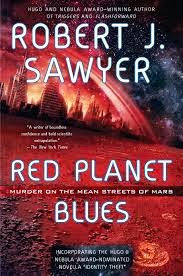
I really wanted to like Robert J. Sawyer's Red Planet Blues. I enjoy most of Sawyer's fare, including the novella "Identity Theft" that forms the basis of this book, but unfortunately, drawing it out into a longer form just didn't seem to work.

The noir-style story follows Alex Lomax, a private detective on a Mars colony where the only real industry left is fossil-hunting, and the population is a mix of those searching for the elusive motherlode of long-lost Martian life, and those trying to make money off of them - one way or another. Those with enough money get themselves uploaded into nearly impervious robot bodies, or buy flights home, while those who don't try to get their share any way they can. Lomax finds himself caught in a mystery involving the discovery of the biggest and best fossil bed in history, and dealing with people who are willing to kill to get their hands on it.

Problem is, as hard as the novel tried, it just wasn't as gripping as it wanted to be, and didn't have any real depth. Remember that line from The Lord of the Rings where Bilbo, having possessed the One Ring for too long, says he feels like butter that's been spread thin over too much bread? That's what Red Planet Blues felt like. And, no matter how many new twists and turns Sawyer tried to jam into it, the story just didn't get any more substantial - I never escaped the feeling that it just should have ended a lot sooner. I didn't really care about Lomax - he had the trappings of a classic gumshoe character, but there was no real depth to him or reason to care that he came out on top, instead of one of the secondary characters who occasionally throw their support behind him. It was like he was more of a caricature than a character. And even some of the supporting cast members weren't as believable as they needed to be... a big-time player on the fossil-dealing scene who's said to have connections with bad people, but who goes into a dangerous situation in the desert without bringing some hired muscle for support? I don't think so.

In the end, I think it would have been a better book if Sawyer had just started from scratch. Rather than trying to inflate an existing novella, he could have used his considerable talents to write an entirely new story with a different character in this setting. As it stands, the story that he has (re)written for us is one that I didn't hate, but, unfortunately, it's one that I can't recommend either.

--------------------------

Old Mars. Of the three books in this Mini Review, this is the one I liked the most. Liked? No. Loved.

This herd of stories that George R. R. Martin and Gardner Dozois managed to corral is just bursting hugely with so much energy and wild imagination that it needs its own soundtrack, and I'm not talking some safe, run-of-the-mill soundtrack from most films these days; I'm talking about something massive and intricate and brain-slapping, like the operatic tidal wave Basil Poledouris threw at us for the original Conan the Barbarian, or James Horner's raucous aural assault from Krull (as terrible as the movie was, you have to admit, the soundtrack kicked ass). But I digress. Old Mars is one fucking great collection.

These are stories in the vein of Wells, Burroughs, Brackett, Bradbury, Wollheim, Lewis, and others from the good old days of SF when the science was still sketchy and Mars and the rest of the universe were wide open to possibilities; where authors could share imaginations of ancient civilizations in the dust just one planet over. This is a collection of stories where, because the editors have given the writers and the readers permission to ignore the hard science of today, there is unbridled energy and a boundless potential for wonder.

And you needn't look any farther than Martin's introductory essay to find an expression of that wonder that SF used to have, and the deep longing for a return to it that's felt by so many of us. Hell, Martin's intro is so good, it deserves to be published and honoured on its own - one of the reasons why I nominated it for the "Best Related Work" Hugo this year.

The book pulls together stories from a range of talented authors, including Matthew Hughes, Ian McDonald, Allen M. Steele, Mike Resnick, Melinda M. Snodgrass, Michael Moorcock, and others, and nearly every one of them is really, really good. In fact, the only one of the bunch that I could have done without was Joe R. Lansdale's "King of the Cheap Romance", which felt like an overly-long and poorly-executed young adult piece. I think the collection would have been much stronger if it would have instead had a story like Camille Alexa's beautiful and heart-rending "Seeds of the Lotus" from Ace Jordyn, Calvin D. Jim, and Renee Bennett's Shanghai Steam anthology (which I would also highly recommend).

Go out and buy this book. If you can still get it in hardcover, it's worth every penny. If you've gotta take a softcover or e-book version instead, that's fine too. Just buy it, read it, and treasure it - treasure it the way you would if you managed to catch a half-understood glimpse of a Martian in the shadow of a ruined wall mostly buried by sand in some forgotten corner of the red planet.

Friday, February 28, 2014

Good Night to The Red Knight

I hate to give up on a book.

It means I've wasted time reading a few chapters or however many pages of something that wasn't interesting, entertaining or educational, when I could have been reading something else.

It means I've wasted money that could have been spent on something else.

It means that because I haven't finished it, I can't even add it to my What the bookworm just ate list.

And - sometimes, anyway - it leaves me with the nagging worry that if I'd persevered just a little longer, I would have got to the part in the story that would make it all worth while.

Only sometimes, though. Usually, it's pretty clear after a couple of chapters whether there's any hope for the thing, and, if a book hasn't been able to engage me by then, it's unlikely it ever will, and regret fizzles pretty quickly.

Miles Cameron's The Red Knight - Book 1 of the Traitor Son Cycle is just such a book.

On the surface, it had elements that should have worked: knights and mercenaries, deaths at the hands (or claws) of nasty critters, a land on the edge of a threatening magical wilderness, and dragons - my favourite mythical creature of all! - or, at least, their stunted cousins the wyverns. And it's written by a Canadian, and I like to support local authors when I can.

Unfortunately, The Red Knight was just too boring for me to be bothered finishing. After two chapters and 50-odd pages, nothing really happens except lengthy descriptions of clothing and armor, and a whole catalogue of characters exchanging typical and utterly forgettable dialogue. Sure, there's a brief bit about a bear-baiting session that goes wrong, and a subsequent tussle with the beast, but that's about it.

Even the opening scene, with the titular Red Knight's cursory investigation into a slaughter at a farm, is detached to the point of being offhand and blase. Sure, we're dealing with a character who's a sellsword with no real emotional involvement in what's happened to the victims, but if the author can't imbue the description of a killing ground with palpable menace and horror, then something's wrong. Ultimately, it's a scene where nothing much happens except mercenaries kind of looking around at stuff. But there's a huge difference between just looking and thinking about something that happened a while ago, and actually showing us the action as it happens. This rather passive passage is really not a great way to set the pace of a novel, much less an entire series.

This especially bodes ill when you consider the sheer size of this monster door-stopper of a book. If it can't engage the reader in the opening scene - a setting of violence - how can it possibly sustain interest throughout the rest of its bloated length (or its sequels). Consider other long books that launched heavy-weight series: the prologue of George RR Martin's A Game of Thrones kicks off immediately with urgency and a sense of men being hunted - even though they're only sitting around a campfire - as one of the rangers from the Night's Watch tries to get the rest of his band to abandon the wilderness for their fort - a prologue that ends with the rangers ambushed and fighting a losing battle against the White Walkers and their undead soldiers. Then there's the prologue to Robert Jordan's The Eye of the World: Lews Therin, having just killed everyone around him, blows the shit out of the top of the Dragonmount. Action. Big stakes. Characters who you're immediately drawn to. Stuff actually happening that compels the reader to keep reading. The Red Knight? Not so much.

So, The Red Knight will be chucked in my "to donate" box, unfinished and, ultimately, unremembered. Pity.

Tuesday, February 18, 2014

My Nominations for the 2014 Hugos

Ask any crowd of fanboys what they think about awards that are given for books/TV/movies/whatever, and you're liable to get at least a dozen answers about whether a trophy is useful to consider as a recommendation when buying a book or comic, or when deciding which show or flick to watch; or about the merits or flaws of judging or voting systems; what a year's win says about fans and fan culture; whether a work that's singled-out as a year's best will actually stand the test of time and become canon; or whether we should even have them.

For my part, in general, I like the idea of a community recognizing the top achievements of writers, artists and others in a given year. Sure, there can be flaws in selection systems, and yeah, it's not uncommon for people to be of the opinion that more deserving works have been overlooked, but no system is perfect, and, at the end of the day, I think we, as a community, should take every opportunity we can to applaud creative people who've done terrific work, and, along with reviews and recommendations, awards are a good way of doing that.

So, as part of my preparations for this summer's trip to the UK for Loncon3/Worldcon72, today I sent in my nominations for this year's Hugo Awards. While I certainly can't claim to have read or watched everything that was released in 2013, of those SF works that I have consumed, the ones I've nominated are ones that I feel strongly about.

Here are my nominations (in no particular order within their categories):

Best Novel:
  • Burning Paradise by Robert Charles Wilson
  • River of Stars by Guy Gavriel Kay
  • Son of Destruction by Kit Reed
  • The Ocean at the End of the Lane by Neil Gaiman
  • Fiddlehead by Cherie Priest
If I had to bet, I'd guess that given his world-wide stature, the intense buzz, and the effect of this year's reading/signing tour, Gaiman's probably got the inside track (at least of these books, but possibly compared to the entire genre's output last year as well). With good reason - TOATEOTL is one hell of a good read. But so are the others I've suggested for consideration. I've previously talked about how much I loved River of Stars and Son of Destruction here on the blog, and tweeted about Fiddlehead and Burning Paradise, both excellent reads as well. As much as I'd be happy if Gaiman makes it to the final ballot and wins, I think I'd be happier if one of the others secures a win without the benefit of a media juggernaut.


Best Novella:
Didn't nominate anything for this one. I don't read as many mags as I should, and, as far as short story anthologies go, I read for the enjoyment of the stories, not to sit there and do a word count. Sure, I could probably look up eligibility lists online, but that's really more effort than I want to go through. If I like a shorter work, I'll nominate it for the Short Story category and let the judges sort out whether it belongs in one of the longer-form categories or not.


Best Novelette:
Same as above.


Best Short Story:
This category is unfair - especially in a year when I've read a bunch of anthologies, in addition to whatever magazines I've picked up - because there are always so many good short stories out there. Five seems too few to nominate! Anyway, here goes:
  • "Nocturne" by E. L. Chen, from Masked Mosaic - Canadian Super Stories
  • "The Secret History of the Intrepids" by D. K. Latta, from Masked Mosaic - Canadian Super Stories
  • "The Creep" by Michael S. Chong, from Masked Mosaic - Canadian Super Stories
  • "The Queen of the Night's Aria" by Ian McDonald, from Old Mars
  • "The Ugly Duckling" by Matthew Hughes, from Old Mars

Best Related Work:
Just one nomination in this category, because this intro/essay was so truly exceptional, it's in a class by itself, in my opinion:
  • "Introduction: Red Planet Blues" by George R. R. Martin, from Old Mars

Best Graphic Story:
  • Kill Shakespeare volume 3 - The Tide of Blood by Anthony Del Col, Conor McCreery, and Andy Belanger
  • Nemo - Heart of Ice by Alan Moore and Kevin O'Neill

Best Dramatic Presentation (Long Form):
There was a lot of garbage on the big screen this year, and I'll be immensely disappointed if that enormous shitpile Star Trek - Into Darkness gets any love; same with the lame ducks Man of Steel and Iron Man 3. But there were a quartet of films that I found pretty entertaining that are worth of the Hugo nod:
  • This Is The End
  • The World's End
  • Pacific Rim
  • The Hobbit - The Desolation of Smaug

Best Dramatic Presentation (Short Form):
As usual with TV, there's a lot that flickers briefly on the radar, but, though entertaining, is ultimately forgettable. Here are some exceptions - stories that really stayed with me, especially because they were so very good:
  • An Adventure in Space and Time
  • Doctor Who - The Day of the Doctor
  • Game of Thrones - And Now His Watch Is Ended
  • Game of Thrones - The Rains of Castermere

Best Editor (Short Form):
  • Claude Lalumiere (for Masked Mosaic - Canadian Super Stories)
  • George R. R. Martin (for Old Mars)
  • Gardner Dozois (for Old Mars)

Best Editor (Long Form):
Sadly, I've gotta confess, I don't give the editors of novels nearly as much credit as they deserve. I've always just concentrated on the writers, so I can't really nominate anyone here.


Best Professional Artist:
  • Andy Belanger for Kill Shakespeare

Best Semiprozine:
Unfortunately, I just haven't read enough semiprozines this year to make any nominations.


Best Fanzine:
I would have nominated SF Signal in a heartbeat for this one, because, for years, it's been the number one go-to destination for all things related to speculative fiction. However, "the bagel overlord" and his gang have decided to abstain from consideration this year, in order to allow others to have a shot at the award - a truly classy move which makes SF Signal even more cool. But, the upshot is that I don't really have any other fanzine sites that I'd like to nominate, because I just haven't made enough time over the past year to read more of them. Big oversight on my part, I know, because the geek-o-verse is populated with a lot of interesting folks running their own cool sites, but time's at a premium, so, here we are.


Best Fancast:
  • The Three Hoarsemen (Sure, they're only got a couple of episodes under their belts, but Fred Kiesche, Jeff Patterson, and John Stevens are just so damn entertaining and knowledgable that they deserve this award. So much so, that I'm deliberately not going to nominate SF Signal's flagship podcast, the SF Signal Podcast - which is also pretty enjoyable - just to give the newcomers a better shot. Strategic nominating, people! Strategic nominating!)
  • Caustic Soda (They don't always talk about SF-related things, but when they do, they do it well. Sodajerks of the world, unite!)

Best Fan Writer:
When I've got time to read fan articles, as good as many of them are, I don't think I follow any one individual closely enough to really nominate one over the others, so I'm taking a pass on filling-in any names in this category.


Best Fan Artist:
Similar to the above excuse. I've seen stuff I've liked, but nothing specifically new to 2013 that's flat-out arrested me and stopped me in my tracks - probably because I simply haven't seen enough. Takin' a pass on this one too.


John W. Campbell Award:
I hate to admit it, but with the reading I've had time to do in the past year, I don't know of any new authors whose names have stuck with me. It's likely that I've read some, and it's likely their stuff has been good, but nothing that's floored me enough to make me remember this far down the road that there was a work by a newbie that I just had to nominate, so I'm goin' for a threefer, and taking yet another pass.

So those are my nominations for the 2014 Hugos. Hopefully some will make it to the final ballot.

If you're going to Loncon 3 this year, Sasquon next year, or if you were at Lone Star Con 3 last year, then you're eligible to nominate your favourites for the Hugos. Can't make the cons, but still want to interfere in the course of Hugo history? Get a supporting membership and then get your nomination in!

Good luck to everyone who's nominated by anyone! And, thanks to all the authors and artists who put stuff out there in 2013, making SF a more interesting place!

Saturday, January 11, 2014

Reunited

Happy New Year, everyone!

I hope you enjoyed the recent holiday season, whether you celebrated specific holidays or not.

For me, it was a great holiday season, especially for indulging my passion for speculative fiction. First: an early gift exchange with my wife (ahead of our trip back east to visit my folks), where she gave me a big stack of books, including new stuff from the likes of Claude Lalumiere and Peter Watts. Second: while prowling around in an antique store in the village of Almonte, Ontario, I found a first British edition (hardcover) of The Silmarillion. Third (and perhaps most important of all): I was finally reunited with the last stray remnants of my hoard.

If you're a book collector like I am, it's an old story you're probably familiar with: I began amassing my SF book and comic collection as a teen, but when it came time to leave for my second round of post-secondary studies in another province, I had to leave most of my babies behind. In the years that followed, I moved several times, following career opportunities; meanwhile, my parents moved as well, carrying the abandoned (Is "abandoned" even the right word? It seems far too negative and harsh a term for a decision that, while necessary, was so very reluctant.) portion of my collection even farther away. More time passed, and I continued to cultivate my book collection, but I always missed the ones that were still most of the way across the country with my folks. Every now and again, I'd go home for some holiday or other, or they'd come out for business or a visit, and I'd have a chance to recover a couple of the missing books (As many as I could stuff into my suitcase on the return trip if I was doing the travelling. Only one or two if it my folks agreed to play mule.), gladly welcoming them back into the fold.

But I always knew that there were still some missing. I just knew they were buried somewhere in the depths of my parents' basement, at risk of the old man tossing them into the donation pile if I didn't get them back soon. Always bugging me by their absence on my bookshelves - holes in the ranks of the titles, books missing singly or entire series not where they should be. What was worse, Dad - right up until this recent Christmas when I unearthed the evidence - always maintained that there were no books left, that he'd brought out all there were, and that there were no boxes left. But I knew he was wrong. One look at my shelves was proof of that. But more than that, it was that sense of the lack of completeness to the hoard, right down to exactly which items weren't there. It was like being Smaug in Tolkien's The Hobbit, when Bilbo steals a two-handled cup from the treasure pile. The dragon wakes up and instantly knows damn well knows that something's been taken from the collection. In fact, he knows exactly what's missing, and he's pretty pissed about it. Like that. Except, you know, I didn't fly around incinerating the outside of a mountain in my frustration. Not that I wouldn't have, mind you. It's just, you know, the absence of an ability to fly or breathe fire.

This Christmas though, was going to put an end to the years of longing for my missing treasures. This Christmas, we went to Ottawa to spend the holidays with my parents, and I was determined to stage a clandestine recovery of the last books that would have rivaled Indy's unearthing of the golden idol at the beginning of Raiders - if he hand't lost it to Belloq and the blowdart gang. After a lot of back-breaking shifting of boxes, I finally got to the bottom of the pile and found it [insert heavenly choir-sounding synth music and sfx-inserted golden glow] - the last box of books! Finally, I was reunited with Red Dwarf - Last Human, Timothy Zahn's Heir to the Empire books, missing installments from Jordan's Wheel of Time, a bunch of Asimov and Clarke books I hadn't seen in years, as well as a couple of favourites from my childhood. From there, it was a matter of finding room for the dozen or so hardcovers in our luggage (after the obligatory gloating to Dad about finding a stash he'd claimed didn't exist), packing and repacking each bag so they wouldn't be over the airline weight restrictions (because paying the overweight bag penalty fee would suck), and getting them home.

And I've gotta tell ya, it feels pretty good to finally have the hoard complete again. A Merry Christmas, indeed.

Tuesday, December 03, 2013

Finding a Dim, but Notable Star in the TV Christmas Special Sky: George and the Star

The other day when my wife and I were putting up our Christmas tree, we discovered the lights on the star weren't working anymore, sending us out on a hunt through three or four different stores to find the perfect star to replace it - or, at least a replacement that wasn't cheesy or too pricy.

Fitting, because the incident put me in mind of a scifi-ish TV holiday special about a search for a tree-topper that I really enjoyed as a kid back in the 80's: George and the Star (alternatively known as George and the Christmas Star).

This Canadian production didn't air that often (I can only remember seeing it once), then pretty much disappeared forever, so you probably won't see it in many lists of the greatest holiday specials of all time. But, for the few of us who did catch it, it made an impression.

The story is about a guy named George (obviously), who lives alone with his cat in a big house. One night, as he's decorating his Christmas tree, George decides he needs a new star for it (no, his old one wasn't broken like mine, it was a paper cutout and our understated hero just wanted something a little more flashy). He goes outside with his telescope, spots a little star glowing in the depths of the night sky, and decides he has to have it for his tree. Using a collection of odds and ends from his house, he builds a starship and heads off on his quest. Along the way, he befriends a robot named Ralph, an astronaut named Barbara, and runs into a troupe of robotic Mounties - er, space rangers (wearing Stetsons, blue serge instead of red, and cruising around in a giant horse-like spaceship). He also runs afoul of space pirates, and, if that wasn't enough, space bikers, before eventually finding his star. And let's not forget the cookie-cutter inspirational songs from Paul Anka.

Over the years, I've looked for it on the off chance that it might have come out on videotape or DVD, but no such luck - or, at least, I didn't have the luck to come across it when it was released. Finally though, I managed to track it down on Youtube, where someone out on the 'net has shown the Christmas spirit and put it up to share with everyone.

So grab your star-salvaging permit, and reserve a bed on the motel moon, it's time to watch George and the Christmas Star.


Monday, November 25, 2013

It's a Dog's Life

Is anyone else waiting for the other shoe to drop?

The death of Brian Griffin on Sunday night's episode of Family Guy seems to have ignited a fair amount of discussion about whether this is the right plot move or not, whether it's an act of desperation to draw in viewers, the sign of a long-running show possibly entering its death spiral, or just a mean trick on fans. Then there are the strong opinion's about Brian's replacement, Vito Vinnie.

What struck me the most about the episode, though, was the sense that this was a setup for something... I wasn't upset at Brian's death (despite his being one of my two favourite characters on the show), or the implications for the show or what the writers/producers may or may not be up to. Rather, I felt a detached sense of waiting, because the whole story had something familiar to it.

By familiar, I don't mean that I thought the writers were ripping anyone off - let's face it, too many primary characters have been killed on too many shows over the years (Henry Blake in M.A.S.H., Marcus in Babylon 5, Fry in Futurama - though he always bounces back) to make a sudden and arbitrary death in any way proprietary - rather, by familiar I mean that the entire episode arc had the feeling of a familiar refrain within the specific Family Guy style: the unrelated aside. The entire episode felt like one of Peter's references to ridiculous past incidents that are obligatory for each episode - "This is just like that time when I [insert your favourite bizarre or inappropriate reference]" - and now it's as though, we, the audience, are waiting for the characters to jump out of the aside, to revert back to the actual story in progress. The whole thing felt very meta in that respect. And maybe that's the point, and we just have to wait for Macfarlane and co. to decide that, having set the joke up adequately, it's time to get to the punchline.

What made the whole thing weird was that this sudden bit of genuine heart, of plain-served drama, is something that Family Guy doesn't do often, and doesn't necessarily do well. Sure, this is a series that'll serve up a bloodbath in any episode, or deliberately confront the audience with something uncomfortable and just plain wrong, but these incidents are always so over-the-top ridiculous or, though we may not want to admit it, funny, that they're in keeping with show's usual feel. In that way, Family Guy is like Southpark, even if it's main characters don't get slaughtered in every episode like poor Kenny was for so long (humiliated, yes, but rarely killed). But you'd probably be hard-pressed to remember one of Family Guy's genuinely dramatic moments. The only one that comes to mind for me is the season 8 episode "Brian & Stewie" where the boys get locked in a bank vault and Brian admits he keeps a gun in case he gets to a point where he feels the need to kill himself. This indicates that Family Guy's dramatic moments/scenes/episodes aren't done well enough, or the structure of the emotions the show evokes in general isn't varied or subtle enough to allow those dramatic moments to have any impact. This is unlike Futurama, which is equally wacky, but is not so obsessed with shrilly mocking things to extreme, and so is able to allow the audience to feel legitimate sadness, and to have that sadness feel like it has a legitimate place within a Futurama storyline. Think of the end of "Jurassic Bark" or "Luck of the Fryish" -  both deeply moving conclusions to funny episodes in a funny series, and endings that were meaningful to the audience because the writers know how to vary the tone, to let the audience know that they won't be made to feel stupid for feeling anything other than cruel amusement when the characters are put in painful situations. Because Family Guy episodes focus on playing just one note, the audience doesn't know how to react when the show changes its tone and tries to be serious.

If it's actually trying to be serious, that is. And again, with that vague meta feeling to the whole episode, I'm not sure that it is. I wouldn't put it past this crew to take us for a ride for a few episodes, then spring an 80s-style "it was all just a dream" reveal on us. We'll have to wait and see if there's another shoe that they'll drop for Brian to fetch, or if it's just a dog's life.


Wednesday, October 23, 2013

Anybody Remember This Story?

A little over a week ago, I was thinking about science fiction during our preparations for Thanksgiving dinner. As you do. I was pulling the turkey out of the oven, and I suddenly flashed back to a story that I haven't read in more than 25 years:

It was a short story - probably not more than a page or two - about a mother getting ready for a holiday meal. Lots of hustle and bustle of family throughout the house as she worked to set the dining table and get the baby into his high chair. Amidst all of this, she was thinking about how great it was to have the modern convenience of an  instant feast in a pill: a large turkey, stuffing, gravy, potatoes, side dishes, etc, all on plates, and all compacted down into one small tablet the size of an allergy capsule. All she had to do was add a drop of water, and in a minute the capsule would expand into the whole huge feast, all of it piping hot and ready to eat. She puts the pill onto the dining table, then gets distracted by something. When she turns back to the table, she realizes the capsule's gone missing, looks around, and, horrified, sees the baby (having leaned out of his high chair across the table) has popped the pill into his mouth. End of story.

Not the best SF piece ever, but it's one that's stuck with me over the years, and I think of it when the bird is ready to put on the serving platter and bring to our table.

What's bugging me though is that I can't remember the title of the story or the author's name.

Can anyone help jog my memory? Do you know what this story was called, and who wrote it?


Monday, October 07, 2013

VCon 38 - Day 3 - That's a Wrap

Sunday's always the toughest day to go to a con. Say what you will about the difficulties of getting out of work early to make it to Friday's programming, or that Fridays sometimes have the weaker sessions because programming committees might predict a lower attendance on opening day, but I've always found Sundays to be the toughest. By Sunday, I've put a couple of days of attending sessions under my belt, usually from noon through until mid-late evening, supplemented by trips to the dealers' room and art show, not to mention late night blogging, and my system's fighting off whatever con-crud I may have been exposed to among the crowds, and it's starting to wear on me. But I don't want to miss anything, and, hey, if I've paid for the full weekend, I want to get my money's worth, so I drag myself out of bed and make the effort anyway. How much worse it must be for the die-hards who stay onsite and rock the room party scene, or doggedly roll dice through the night in protracted gaming campaigns! Yeah, no matter who you are, Sundays are tough. But you go anyway. 'Cause for SF geeks, this is your scene, and that's what you do.

So. Sunday. VCon. I blasted up the highway late this morning in The Ol' Porkchop Express and got to the hotel in time to catch the last half-hour of the "Science Adventures" panel, which profiled some of the naval explorers of the past and their exploits. A good, solid, informative session, and I wish I'd been able to attend from the beginning, but I guess I missed the boat on that. Ha ha. Heh heh. Ugh. Feeble, I know, but I couldn't pass it up. Anyway, a good start to the day.

Then it was over to the "Exploring Worlds Far, Far Away - Without Hyperdrive", where UBC prof Jaymie Matthews gave an entertaining lecture on how exoplanets are found, how the search is going (something like 952 planets confirmed, as of this morning, he said, and many more waiting in the wings for verification), and the status of some of the satellites that've been launched to discover them. On that note, a big "Way to go!" to Canada's MOST satellite, nick-named "the humble telescope" for its very modest size (in the range of a suitcase) and budget (just a few million), and otherwise known as Spongebob Squarepants for its appearance, for continuing to operate and get the job done when bigger, more expensive platforms have experienced problems.

From there, it was up to the "Alternate Canada, Eh?" session, which wasn't bad, but wasn't great. There were two panelists and probably more audience participation than there needed to be. Enthusiastic crowds are great (heck, I made a couple of comments myself), but in this case, the audience started to take control of the session fairly quickly, and while there were a lot of alternate history ideas tossed around, the sheer volume of them, and the rapid-fire barrage of ideas coming from members of the audience (frequently from 5 or so of the same people) who wanted to get their two cents in, prevented any real, in-depth discussion of the ideas, or a separating of the wheat from the chaff. I enjoy alternate history panels (regardless of national or general themes) when they're done well, but to be done well, you need at least four panelists who have the depth of historic knowledge to really explore the possibilities raised, and to play off one-another, and you need a strong moderator who can set the panelists off in the right direction, and keep audience participation focussed, and limited, because this is a panel discussion, not a 30+ person random brainstorming session.

After that, I left the hotel to grab a late lunch at a local Chinese mall's food court, where I found myself eating just a table away from a guy who looked like an Asian version of Danny McBride in This Is The End - right down to the mullet. In fact, the resemblance was so uncanny, I began to worry that he was going to waste everybody's bottled water, and I didn't even want to think about what he might have done to the magazine rack around the corner. I finished my meal and fled as fast as I could before the winnebago full of post-apocalyptic minions could show up.

Back at the Con, a different kind of horror awaited me. After using a couple of "con scrip" dollars I'd found in the bottom of my registration bag to buy another nerdy button in the dealers' room, I went to the "Turkey Readings". The Turkey Readings are a VCon tradition where some of the guest panelists sit at the front of a room reading from pre-selected, old SF novels that are so poorly written that they're probably banned under the Geneva Convention, making it a miracle that the con hasn't been invaded by a UN peacekeeping force sent to dispose of these weapons of mass mental destruction and arrest those responsible for inflicting them on con members. But it gets worse. Members of the audience volunteer to act out the scenes from these "books" as they're being read. It's up to the seated members of the audience to then endure the madness that follows. Audience members can bid cash in an effort to make it all stop, but other sick individuals can counter-bid to keep the suffering going. When the "make it stop" side finally coughs up enough money to put an end to it, another panelist will crack open a different book, and the horror begins anew. Funds raised go to... well, at this point, given the lateness of the hour and the brain damage I sustained attending this session, I can't remember what worthy cause the funds go to, but the Turkey Readings do raise a reasonable chunk of change, which might be a redeeming virtue, but probably not, given the pain they inflict on the audience. Why do I keep going year after year? Sometimes the "performances" are worth a laugh, but if there's a reason beyond that, it's inaccessible behind the wall of psychological, emotional, and physical scarring the Turkey Readings have inflicted on me.

Reeling from that experience, I clutched at my chair when it was over, and waited for the Con's closing ceremonies to begin in the same room. The usual round of heart-felt thank-you's and see-you-next-years was enhanced this year with a cool announcement: VCon will be hosting Canada's national SF convention, Canvention, and the Aurora Awards (prizes for the best in Canadian SF) in October 2014! Congrats to VCon for landing this honour!

Maybe I'll volunteer at the Con next year - specifically, maybe I'll try to convince the organizing and programming committee to bring back the movie room. Things just weren't the same this year without the movie room. Don't know why they didn't have one, whether it was an issue of finding someone to man it, or of dealing with government regulations around using movies at a con, or if there's some other reason, but the movie room's absence this year just wasn't right. I'll have to send a note to the organizers to find out. If it means I have to step up to the plate next year to make it happen, then so be it. We'll see.

One of the great things about VCon, and cons in general, that I haven't talked about this year is the nice one-off conversations that strangers tend to have with each other. When I was leaving the hotel this afternoon and walking across the parking lot, I heard some strangely familiar music coming from another car... music I haven't heard in 25 years... It was a song (and video) I remember a DJ playing at one of our highschool or junior high dances back in '88 or '89 that once every few years flits like a ghost in the back of my mind, but I haven't heard it since school, and have never been able to remember the name of the band or the title of the song. Ditching my stuff in my car, I walked over and had a chat with the group standing around the other car, obviously enjoying themselves in the wash of nostalgic notes. The song was "Doctorin' the Tardis" by the Timelords (the Jams). A completely and utterly silly song, but fun as hell to listen and dance to. I downloaded it off of iTunes as soon as I got home. Many, many thanks to author Lisa Voisin for passing along the band name, song title, and YouTube link to the song! (Here's the  link to the original video)

So that's it for VCon 38. On the whole, it was fun, and time and money well-spent. Our local Con organizers know how to bring the geek community together and ensure there's something for everyone to enjoy. Thanks for putting it on, folks, and I'll see you next year!

Sunday, October 06, 2013

VCon 38 - Day 2 - Guiding a Newbie Deep into the Jungles of Nerdom

I am not a morning person. Really, really, really not a morning person. Even when I've had to get up stupidly early for weird job shifts back in my radio daze, I could do mornings, but never learned to like them. Tolerated them at best. When it comes to SF cons, I may make vague noises about attending morning sessions (and cons - including VCon - very often have good sessions scheduled in the morning), but, for various reasons - not the least of which is the complete awfulness of mornings - never wind up going to them. Until today.

The day started far too early (especially given last night's late blogging run-down of Friday's adventures at the Con) because I had to drop off my wife at her volunteer gig if I was going to be able to have the car to go to the Con. Luckily, the wife's activity and the Con are in the same municipality, so that made things fairly easy - dropped her off, then drove over to the Con hotel in less than five minutes. I even arrived an hour before programming started, so I was able to get breakfast at one of the hotel's restaurants. Breakfast is a somewhat alien meal, what with my avoidance of mornings, but when in Rome...

The first session of the day for me was 10am's "Others Among Us", concerning mainstream culture's adoption of an increasing number of science fiction and fantasy movies, TV shows, books (Harry Potter, A Song of Ice and Fire, etc.), and even comic conventions, and raising the question of whether that means nerds are no longer outsiders. Absolutely fantastic panel, and they had a lot of thoughtful things to say (even if they wandered off topic a little from time to time) about whether mainstream culture really is more accepting of the SF community now, and what the obstacles to greater acceptance might be. Some pointed out that while younger people tend to adopt SF culture more readily, they may not be fully integrating with the traditional SF community (or integrating the traditional SF community into their own) because they just aren't communicating through the same channels - they don't know that we're even here! A good point; it's been nagging at me for years that as I've looked around the con (and the WorldCon in Montreal not too long ago, and the one many years ago in Winnipeg) that fandom seems to be getting older. Sure, there are a few highschool and university students who come, and some of the people my age who are parents bring their kids. But by and large, the crowd is predominantly middle-aged people and seniors. That's a problem if this sort of gathering (meaning cons that are focussed on thoughtful discussion of literature, rather than comic cons which seem increasingly to be merely a place to strut flashy costumes and less concerned with substance) is going to continue. One thing that wasn't mentioned, which I've often wondered about, is whether the younger generation is more accepting... kids do seem to be flocking to the comic cons by the thousands, and following SF-related books, TV, and movies, while middle-aged mainstreamers tend to maintain the old illusions of the ghetto of science fiction. I recently had some co-workers who were otherwise well-read and reasonable people, who stated that they couldn't stand sci-fi... until I pushed them a little and got them to admit that they loved Game of Thrones, and Battlestar Galactica, and thought "they guy who directed the new Much Ado About Nothing was brilliant" (Whedon). And even then, they were a little uncomfortable with the notion that SF could be intelligent, mature, and compelling. I remember a few years ago talking to another coworker who pulled out every term in the literary criticism dictionary and twisted them in all kinds of weird ways to allow that Tolkien's LOTR was "real" literature rather than fantasy - of course, having majored in English Lit, I was able to smile and call her on her bullshit and point out that she was just waving her hand and using a lot of fancy terms that basically meant fantasy, and that there was nothing wrong with the "F" word. So, I don't think acceptance of geeks and geek culture is truly here yet. But getting back to the panel, someone pointed out that part of the problem is within the geek community itself, because, like all communities, we have our own bullies who try to belittle and marginalize newcomers, which doesn't make us any allies among the mainstreamers who try to adopt parts of geek culture. That's an important point, because if we, as a culture, are going to whine about ostracism from the mainstream, we better damn well make sure we're not putting up our own barriers that keep newcomers out.

After that, I had to duck out of the con for a little while to pick up my wife. We're going to Worldcon next year in London, but she's never been to an SF convention before (I don't count the Vancouver FanExpo we both went to two years ago, because the atmosphere of a Worldcon is closer to that of a smaller, local SF con, rather than a bloated commercial comic convention/merchandising marketing blitz), so I thought the best way to prep her was to bring her to the Saturday programming at VCon this year. So, after lunch, we came back to the hotel, got her registered, and wandered around for a while so she could take it all in. Admittedly, this isn't traditionally her scene, so she was a little taken aback at first, but she was very impressed with the level of skill many of the cosplayers had put into the making of their garb, and by the time we hit the dealers' room, she was getting into it. First stop was at the White Dwarf Books table to chat with our buddy Walter, the owner. Then, as we made our way around the room we came to a lady selling knitted wares, who made an easy sale when my wife caught sight of her TARDIS toques, and I saw that she had a couple of 4th Doctor scarves. We probably would have bought them anyway, but when she offered us a deal if we bought both, we were hooked. So, add one TARDIS toque, and one Baker-era scarf (don't ask me which series, I'm too tired to remember scarf specifics, and I don't want to unroll the damn thing to check the tag on the end that's currently buried in the middle) to the pile of Con goodies.

Her first real session was the live Caustic Soda Podcast, with guests John Kovalic (of The Dork Tower) and Mur Lafferty (of I Should Be Writing). I became of fan of Caustic Soda last year when I attended their podcast recording at VCon, and shortly after I began listening to it, my wife picked it up and fell in love, so this was the perfect way to begin the programming side of her con-going experience. As usual, Joe, Kevin and Torren were wickedly, mercilessly, brutally funny while talking about a range of awful subjects, ranging from families dying in unusual accidents to discontinued sugary cereals of the 80s. John and Mur fit right in, and were hilarious in their own right - in fact, they had probably the best lines of the 'cast:
Mur: "...you can't brawl to Simon & Garfunkel."
John: "You people have ruined me."
At the end, we went up and thanked the team for their efforts, and I bought a Caustic Soda T-shirt. It'll go nicely with the podcast's pin that I picked up last year. Does that now make me an official Soda Jerk? Or do I have to undergo some arcane and uncomfortable ritual to be initiated into the ranks of this particular fan sub-set?

From there, we went up to the "Justify The Science Flaws" panel, where a crack team of real scientists, moderated by Neo-opsis editor Karl Johanson, focussed their collective genius on pointing out science flaws in well-known SF movies and TV shows - including Pacific Rim and episodes of classic Star Trek - and then tried to come up with explanations (some more plausible than others) for why those supposed mistakes might actually be possible. Another panel of great personalities, and (as it is every year) the session was educational as well as entertaining. I certainly enjoyed it, and I was happy that my wife did too.

After that, we had a look around the art exhibit, and then called it an early day. I could have kept attending sessions and stayed until mid-evening, but my wife had had her fill for the day, and I didn't want to ruin her positive first con experience by forcing her to stay and overload on nerdity. Sometimes easing into the pool is a better way to teach a person to swim than booting them into the deep end. Now she knows what to expect at Loncon 3 next year (sort of) and will probably be able to enjoy it more.

As for me, I wasn't going to complain about an early day and the chance to eat at home and get to bed earlier. That'll give me the energy to more thoroughly enjoy the final round of sessions on Sunday.

Saturday, October 05, 2013

Arrrrrr, it's time to get Conned again! VCon 38 - Day 1

Well. buckle my swash! Avast! And timber my shivers! October's come in like a galleon under full sail, and that means it's time for VCon again! And - if the corny buckaneerisms haven't tipped you off yet - this year's theme is pirates (of the sea, space, the web, and anything else that you can cram a tricorn cap on top of).

As far as themes for the con go, "pirates" isn't a bad idea. Granted, in mainstream pop culture, most people probably see coursairs as a straight-forward part of a real, by-gone era (or, possibly still relevant in the modern era, with incidents of piracy in the waters off of Africa getting news headlines - and even a Tom Hanks movie - these days). But pirates have always comfortably commanded a place in genre fiction too - from the founding of modern speculative fiction in the 19th Century with Jules Verne's Captain Nemo, to more recent dashing swashbucklers, like Captain Harlock or Han Solo. Beyond the literary and cinematic appropriateness, the pirate theme is also a good way to challenge cosplayers to show off their sewing skills in a different way than previous years. While you won't find me sporting a peg leg or armed with a cutlass (though I have been forced to wear an eyepatch on occasion in the past, post-op), I enjoy seeing what other people have managed to put together.

The day started for me just after noon. After making a wrong turn (no, not at Albuquerque, rather on the approach to Cessna Drive - the entrance to the Delta Airport Hotel in Richmond has been a real pain in the ass for years, ever since Translink slapped a minor transit hub in front of it, blocking the main way into the parking lot), I finally managed to get to the hotel. Parking's free for the weekend, which was a good way to open the Con experience. The registration area was a bit cramped, but they were moving people through in a reasonable fashion, so I couldn't complain.

First order of business after that was to get my Con T-shirt. There was the usual inefficient payment shuffle from the T-shirt table, to the registration desk to process credit card payment, then back to the T-shirt table to take possession, but the real disappointment was this year's T-shirt design: they've gone with this year's overly cutesy mascot drawing, which looks like it belongs on an educational cartoon for 4-year-olds, and that, in and of itself, is a big disincentive for me to actually wear the thing (well, I'll wear it at least once - just this weekend - if only because I've paid for the thing). It's also just a bare-bones, white line outline of the mascot, totally lacking in detail. Really a poor showing, especially compared with Con T-shirts from years past. I was so disappointed, I almost didn't buy it. Until this year (at least in the years since I've been attending), VCon has consistently produced Con T-shirts with great designs that I would (and have!) proudly wear to other cons, showing the world the cool stuff coming out of Vancouver's local Con. This year... this year's was so lame that after this weekend's obligatory wearing, it'll go at the bottom of the Con T-shirt collection drawer and never see the light of day again. Ever. You may ask, if the shirt is so bad, why did I bother buying it? Very good question. I'm still asking myself too. I was only just barely tipped onto the purchase side of the decision because I've got every other Con shirt from the past several years, so I thought I might as well have this one to complete the collection, and every collection needs the one mistake to look the good ones look even better. Really though, I hope next year the Con organizers will choose a design that's actually worth buying - there are enough good genre artists around that they don't have to settle for this kind of crap.

Normally I don't buy anything in the dealers' room on the first day, but the Con T-Shirt left such a bad taste in my mouth, that I had to counteract it by purchasing something good, so I picked up a trio of geeky buttons, and a trio of books at the Edge Publishing table. Having just moved into a new house and reshelved all of my books, I'm all too aware of how stupidly big my "to-read/inbox" pile is, but I always look forward to picking up the latest issue of the Tesseracts annual Canadian SF anthology at the Con, and, while I was there, I saw a couple of other collections that looked cool - Shanghai Steam (edited by Ace Jordyn, Calvin D Jim, and Renee Bennett) and Urban Green Man (edited by Adria Laycraft and Janice Blaine) - and I'm a sucker for anthologies, and, what with Edge offering a deal on pricing, I had to buy all three.

Leaving the dealers' room, I prowled around the hotel a bit to find out where all of the Con session rooms, etc were, and then it was on to the first panel of the day.

The 1:00 session of "Meet You At The Airship Terminal" (a panel about alternate history) was a bit problematic. Seems that due to some scheduling confusion, the session had already taken place at 12. But since the Con program listed it at 1, a pair of the panelists stayed on to do a bit of a recap for our (very) small audience. The panelists were nice guys, so I stayed for the whole thing, but they only ran for half an hour, it felt very much like a highlight reel, rather than an actual panel discussion, They also occasionally made historically incorrect statements (Such as one offhandedly mentioning that Britain had lost its legends when Charlemagne invaded. Charlemagne? Um. No. That'd be William the Conqueror.) - and not in the same deliberate way as when they were giving examples of alternate history in literature or film - which was pretty jarring. Something that's always made alternate history panels at previous/other cons interesting and worth attending is when the panelists are actually well educated in history, and make accurate references to real history as the basis for discussing alternate history, and so today's session, lacking that, seemed more than a little amateurish. As an audience member, there isn't a lot of incentive to ask questions or engage in discussion with panelists if it isn't clear that they know what they're talking about, or that they have an in-depth perspective on the subject matter (in this case, a real knowledge of history in order to be able to discuss alternate history significantly).

Since that session ended early, I did a little more poking around, and found the hospitality suite. Then it was on to the panel that was simply titled "ARRRR!", concerning pirates. Unfortunately, I didn't find the panelists to be terribly engaging, and rather than getting into any real detail about piracy in a speculative fictional sense or from a historical perspective, there were just a bunch of bland statements about pirates being terrible people, but how they represent freedom - mixed with the occasional bit of strangeness, such as one panelist stating that pirates were people of ultimate principles (even if some of them were bad), like mobsters. Really? Anything historical I've read or seen about pirates seems to indicate that while some of them had occasional quirks that were somewhat principle-like in nature, most were, as most criminals are, unprincipled people who would do whatever they had to, and whatever they thought they could get away with, regardless of their code or their shipboard quasi-democracies. Despite being located in one of the larger session ballrooms, this panel had a fairly small audience turnout (to be fair, it was the middle of a Friday afternoon, not the busiest time of the Con weekend) - not more than half a dozen of us, which didn't help with the energy level in the room. But it was the general blandness of opinion on the panel and lack of meaty discussion that did me in though. I called it quits after about 10 minutes and left to grab a bite.

Sadly, things weren't much better with my late lunch. A nice view of the marina from the hotel restaurant that's perched out over the river, but the service was shockingly slow, and the food was overpriced and - I hate to use the word again - bland.

After lunch, I ambled over to the ballroom housing the art display, and here I was really impressed. Lots of good entries this year. Some are the same artists and works that have appeared in previous years (hell, the Con just wouldn't be same without some of the same damn pictures turning up year-in, year-out), but of those, there were more entries from the more talented artists. And there were new entries from new artists - many of them extremely skilled. I was especially interested in a set involving glass and plants - one especially that looked like a glass human head, used as a terrarium, with a watering tube as a sort of crown. Not sure it, or the other works in that particular display, would fit in with the decor at our house, but I really enjoyed looking at it.

At that point, I bailed-out of the Con for a little while to run some errands, but I was back in time to catch the last couple of minutes of the Opening Ceremonies (which had a pretty good turnout).

From there it was on to a pair of back-to-back sessions on how to work with audio: "Kitting Out Cheap: Building Audio Toolkits On A Budget" (we all had a laugh when a couple of people arrived a few minutes late wondering where the session on "knitting" was being held - "kitting", not "knitting") and "Home Recording 101: Using The Kit You Built". These sessions were a real pleasure to attend. Admittedly, they were perhaps a bit too technical at times, but the information covered was absolutely necessary for anyone toying with the idea of home recording for podcasting or music recording. The hosts were also friendly and engaging, and clearly very passionate about working with sound, and helping others learn how to do it right. The two hours blew by in a flash.

At that point, I thought about grabbing a quick bite, then coming back for a couple of late evening panels, but I'm tired and not feeling 100%, and I've got to get up early tomorrow to drive my wife to her volunteer gig before the Con, so I figured best to call it quits and head home.

On the balance, I'd say a 50-50 start to the con, maybe leaning slightly more towards the positive because of the art room.

One thing I do miss though: the movie room. I looked high and low through the program and the hotel, but I couldn't seem to find it. What a shame. The movie room has always been a highlight in the past - the perfect venue to drop in on during those lulls in programming where I (and others) just couldn't find any panels of interest, and there was always an ever-changing crowd of easy-going, nice people to chat with, jointly heckle the movie with, and sometimes quietly enjoy films with. I hope the lack of a movie room was just a Friday thing this year. If it's off the roster completely, perhaps I'll have to send a polite request to the Con Committee, or maybe even get off my lazy butt and volunteer to run it next year.

Oh well, let's get the next two days of this year's Con out of the way first.

Thursday, August 29, 2013

The Doctor and the Dwarf


I had no idea that August would be filled with so many unexpected (hence, my having no idea) reminders of the best of BBC science fiction, but it seems to have panned out that way.

It started a couple of days ago when my wife and I were celebrating her birthday Downtown. We'd wandered into Golden Age Collectables to pick up some comics and graphic novels, when she spied a Doctor Who TARDIS mug (rectangular-sided, to make it look, well, TARDIS-like). Not unusual to find the Doctor's merch in a comic store, I just didn't expect to be buying any. But it was her birthday, so... "Happy wife, happy life" as my mother-in-law once instructed, and the TARDIS mug now has a place in our kitchen.

Fast-forward to yesterday when my coworkers were throwing me a bit of a farewell celebration because my contract's come to an end (mental note: must tighten the budgetary belt and keep spending in the merchants' room under control at VCon in October). I opened the envelope and pulled out the extremely cool TARDIS card that my coworker and friend - and graphic designer extraordinaire - Nancy Berke (the same artist behind the new bloginhood logo) had created. Now, my coworkers all know that I'm a nerd, and two of them are fellow fanboys, but this was the last thing I expected to find. A Hallmark card, sure, but something tailor-made to my geekiness and printed in-house on high-quality paper? I probably enjoyed getting the card more than eating the cake they brought out - and that says a lot, considering my love of cake! The best was when Nancy brought out the alternate card with its Dalek design. I may frame that one and put it up in my study.

Then there was the fridge that should be on the set of Red Dwarf. We've sold our house, and in preparation to move into the new place, my wife and I are combing through a lot of furniture stores to get ideas. A few days ago, she dragged me into some hipster home decor boutique on south Granville. Wandering around on my own, wishing greatly to get the hell out of there, I stumbled upon this gem and burst into laughter: a compact, bright red refrigerator with "SMEG" proudly emblazoned across the front (in hindsight, I should have checked the back to see if the manufacturer was listed as the Jupiter Mining Corporation). Some of the resident hipsters spared me a brief, condescending glance, and then looked away - clearly too cool and lacking in vocabulary or knowledge of SF culture to understand the humour in what they were trying to sell. Sure, this thing would be a perfect addition to any nerd's basement to keep his lagers cold and his chicken vindaloos fresh while he's watching reruns of the short rouge one - so perfect, in fact, that for a second I was half-tempted to snag the fridge myself. But even better was the fact that if you ignore the Red Dwarf allusion, then it would certainly appear that the manufacturers are proudly proclaiming that this fridge is best suited for duty in a hospital lab, specifically for the storage of urological specimens. Really, no self-respecting consumer appliance or home decor store would stock a fridge with a slang shorthand for smegma as its branding if they were aware of its definition. And, while hipsters do love their affected irony, it was pretty clear from the other merchandise in the store that there's little to no irony intended in their selection of wares. No, this is just an example of a purchaser thinking a loudly-red little beer fridge would be something that somebody would buy, with said purchaser being completely ignorant of what it's name meant. Which made it all the funnier. What a smeghead.

Tuesday, July 09, 2013

Who's Who?


It's been a while since BBC announced Matt Smith will be stepping down from his titular role in Doctor Who, and since then, the net's been abuzz with speculation about who his successor will be, as well as the occasional threat from some fans that they'll stop watching if this criterion or that is not met in casting the next Time Lord.

For my part, I'm glad to see Smith go. He wasn't terrible – I just didn't really like him in the title role. Maybe it's because his head is too big. Seriously, it makes Tommy Lee Jones' enormous noggin look normal. Damn thing pushes past the borders of my TV screen when the show's on, and intrudes on the rest of the room. Shallow, I know, but you've gotta be honest with your comfort zones. Beyond that, there was just something I couldn't really pin down about him that prevented me from really liking his Doctor and getting in his corner – to the point where I was, surprisingly, kind of indifferent to missing a few of this past series' episodes.

I won't try to engage in speculation because I have no connections whatsoever with the network or producers, and, unless you are in that inner circle, there's no way you'll know who they're really serious about choosing either.

As for threats to stop watching if certain casting conditions aren't met? Whatever. Empty words from most people who make statements like that, because, ultimately, if you're a fan of the character or the series, you'll come back for a peek. Hell, chances are you'll stick with the series anyway, just to see what the writers/producers/directors do with that incarnation you don't approve of. How many people bitched about what Lucas did with the Star Wars prequels, and how many of us went ahead and watched all three anyway? It's a philosophy that's been successfully applied to talk radio for years. And if you really stick to your guns, it won't matter. The show will keep lumbering on. Moreover, if you stop watching, you run the risk of missing a potentially good performance (or at least an entertaining episode or two) from an actor who might rise to the occasion, despite the absence of the characteristics you insist upon.

For my part, I hope they don't cast the Doctor any younger than Smith. I understand that in the UK, Doctor Who is classified as a kids' show, and there's logic in casting younger actors to appeal to the primary demographic. But, really, if the Doctor gets any younger than he is now, I'm going to start feeling like I'm rewatching an old episode of Mork & Mindy with the late Jonathan Wintes (or, similarly, from much later, the Star Trek - Voyager episode "Innocence") with aliens who age backwards. But again, that's all in the hands of the producers.

And while I won't claim any authority to speculate on who will get the part, I will (in no particular order) indulge in offering a few thoughts about actors I think would do a great job at the helm of the TARDIS:


  • Stephen Fry – Imagine the TARDIS doors opening after the transformation flash, and seeing Stephen Fry step out to evaluate the Whoniverse! Here's an actor with gravitas balanced by a sense of humour, an air of intelligence and attentiveness, and an excellent sense of timing. The only problem is, I just don't see his Doctor running much, and there's a lot of frenetic running on this damn show.
  • Lenny Henry – Years ago, when it was announced that Tennant was stepping down, I said I'd like to see Lenny Henry take a crack at this role, and I still stand by that statement. The electric wit he demonstrated on Chef! was perfect, and while the Doctor's temper isn't anywhere near as explosive as Gareth's, sometimes, despite the fact that the Doctor tries to let on that he's mellowed with age, I think it would do to have an actor who could give the sense of simmering when confronted with something deeply annoying, if not life-threatening. Henry's also got a depth of feeling and a sense of timing that would be perfect for the Time Lord.
  • Emma Thompson – I seem to remember John Scalzi mentioning on his Twitter feed that he'd like to see Emma Thompson become the next Doctor. I was on-board with this as soon as I read it. Yes, Emma Thompson would be perfect. Any doubts? Rewatch her in Much Ado About Nothing. Genius. Enough said.
  • Omid Djalili – Yes, the comic who played the warden in The Mummy. Talk about a sense of timing! In his stand-up act, or in his movie roles, Omid Djalili is always spot on with the timing of his delivery – just the right nuance of tone and speed at just the right time, and the ability to switch gears instantly. He's also got that sense of watchfulness that the Doctor needs – regardless of his role, you always sense that his characters are paying attention to the situation. They may not be able to cope with the situation, but they're taking it all in, and that's something the Doctor always seems to display. I think he's also an actor who could show us the right depth of feeling for the Doctor, even if previous roles haven't afforded that opportunity. As much as this Doctor could make us laugh, I have a feeling he could show us what it's like to hurt if he wanted to.
  • Lena Headey – If you could pry her away from Game of Thrones, Lena Headey would be The Oncoming Storm - the battle angel version of the Doctor, if you needed to show some serious kicking of Dalek ass. And yet, as we saw in moments in Terminator: The Sarah Connor Chronicles, she can show a pretty good range in character. I'd like to see what she could do with the Doctor.
  • Alexander Siddig – Okay, Alexander Siddig has already played a space-and-time-travelling doctor in Star Trek - Deep Space Nine, but I think he'd make a fantastic Doctor. As an actor, he's got a great range, and I could see him bringing some of the even-tempered wisdom of his character in Kingdom of Heaven to the Time Lord. He's also got that timing and sense of watchfulness I've mentioned before, that I find so essential to the Doctor.
  • Chiwetel Ejiofor – I saw Chiwetel Ejiofor again the other night while rewatching Serenity, as the parliamentary assassin sent to run-down River Tam, and thought, here's an actor who would just feel right as the Doctor. I thought back to how much different his character was in Inside Man, and yet how completely at home he seemed in both, as different as they were, and it just reinforced my impression that he would make a completely believable Doctor who could show us a lot about the character that maybe we haven't seen before. Like the others I've mentioned in this list, timing and watchfulness are traits that he's got down.

To reiterate, this is not a predictive list, just some thoughts about actors I think could bring something new and interesting to the role of the Doctor.

In any case, regardless of who the producers select, I'll be watching when the changeover happens, and, as long as the Doctor's head doesn't get any bigger, I'll be willing to give whoever it is a chance.

So, if it was your call to make, who would you cast as the Doctor?


Monday, June 24, 2013

Robots vs... Gummy Bears?

Congratulations to my coworker, Derik Whitehead, for winning the Jury Award at Vine's first FastFilmFest!

Forget King Kong vs. Godzilla, or Aliens vs. Predator, Derik's submission is a very short film that would make even the most mashup-crazed nerd wide-eyed with awe: Sour gummy bears vs. robot!

Personally, I would have put odds on the 'bot winning, but there is a convincing argument to be made for the bears taking down their mechanical opponent, since they could, you know, gum up the works.

Thursday, June 06, 2013

Mini Review 1 - River of Stars, Son of Destruction, Masked Mosaic

As promised, this is the first of a somewhat regular series of mini book reviews. In this issue, we'll take a look at a trio of great reads:
River of Stars by Guy Gavriel Kay
Son of Destruction by Kit Reed
Masked Mosaic: Canadian Super Stories edited by Claude Lalumiere and Camille Alexa

------------------------------


 River of Stars by Guy Gavriel Kay

Inspired by the Mongol invasion of China, River of Stars is Guy Gavriel Kay's tale of individuals living in a time when their culture is threatened with utter destruction, the different ways some fight against the threat, others enable it, and the rest bear witness - while they live. This is the second novel set in Kay's fantasy world of the Kitan Empire, picking up 400 years after the civil war that was ignited at the end of the brilliant Under Heaven - a war, we learn, that has resulted in the loss of several northern territories (and a lot of pride) to hostile horsemen of the steppes. It's also left a weakened Kitai "protected" by an incompetent army, humiliated by protection payments to the northern tribes, and ruled by corrupt, in-fighting officials and an emperor more interested in art and his garden than the plight of his people. Amidst this, a young man from a country village, Ren Daiyan, uses his intelligence, education, and self-taught fighting skills to rise from being his family's second son without many prospects, to a Robin Hood-esque outlaw leader, to a general who may be the only hope to stop the northern invasion. Meanwhile, Lin Shan, ferociously intelligent, a gifted poet, and (gasp!) an educated and opinionated woman, fights to preserve their culture on another front, mastering verse, creating a new style of song, and collecting artifacts. More importantly, when her artistic abilities capture the attention of the artsy-fartsy emperor, she uses her poems and songs to imply that all is not well in Kitai, urging him to remember the glory and pride of their past in a bid to convince him to take action. Orbiting around them are a collection of poets, bureaucrats, soldiers and others swept along in the increasingly rough currents at court, in the countryside, and eventually on the field of battle.

River of Stars is another example of Kay's mastery of worldbuilding. As with its predecessor, he's created a sort-of-China that's so close to the original that when he describes the cities and countryside, you can taste and smell the grit of the real hills in the north outside of Beijing, or the oppressive humidity of the south near Hong Kong. His 12th Dynasty echoes the Northern Song Dynasty. The culture has the Confucian hierarchy and values of the real thing, and the myths include the fear of ghosts still felt today, and warnings about the perils of fox demon women. And yet, as similar as this world may be to China of the past, it is its own creature. One of the major differences (aside from people and place names): the ghosts are real, though not so prominent in River of Stars as they were in Under Heaven.

Kay also does excellent work developing his characters. Ren, Lin, and the rest are fully-fleshed and three-dimensional. You can believe they would have existed in this kind of culture, behaved the way they do, and come to similar fates. Ren is likable, but the life he's chosen means at time he does terrible things and is capable of cruelty and sacrificing others to get the job done. He's brilliant at leading others and winning battles, but for all his knowledge, he isn't quite able to grasp in time how easily other people can compromise themselves or the world around them - that others don't hold to his standards. For her part, Lin is able to confront poets, court officials, emperors, and would-be assassins in a way that few other women do, and yet she remains confined to the limitations of her culture (confines that she recognizes and sometimes laments, but remains within none-the-less), and in so doing remains believable.

The novel's pace also has an engaging ebb and flow, focussing on the principle characters for a time, then shifting to supporting cast, then farther out to the country as a whole, then back in, again and again, over time, with the narrative occasionally offering philosophical comments about the way of the world.

River of Stars isn't a quick read, but it's worth the time, and certainly worth spending extra to get a hard cover copy.

-------------------------------

Son of Destruction by Kit Reed

Who could take a common event like a person who wants to understand his past searching for a parent he never knew, season it with the greasy unspoken pressure on a group of people who don't want to acknowledge an ugly part of their collective past, drop the story into a banal setting like middle-upper class suburbia, and then toss in, oh, let's say, spontaneous human combustion - or is it some kind of deliberate pyrokinesis - and maybe an angry ghost? Kit Reed - that's who!

Reed is the queen of taking the banal and making it completely, utterly, disturbingly surreal, as she's demonstrated on many occasions with works like Thinner Than Thou, Enclave, and Magic Time (look for a review of this one in the coming weeks), and Son of Destruction doesn't disappoint. But don't think for an instant that this author's a one-trick pony relying on a gimmick like M. Night Shyamalan. Make that mistake, and her stories will bust you on your ass and leave you crying like an acidhead in a funhouse. Reed's stories are as much skillfully crafted character studies of people coming to grips with themselves and each other in situations that hit uncomfortably close to home, as they are tales of daring escape from real or metaphorical prisons. And then the spontaneous human combustion - or pyrokinesis! - happens.

But I'm getting ahead of myself.

Son of Destruction is the story of reporter Dan Carteret as he prowls around a sweltering middle-and-upper-class Florida suburb trying to reconstruct his dead mother's youth in an attempt to find out who his father is. To hide his purpose, Dan pretends to be working on a story about a series of mysterious deaths that have occurred there over the years, apparently involving spontaneous human combustion. But the story's also about Nenna, and Jessie, and Bobby, and the others who went to school with Dan's mom, and the lengths they'll go to to keep the details of their collective past more tightly wrapped and locked away than a corpse at the morgue - and people bursting into flames are the least of their concerns. Throw in Walker, who constantly dwells on his desire to be left alone, but can't help but come in from the fringes on a quest of his own. And then there's Nenna's teenaged daughter Steffy, who doesn't care much what the adults are up to, but inadvertently acts as observer, confidant, and spy, and ultimately sets the stage for her own play about the lengths people will go to to get what they want, and whether they can make different choices and change history (after a fashion).

But the novel is more than just a who-dunnit or what-the-hell-really-happened yarn. It's also probably one of the most brutally incisive and accurate examinations of the machinations, self-delusions, fears, failures, aspirations, compromises, and possible redemptions of middle-and-upper-class society players since William Thackeray's Vanity Fair or George Eliot's Middlemarch. Every nasty nuance of a ladies' gossip group whose members oh-so-politely jockey for dominance over one-another; the quiet moments of impotent desperation of men who've peaked and slid into irrelevance or failure as they watch peers of lesser moral worth continue to ascend; the dirty not-so-secrets that are protected simply because shame for one at the hands of outsiders would be embarrassment for all; and the incomprehensible lengths people will go to support - or appear to provide support - for former friends who have (though no-one wants to publicly admit it) long since drifted away as they went along other paths in life or who are downright disliked (with the attendant realization that maybe they never really were friends), merely out of the clinging ghost of a sense of duty - all of this is captured in Reed's unflinching psychological and sociological analysis.

Add to that a tight writing style and relentless pace to the plot as it builds to its explosive conclusion, and Son of Destruction is definitely worth buying in hardcover and moving to the top of your to-read list.

------------------------------

Masked Mosaic: Canadian Super Stories edited by Claude Lalumiere and Camille Alexa

As we crash into a summer of superhero movies, how could we not talk about Claude Lalumiere and Camille Alexa's long-overdue blizzard of tales about metahumans and their adventures across Canada? I say "long-overdue" because Canadians have a grand tradition of superhero storytelling - from Joe Shuster's groundbreaking Superman, to Cory Doctorow's "The Super Man and the Bugout,"to the worlds and characters of Minister Faust's Coyote Kings of the Space-Age Bachelor Pad and From the Notebooks of Dr. Brain, to the legion of authors whose stories are jam-packed into this newest addition to the genre (not to mention the historic milestones listed in Mark Shainblum's opening essay for the book). It's a wonder a lab experiment gone wrong, strangely radioactive meteorite, or genetic mutation hasn't caused this anthology to bound onto bookstore shelves before!

The volume contains stories by authors from across the country, featuring characters from Canada and around the world having adventures here in the Great White North. Where other editors might have been tempted to take a shared-world approach like George R.R. Martin's venerable Wild Cards series, or the superhero worlds of the Marvel or DC comic franchises, Lalumiere and Alexa have elected to go with diversity - each author writing unique adventures in his or her own universe. And that's appropriate for a collection about Canadian superheroes. For a country with so many different regions and voices, it makes sense to have a collection of stories that have different tones and paces and histories and political viewpoints and types of characters, which somehow flow from one to another quite comfortably, which almost seem to form a cultural conversation with one-another and the reader, and, taken collectively, make for one hell of a good read. This book is Canada - if people could fly. Which would be awesome.

My favourites among the bunch were E.L Chen's grim lead to the collection, "Nocturne," about a hoodied (yes, hoodied, as in kangaroo jacketed) hero in Toronto; Kristi Charish's funny "Canadian Blood Diamonds," about a super villain's attempts to make a profit, avoid arrest, and meet the right guy;  the ass-kicking "The Secret History of the Intrepids" by D.K. Latta, putting a Canuck spin on the League of Extraordinary Gentlemen mashup idea; Mike Rimar's super villain origin story "A Bunny Hug for Karl"; Michael S. Chong's creepy "The Creep"; and Jason S. Ridler's take on antiheroes in "Revenge of the Iron Shadow". In fact, in the whole anthology, I'd say there was only one story that I didn't enjoy: "The Shield Maiden" by Alyxandra Harvey, which wasn't terrible, rather just longer than I felt it needed to be.

The only real downside to the book is the type of paper Tyche Books went with for the covers. At least with the first print run (yes, I ordered early, and got a copy with a mistake in the accent over Lalumiere's name - which makes it a collectable! Woohoo!), there's something vaguely and unpleasantly waxy about the texture of the cover. And within a day of bringing it home - even before I'd had a chance to open it and flip through - the covers had curled back quite significantly.

That said, the contents of the book are what's most important, and, whether you're a Canadian or not, if you're a fan of first-rate superhero tales, get yourself a copy of Masked Mosaic: Canadian Super Stories as soon as you can - whether you have to walk to your local bookstore, order online, or leap a few tall buildings in a single bound.