Showing posts with label books. Show all posts
Tuesday, June 23, 2020
Invaders From Planet 3 - Ep 51 - Kristi Charish's Top 5
It's been a while, but we're back! The Invaders From Planet 3 bonus season continues with the return of author Kristi Charish!
In this previously-unaired mini interview, Kristi shares her list of her Top 5 favourite speculative fiction movies.
Keep in mind, it's been a couple of years since we had this conversation, so Kristi's favourites may have changed since then. But they're certainly worth searching for on your favourite streaming service.
Meantime, be sure to visit your local bookstore or library and ask how you can get copies of Kristi's books!
For more information on Kristi or her stories, visit her website:
www.kristicharish.com
To listen to Invaders From Planet 3, or to subscribe, visit Libsyn, iTunes, or your other favourite podcatching service. Be sure to rate and review us while you're there!
Let the Invasion begin!
Tuesday, May 26, 2020
Invaders From Planet 3 - Ep 48 - Alyx Dellamonica's Top 5
The bonus season of Invaders From Planet 3 continues, this time with the return of author Alyx Dellamonica!
My excavations of the archives in the Lair of bloginhood (currently located in a porch swing converted to a blanket fort, somewhere in Waterloo) have uncovered a previously-unaired mini interview with Alyx, where she shares her Top 5 list (and more!) of her favourite speculative fiction stories by other writers.
Keep in mind, this conversation took place a couple of years ago, so her favourites may have changed.
That said, contact your local bookstore or library to find out how you can get your hands on these stories. And be sure to ask them for copies of Alyx's books while you're there!
To learn more about Alyx or her writing, visit her website:
alyxdellamonica.com
To listen to Invaders From Planet 3, or to subscribe, visit Libsyn, iTunes, or your other favourite podcatching service. Be sure to rate and review us while you're there!
Let the Invasion begin!
Tuesday, December 31, 2019
The Best Books of 2019
In the final hours of the decade, it's dawned on me that I haven't posted any book reviews in a while. I make no apologies for this. Between, travel (Worldcon!), going back to school (like that great sage of yore, Rodney Dangerfield), grief (the unexpected death of my four-year-old cat, Ripley, while in the vet's recovery room after a routine teeth-cleaning procedure) and other happenings in life, I just haven't had the time. But, with a few moments before I head out to celebrate the New Year, I thought I'd highlight my favourite science fiction and fantasy reads of the past year (though, admittedly, not all of them were published in 2019). There were other sf books I enjoyed, but these are the ones that stand out in memory, and they're the ones I'm consistently recommending to others. They are:
They Promised Me the Gun Wasn't Loaded by James Alan Gardner
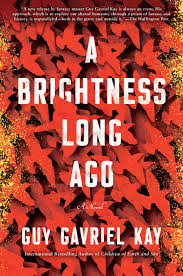
A Brightness Long Ago by Guy Gavriel Kay
Blackfish City by Sam Miller
America City by Chris Beckett
Warning: Spoilers Ahead (though, let's face it, if you're reading this anytime in the next day or so, you're probably on the bring of being sloshed while yowling Auld Lang Syne, or it's the morning after and you're completely hung over, so chances are, you won't remember the spoilers anyway).
---------------------------------------------
They Promised Me the Gun Wasn't Loaded by James Alan Gardner
In James Alan Gardner's first book of his Dark vs Spark series, All Those Explosions Were Someone Else's Fault, we were introduced to a world where vampires, werewolves, demons and other supernatural forces of evil were in control of the world's governmental, financial and cultural elite with their promise of power and eternal life, while superheroes (and occasionally mad geniuses) had risen to fight them. A group of four University of Waterloo roommates (including the story's focal point protagonist, Kim, a gender-fluid student who gains the power of near-indestructibility and the ability to shrink) is thrust into this conflict when they stumble across a scientific experiment gone awry, which gives them superpowers. Mayhem ensues. Good triumphs. Sort of.
Now, in book two, They Told Me the Gun Wasn't Loaded, the struggle continues, with the focus changing to another of the friends, Jools, a jock with what's possibly early-stage alcoholism who becomes peak human. Essentially, she's the best at everything a normal human could do. Instant Captain America-level mastery of every physical ability in any situation that arises, along with genius-level intellect and complete knowledge of every subject. Like the others, Jools is still coming to grips with her new abilities and their effects on her life when fighting and intrigue involving the forces of darkness leads her to the appropriately-named Transylvania Club (an actual venue in Waterloo) where she's kidnapped by a band of Robin Hood-themed superheroes gone rogue. While fending-off the sexual harassment of the team's leader, Jools has to not only figure out how to escape, but also come to grips with her identity and her right to choose who she is and what she'll become.
TTMTGWL is a worthy follow-up to ATEWSEF, and one hell of a read. Gardner knows how to put together a big, loud, fun mashup adventure while writing three-dimensional, believable characters and stakes that matter personally as well as holding the fate of the world in the balance. It's also a fast read, and one that burns brightly enough that it sticks out in my memory months later. I can't wait to read the next instalment in the series.
----------------------------------------------
A Brightness Long Ago by Guy Gavriel Kay
A Brightness Long Ago is another moment in time from Guy Gavriel Kay's fantasy world inspired by real history. It's a world with two moons, a little, fading magic, the occasional ghost or other supernatural creature, but otherwise a close resemblance to our own Medieval and Renaissance past. Here, we have the reminiscence of a nobleman from an analogue of Venice, who recounts his rise from being a nobody of common birth who lucked into a good education, and who, by happenstance, repeatedly finds himself caught up in the struggles between his world's version of the jostling Italian city states and their merchant and mercenary princes. One night, he finds himself in proximity to an assassination, and by helping the killer escape, he meets the love of his life: a noblewoman who he can never openly romance. The story takes us to palaces and taverns, staging grounds for sieges, and pivots around a high-stakes (and potentially lethal) horse race. In the end, our protagonist, now one of the movers-and-shakers of his world, reflects on what matters the most.
Kay is a brilliant writer and ABLO is an exquisitely-crafted story. It didn't make me cry like his previous novel, Children of Earth and Sky, did, but I came pretty close. Just go out and experience this book as soon as you can.
-------------------------------------------------
Blackfish City by Sam J Miller
Imagine if William Gibson and Cory Doctorow decided to get together and write a post-climate-disaster ecopunk story, with some ad-hoc family suggestions from Kit Reed, and a dash of Rob Grant & Doug Naylor humour. You'd have something approaching Sam J Miller's Blackfish City, a yarn about a biohacked woman who's psychically linked to an orca who comes to a floating Arctic city with a polar bear in tow, looking to find what's left of her family and exact revenge upon the corporate types who destroyed her people. Throw in a gutter punk courier, a rich kid coming down with what appears to be a collective unconscious-channelling cognitive disease, a washed-up fighter, a city bureaucrat who's trying to hold things together and help her sick mother, warring gangsters and rich guys, and a mysterious, illegal story about the city that its residents can't get enough of, and you're ready to go wading into Miller's future. Just make sure you get yourself a bowl of steaming noodles while you're there.
Miller's absorbing, thoughtful and entertaining story paints a future where humanity is barely treading water in a sea of its own mistakes in painfully real detail. But for all that, humanity is still treading water, and there is hope and meaning to be found, both for society and, most importantly, for the protagonists individually and as a thrown-together family. Definitely worth the read.
-------------------------------------------------
America City by Chris Beckett
In America City, Chris Beckett presents an all-too-believable future where, due to climate change and higher sea levels, the US Eastern Seaboard is evermore frequently knocked flat by super hurricanes, the Southwest has become a virtually uninhabitable desert, and Americans are starting to turn on each other. Amidst all of this, a liberally-inclined (at least, initially), British-born communications professional, Holly, is recruited by Senator Slaymaker, a straight-shooting, down-home, right-wing entrepreneur with a military past to help his bid for the US presidency. To set their candidate apart from the rest of the pack, Holly and the rest of Slaymaker's team manufacture from scratch a crisis with Canada. A crisis that develops into a land-grab in Canada's Iqaluit, Northwest, and Yukon territories, eventually the military conquest of most of the great white north. As Slaymaker's fortunes rise and the Old West-style invasion of Canada accelerates, Holly finds herself becoming the type of person she would never have imagined being, and losing more than just her old identity.
As always, Beckett does a masterful job of creating believable characters and situations, set in intricately-detailed worlds. For many readers around the world, America City will be a novel about faustian bargains individuals can make in pursuit of professional success and new challenges, about how people change over time, and about the consequences of environmental collapse. To Canadians like me, this novel reads like a horror story, outlining the all-too-plausible invasion of our country by the US, a nation that already tried — and failed — to do this in 1812, which has had its eyes on our oil, water and other resources for years, and which has its notion of manifest destiny (read continental domination) written into its constitution. As a former communications professional, I read this with an eye to Holly's ability to use storytelling and messaging to manufacture and manage a crisis, and found it entirely believable. Really, the novel itself could be used as a manual to create the pretext for an American invasion. And when seemingly rational Americans like Bill Nye start to casually talk about annexing parts of Canada, this story seems less like science fiction and more like a bleak prophecy.
Saturday, March 16, 2019
My Nominations for the 2019 Hugo Awards
Last night I got my Hugo nominations in with about three minutes to spare. With everything involved in my recent move, as well as everyday life, I just haven't had the time lately to consider the awards, never mind vote in a timely fashion. It was only the reminder email from the awards committee that came around that spurred me into action. To be fair, I didn't read as much new stuff in 2018 as I normally like to (consequently there are a large number of categories I've left blank), but I figured I'd nominate what I did read that really stuck out for me. Here's my two bits (listed, in each category, in no particular order):
Best Novel:
They Promised Me the Gun Wasn't Loaded by James Alan Gardner
Fire & Blood by George RR Martin
The Freeze-Frame Revolution by Peter Watts
The Night Lies Bleeding by MD Lachlan
Best Novella:
Gods, Monsters, and the Lucky Peach by Kelly Robson
Best Novelette:
(No nominations in this category.)
Best Short Story:
(Feeling really guilty about this, but no nominations in this category because I didn't read many new short stories in 2018.)
Best Related Work:
(No nominations here because, unfortunately, nothing that I read in 2018 really stood out in my memory [and, in all fairness, I don't think I read widely enough last year], and I think it's kind of in poor taste to nominate one's self, so I didn't nominate anything from my blog.)
Best Graphic Story:
(No nominations here because, although I read a few graphic novels last year, I don't think any of them were published last year for the first time — they were probably collections of comic issues published the previous year.)
Best Dramatic Presentation (Long Form):
Deadpool 2
(No other nominations because even though I saw a few other new sf films in 2018, I didn't think any were award-worthy.)
Best Dramatic Presentation (Short Form):
The Terror — "The Ladder"
Watership Down — "The Siege"
Castlevania — "The River"
Westworld — "The Passenger"
Sense8 — "Amor Vincit Omnia"
Best Editor (Long Form):
(No nominations because, sadly, I don't pay attention when a book is edited properly, only when it's edited poorly, and that's a shame because editors who do a good job deserve recognition.)
Best Editor (Short Form):
(No nominations. See above, although in the past I have nominated for this category if an anthology has been especially good; it's just that last year I didn't read any new anthologies.)
Best Professional Artist:
(No nominations. Didn't read/look at anything new.)
Best Semiprozine:
On-Spec
Best Fanzine:
(No nominations.)
Best Fancast:
The Coode Street Podcast
Radio Free Krypton
(Normally, I would have also nominated The Three Hoarsemen, but I don't think they put out four episodes last year. I also didn't nominate my own Invaders From Planet 3 podcast because, as stated above, I'm uncomfortable with the idea of nominating one's own work.)
Best Fan Writer:
(No nominations because nothing I read in 2018 stood out in my memory, and I think it would be in poor taste to nominate myself.)
Best Fan Artist:
(No nominations.)
Best Series:
(No nominations here because, at 3 or 4 minutes to the deadline and with a million other things on my mind, my brain just wasn't processing the rules around eligibility enough to make sense of them. In retrospect, there might be a series or two that I could have nominated, but it's too late to go back and change things now. Oh well. It's kind of a weird category anyway.)
The John W Campbell Award:
(No nominations.)
Now, whether enough of the rest of the voting Worldcon membership agrees for any of these nominations to make the final ballot remains to be seen (they often don't), but even if they don't, I think it's important to give a shout-out to what I think is the good stuff.
Good luck to everyone!
Labels:
awards,
books,
comics,
fantasy,
graphic novels,
Hugo Awards,
movies,
podcast,
science fiction,
short stories,
speculative fiction,
TV
Saturday, September 22, 2018
Concerning Hobbits — and Bachelors
Happy Hobbit Day, everyone ! I hope you've been able to celebrate the shared birthday of Bilbo and and Frodo Baggins with seven or eight stomach-explodingly large and delicious meals today.
Meals are, of course, the closest thing to a hobbit's heart — even dearer than genealogy, gardening, or xenophobic grumbling. And meals often form the heart of some of the most entertaining — and sometimes meaningful — moments in JRR Tolkien's The Hobbit and The Lord of the Rings novels, as well as Peter Jackson's cinematic adaptations of them. Who can forget the raucous feast of the dwarves as they barge into Bag End in TH, or the extravagant double birthday party that opens LOTR (interesting how both stories, regardless of their soft openings, get their real start with a meal)? Or Frodo & co dining with the elves under the stars as the flee the Shire in The Fellowship of the Ring? Or Sam and Frodo's meagre rations of lembas on their trek towards Mount Doom?
But the meal that's come to mean the most to me in recent years is Bilbo's sit-down just before the arrival of the first of Thorin's companions in The Hobbit. Not much is made of it in Tolkien's novel; just a mention that Bilbo was about to sit down to tea. Peter Jackson spends more time crafting this moment in The Hobbit: An Unexpected Journey though: in his version, Bilbo's sitting down to a quiet supper.
And craft is the right word for it. This is an exquisitely crafted little scene where we experience the quiet of the evening in a relaxed little community in an uneventful corner of the world, with Bilbo, the solitary bachelor, cooking his fish and a few side dishes, sitting down in a silence broken only by the murmuring snap of the fire and soft scrap of dishes, and preparing to eat, alone. The first time I watched that scene, it took my breath away. It only lasts a second or two before the dwarven assault on the pantry begins, but in those few seconds it captures entirely and perfectly the essence of bachelorhood. Here, in the comfortable silence and dim light of the hearth and candles, we see a man who is content, perhaps even happy with his life, but at the same time, probably unconsciously, feeling lonely and unfulfilled. Living life well enough, but somehow feeling that he wants more, even if he isn't aware that he's feeling it. Not an angst, but a calmly accepted and possibly forgotten absence. It is a state of being I've felt before as a bachelor, and these days, now that my marriage has collapsed, it's a feeling that's enveloping me again. It's a moment that's a universal statement about the bachelor experience (and probably that of bachelorettes, and, to some degree, possibly of widows and widowers, although those would be freighted with loss and more overt sadness).
Sure, there may be some of you out there reading this who say "I'm single and I couldn't be happier! That scene isn't relevant to me at all!" Okay. So be it. You can go back to writing your erotic sequel to The Mysterious Two then.
The rest of us, meanwhile, will take a little time to appreciate a cinematic moment that's beautifully filmed by Peter Jackson, and played confidently and subtly by Martin Freeman. No other film I've seen has ever captured the true feeling of bachelorhood as well as THAUJ — others are always moving too quickly when they set up a character's bachelor lifestyle; there's always a musical score or theme song that's trying to shoulder its way in front of the real, potentially meaningful content of the scene; the pace and cuts are frequently too quick to let the viewer experience the person's state of being; the tone is frequently engineered to mock the character (as in The 40-Year-Old Virgin), or, if the actor is playing it cool, to blatantly tell us that something is lacking in their deliberate detachment (like in Up in the Air). But as short as this moment is in THAUJ, within itself, it gives itself time to really let us experience a life and how that life feels in an honest and meaningful way. Say what you will about Jackson's Hobbit trilogy (and there are plenty of flaws), this is, as J Michael Straczynski's Vorlon Ambassador Kosh might say in Babylon 5, "One moment of perfect beauty."
One that's served up in a simple hobbit meal. Happy birthday, Bilbo.
Labels:
books,
fantasy,
Hobbit Day,
Lord of the Rings,
movies,
Peter Jackson,
The Hobbit,
Tolkien
Sunday, September 02, 2018
Final Episode of Excellent Prisoners of Gravity Documentary Now Online
The team at Radio Free Krypton has now posted/aired the final episode of its excellent documentary on Prisoners of Gravity!
Part four of "Inside the Orbit of Prisoners of Gravity" talks about the show's legacy, and asks the question of whether it could be done today. Interviewees include the PoG host and producers, author Robert J Sawyer, and fans — including me. For my part, I think, at least as far as Canadian fans go, the legacy of PoG is every sf-related, interview-oriented podcast and video log/Youtube show. Whether these shows follow the PoG template or go in their own directions, Commander Rick and his producers showed us that it could be done (nearly 30 years ago), and so all of us have escaped the world to our own little broadcasting/podcasting/vlogging space stations. We're all the children of Commander Rick (although I can only wish that I had his hair).
Thanks to Radio Free Krypton for putting this documentary together. As important as Prisoners of Gravity was 30 years ago, it's just as important now for fans to celebrate what the host and producers accomplished for the speculative fiction community — especially the Canadian sf community (though not exclusively so, since the show contained many interesting interviews with American and British sf and comics creators too) — and the legacy it created. It was the first time (at least in this country) where our community had a voice that showed the significance of its work, it was a voice that further connected our community, and it was a voice that could be heard/seen by people outside of our community. For Radio Free Krypton to document this achievement, and explore its ongoing relevance, is also important to our sf community. For that, the RFK team deserves an Aurora Award. And I'm not just saying that because they invited me to participate in this doc (although being part of this group does tickle me immensely) — I would have endorsed it anyway. It's that good.
Lastly, I think it's also important to thank TV Ontario for airing the show in the first place. During the first half of my childhood, in Ontario, I devoured TVO's programs (Hey, TVO introduced me to Doctor Who! That's why Tom Baker will always be my favourite.), and even after moving away and growing up, I can still see them for the quality shows they were. It's also important to thank BC's Knowledge Network for picking up PoG from TVO — without Knowledge, I wouldn't have seen the awesomeness of Prisoners of Gravity in its original run back in the late 1980s and early 90s. The value of public broadcasters is incalculable.
If you haven't listened to "Inside the Orbit..." yet, head over to Radio Free Krypton and do so! And if you've never seen an episode of Prisoners of Gravity, what are you waiting for? Punch it up on Youtube and watch one, or three, or all of them! Thirty years on, it's still as relevant, thought-provoking and entertaining.
Labels:
books,
broadcasting,
comics,
fantasy,
horror,
movies,
podcast,
Prisoners of Gravity,
radio,
Radio Free Krypton,
science fiction,
TV
Thursday, September 28, 2017
Goodbye and Thank You, Kit Reed
Sometimes life pounces on you like an automatic tiger.
On Sunday, I'd just finished writing something for a client and decided to catch up on gossip on Facebook. A minute after logging in, it felt like I'd been kicked. My wife, hearing me say "Oh no", came in, and asked what was wrong. Kit Reed had died.
The news, posted to her feed by her son Mack, was that she'd gone in her sleep, at 85, after a battle with brain cancer.
Kit was one of my favourite authors. There are a lot of writers whose work I like. There are a few I absolutely love. Beyond that, there is a select core of absolute favourites — the ones whose work penetrates the deepest, and resonates once it gets down there so hard that it rewires my brain. Authors whose books are so damn good that I'm willing to push just about everything else on the to-be-read pile out of the way so I can crack them open as soon as they're available. Kit was one of those.
My first encounter with her work was her novel Thinner Than Thou, probably back in 2006. I don't recall whether I read about it online, or if it just caught my eye on a shelf at the bookstore, but the title just grabbed me, and after devouring the first page, I had to have it. The frankness, the cynical humour, the unflinching examination of what makes people tick and the hypocrisy of society and its portrayals of — and judgements of — weight and body image, the intelligence of the book, and its ability to be deeply dark while still allowing the possibility of hope and redemption were all served up masterfully. The descriptions of a landscape overrun by suburbs and identical mini-malls conjured up the Pretenders' song "My City Was Gone" as the relentless soundtrack to the Abercrombie family's trek to rescue Annie. William Gibson may have talked about the post-industrial tech midden of the east coast sprawl in his cyberpunk novels, but Kit's endless strip malls, though more tame in appearance, were more apocalyptic for their visceral, banal realness and inevitability.
After that, I snapped up every Kit Reed book that I could find.
It would be easy to talk about Kit as an author in comparison with literary giants of the past. She was as incisive as Thackeray, with her surgical dissection of American upper-middle-class individuals in their suburban community in Son of Destruction being as keen as the examination of its Victorian England counterparts in Vanity Fair. Their masks, self-delusions, hypocrisies, crimes, weaknesses and flaws laid bare and catalogued, the characters are then probed deeper for possible (but not guaranteed) signs of hidden strengths or redemption. In her collections The Dogs of Truth and The Story Until Now, she sometimes conjured images as soulful and melancholy as anything from Poe or Hardy. And, in everything she wrote, Kit had the ferocious, merciless wit of Twain. But her voice was all her own. Even when she played with different styles of writing, skipping gleefully and unpredictably between subjects as varied as rampaging giant babies, nocturnal visits from zombie princes, the hunts of feral girl scouts, and the hijackings of entire towns to pale alternate dimensions, you always knew you were reading a Kit Reed story.
There were two tropes in particular that were hallmarks of her stories: the transformation of banal settings into the surreal; and the notion that it's inherently dangerous for an individual to be completely isolated from a group, even if that group is itself in a dangerous situation or place, or making questionable choices. We see these tropes come up again and again in her work, especially her novels, from the theme park secretly doubling as a reality show in Magic Time, to the disease outbreak at the private school/mountaintop prison in Enclave, to the various types of hauntings taking place at the family home/trap in Mormama. Each time, Kit would pick up these tropes and re-examine them from different angles in an attempt to reveal something new and interesting about human beings, and how they behave and see the world — and each other — from within and outside of groups.
Over the years, I had the pleasure of getting to know Kit a little beyond her stories. It started when Mack came across an online review I'd written for one of her books, got in touch, and connected me to her via Facebook. She was warm, sharp, funny, and genuine, and I always enjoyed chatting with her about her stories (I still remember one day when she mentioned someone was trying to get Thinner Than Thou banned from some school somewhere in America, and I replied that it should be required reading — especially at the high school level) or what made a con just the right size to attend, or reading her posts about everyday life — from heading out to the matinee to catch some over-the-top popcorn flick, to baking for company, to the continuing adventures of her little dog, Killer.
It was also an honour and a real pleasure when I had the chance to interview her for an episode of my podcast, Invaders From Planet 3. We talked about a lot of things — the stories that were early influences, her career as a journalist, her own writing — but I think my favourite part of our conversation came near the end when we talked about comics. I listened that episode again the other day when I was in the car, and you can hear her just light up and get so excited talking about Preacher and other comics. Those are the kinds of moments that turn an interview into a delight.
And then the news came down that she was gone. No more new Kit Reed stories to challenge and entertain us. No more warm, thoughtful personality for the rest of us to orbit, whether at the distance of the internet, or — for those luckier than I, who knew her as a friend, family member, or mentor — more closely in person at her home, the university, or cons. Sure, there are other intelligent, entertaining authors who are great people to get to know, but the speculative fiction community is still diminished because she is gone. But then I look over at my bookshelf, at all of her wonderful stories waiting patiently to be revisited, and I think how lucky we all were to experience her work, and to get to know her as a person, if only for a while. And I'm grateful for that.
Thanks, Kit.
Labels:
books,
comics,
Kit Reed,
short stories,
speculative fiction
Tuesday, August 08, 2017
Winners of the Dark Tower Giveaway
Congratulations to the winners of the Dark Tower Giveaway, Geordie Howe and Carol Williams!Carol and Geordie have each won a copy of Stephen King's The Gunslinger (the first book in his The Dark Tower series), courtesy of Simon & Schuster Canada.
Enjoy!
Labels:
books,
Dark Tower,
giveaway,
Gunslinger,
Stephen King
Sunday, October 04, 2015
VCon Day 2 - Wake up! Time to buy!
When you allow yourself to drift into the dealers' room at a con not once, not twice, but three times, there's no way you're going to leave financially unscathed. Today, I was scathed. Oh so scathed.The day started a little later than I'd intended. No surprise there — that's the story of my con-going life. I'd wanted to arrive around 10 this morning, because VCon's programming looked pretty good right off the block this year. But with last night's blogging, followed by reading, and a leisurely get-up this morning, 10 turned into 11:30 by the time I rolled in the door. That was the first time the dealers' room got me.
Oh, it started off innocently enough... I'd gone in to drop-off a care package: my wife makes chocolates and other confections, and she'd sent me with some treats to give to our friend Walter at the White Dwarf Books table. Which was fine. Except the coolness emanating from the Cat's Knitting table dragged me over like tractor beam from a Dalek command ship: there was a set of cool Doctor Who-themed scarves that I knew my wife would love. With our tenth anniversary coming up, the outcome was a forgone conclusion. So the wallet came out, and I bought her a black scarf with red trim, a red Dalek, and the word "Exterminate" woven into the pattern. Deadly stylish.
At noon I hit my first session of the day. Sessions, as a matter of fact. I started by trying to go to the "Science of Time Travel" panel, but the room was packed, some video was playing (for quite some time), and my space along the wall didn't allow me to see the screen, so I abandoned ship in favour of something else. The next option was the Joe Haldeman reading. Definitely worth going to. Haldeman read an excerpt from a new book he's working on called Phobos Means Fear, and showed the audience the notebook he's using to write the thing out. Bonus points to him for still doing most of his manuscripts in pen. Extra bonus points for his wicked sense of humour — Haldeman frequently had the audience in stitches during the Q&A afterward.
Heading out into the hall when it was done, it struck me that VCon feels smaller this year. Not as many people as you'd normally see on a Saturday, and not as many in costume. I can't back this up with numbers, but that was my impression. Not sure why it would be smaller this year (if it is) but while it wasn't crowded, the turnout at least looked respectable. And while there weren't as many costumes as I'm used to seeing, there were a few, and some of them were pretty good. I got a kick out of seeing someone dressed as Ratchet, the Autobot medic from Transformers. It could only have been better of it was capable of transforming, but that's a pretty tall order. Later on, just before I left this evening, there was a couple sporting intricately made Time Lord robes. I'm not a cosplayer myself, but I certainly respect good workmanship and people who have a real passion for their outfits.
And speaking of a dedication to fannish pursuits, I've got to give credit to a couple of folks in the games room, who wanted to get a group game of Magic The Gathering going so badly that they came out into the hall to try to recruit people to come in and play. One of the guys approached me, but since I haven't played Magic since university 20-odd years ago, and back then I played it poorly, I had to politely decline. But I certainly appreciated the invite. That's one of the things I like about VCon: it's not the biggest convention in the world, but most of the people who go are friendly and welcoming.
After a quick lunch, I was back at the hotel to take in the taping of an episode of the Caustic Soda podcast. What? You're not listening to Caustic Soda? Go and download an episode now. Seriously. Minimize this window, go to the show's website or iTunes, download an episode on whatever uncomfortable topic seems most interesting, and hang on for the ride. This time around was a little different, with only one of the regular hosts present, supported by a panel of guests, but ultimately the show worked, and was a good mix of information and entertainment delightfully skirting bad taste.
The show ran just over an hour, so when it was done, rather than jump into another session midway through, I drifted back into the dealer's room. Do I need any more books to add to my to-be-read pile? No. Did I buy some. Yes. Because I have no power to resist a good bookstore/stall. So I picked up an anthology of Canadian speculative fiction (a book with the highly inventive name Canadian Tales Volume IV) from the SF Canada stall, and then, from White Dwarf, a copy of Haldeman's A Separate War and Other Stories and the Chinese-themed anthology The Dragon and the Stars, edited by Derwin Mak and Eric Choi. It wasn't too long before I was then browsing at antiquities and replicas of antiquities at the Gaukler Medieval Wares stand, and doing my best to fight the temptation to buy something there. Because as much as I may want an authentic Viking-era ice skate carved from some animal's thigh bone, it would be hard to make the case that I actually need to have it... although part of me thinks that I do actually need to have it (though ultimately my wallet won-out on behalf of the "no" side of the debate). It was a long battle too — I was probably there for the better part of half an hour, shooting the breeze with the owner about various historical knick-knacks. But I held firm. For a while, anyway.
To wrench my attention away from the lure of shiny things, I did a circuit of the art room. As usual, it was a mix of very nice work alongside stuff that, well, just isn't what I'd put on my wall or in my display case. But to each his/her own.
By 5pm it was time for the "Justify the Science Flaw" panel, an annual tradition at the con, and a session that's become one of my favourites over the years. This year's panel was made of a large and diverse collection of experts, and it was pretty funny seeing them stretch science to its limits to try to plausibly explain things like the salt vampires from the old Star Trek series, or how the nightfall in the classic Isaac Asimov short story "Nightfall" could actually work if you juggled the orbit of a planet, its gaggle of local stars, and maybe a moon or other planet just right.
I'd been doing some thinking about what I'd seen in the dealers' room, so after the JTSF panel let out I went back to the Gaukler table. As I mentioned earlier, my anniversary's coming up, and I thought I needed to get my wife a little something more than a scarf. She's been mentioning lately that she'd like a nice pendant, and I saw a really nice brooch with nine amethysts (a replica of an actual piece from the Anglo-Saxon period in Britain) that could easily be repurposed with the addition of a chain. The price was right, so I completed my anniversary shopping. From the rib-crushing hug I received when I got home, I think it did the trick.
Initially, I'd intended to hang around for the Masquerade at 7pm, but after waiting around in the hall with half of the other con attendees for 20 minutes with still no sign of it getting under way, I gave up and left to find some supper and go home. Sure, I could have stuck around for a while longer for the costume show, or gone to a room party, or had dinner and come back for a late panel (the late evening "Sophisticated Insults for More Dignified Folk" session looked particularly appealing), but I'll freely admit I'm at that point in life where something's gotta be pretty spectacular to keep me around in the evening, when really, all I want to do is go home, see my wife, have supper, relax for a little bit, then do some blogging or reading before hitting the sack. Let the others hold up the party banner. I've been there, done that, and got the t-shirt. Speaking of bed...
Tuesday, July 14, 2015
Now with More Irregularity
I'm irregular!
Wait, that doesn't sound good for anybody.
I'm an irregular!
Still not quite right. Sounds like a downtrodden caste in some dystopian YA novel. Let's try something else...
I'm one of the Irregulars!
Yeah. That'll do.
A bit of good news to pass along: I've been invited to join the most ancient and esteemed order of the SF Signal Irregulars.
As many of your know, I've been a big fan of SF Signal for a long time – since shortly after it was launched, in fact. John and his team of contributors, known as the "Irregulars," have been offering up interesting reviews, engaging discussions, eminently listenable podcasts, and plenty of nerd-related news for 12 years now.
During that time, I've left the occasional comment, and it's been my privilege to have participated in a couple of Mind Melds. Not too long ago, John floated the idea of my joining the Irregulars, and I had to ask myself "Self (because, in the words of the late, great George Carlan: I do so enjoy good conversation), how can I say no?" Well, I couldn't! Who wouldn't want to be part of this awesome team?
So here we are, all Irregular. For starters, I'll be one of the site's army of book reviewers, but there may be opportunities for other things later – we'll see whether they can tolerate my Canadian spelling, awful sense of humour, and steadfast refusal to give up my worship of donuts in favour of bagels. Seriously though, I'm pretty excited about being a small part of SF Signal.
Really seriously though: donuts are much better than bagels.
Meanwhile, I'll continue to blather away here on bloginhood.com as usual. More mini book reviews, the occasional rehash of Saturday morning cartoons, grumblings about movies and TV shows, exhausted mumblings at the end of the day from whatever con I happen to be attending, and whatever else catches my attention. And I'm working on something special for later this year or early next... but no spoilers.
Stay tuned for more sf goodness both here and on SF Signal.
Irregulars... that's a lot better than being one of the Expendables. Less chance of getting dysentery crawling through some bacteria-infested creek somewhere with bad guys shooting at you. That'd be like having to eat bagels.
Subscribe to:
Posts (Atom)