Showing posts with label superheroes. Show all posts
Friday, February 14, 2020
Invaders From Planet 3 - Ep 36 - Walter Jon Williams
Author Walter Jon Williams joins us in this episode! We talk about his first loves in science fiction, including Heinlein's Have Spacesuit — Will Travel and John Schealer's Zip-Zip Goes to Venus. And Walter tells us about his evolution as a writer: from feeling the compulsion to write at age 3, to getting a rejection letter from the editor of The New Yorker, to writing historical fiction novels, to getting into sf. He also reflects on the nature of his compulsion to write, including finding a balance between the business needs of writing and the compulsion, and eventually watching the compulsion die.
We also talk about the universe of science fiction publishing, and the change from the days of limited selection to today's huge output of stories, and the challenges of maintaining a sense of what the community is talking about. We discuss Walter's time in the spotlight in the 1980s when his cyberpunk novel Hardwired garnered love and hate. And he shares the story of his involvement in the Wild Cards mosaic superhero novels, including his coining of "toaster" as a derogatory term for androids.
And Walter shares some details from his two newest novels, Quillifer the Knight (published in late 2019), and the latest, as-yet-untitled Praxis novel, due later this year.
Our conversation took place in the impromptu studio of bloginhood in the Dublin convention centre last summer at Worldcon 2019.
To learn more about Walter and his novels, visit his website:
www.walterjonwilliams.net
To listen to Invaders From Planet 3, or to subscribe, visit Libsyn, iTunes, or your other favourite podcatching service. Be sure to rate and review us while you're there!
Let the Invasion begin!
Tuesday, December 31, 2019
The Best Books of 2019
In the final hours of the decade, it's dawned on me that I haven't posted any book reviews in a while. I make no apologies for this. Between, travel (Worldcon!), going back to school (like that great sage of yore, Rodney Dangerfield), grief (the unexpected death of my four-year-old cat, Ripley, while in the vet's recovery room after a routine teeth-cleaning procedure) and other happenings in life, I just haven't had the time. But, with a few moments before I head out to celebrate the New Year, I thought I'd highlight my favourite science fiction and fantasy reads of the past year (though, admittedly, not all of them were published in 2019). There were other sf books I enjoyed, but these are the ones that stand out in memory, and they're the ones I'm consistently recommending to others. They are:
They Promised Me the Gun Wasn't Loaded by James Alan Gardner
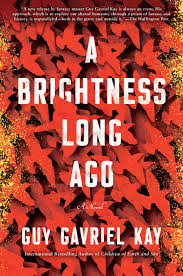
A Brightness Long Ago by Guy Gavriel Kay
Blackfish City by Sam Miller
America City by Chris Beckett
Warning: Spoilers Ahead (though, let's face it, if you're reading this anytime in the next day or so, you're probably on the bring of being sloshed while yowling Auld Lang Syne, or it's the morning after and you're completely hung over, so chances are, you won't remember the spoilers anyway).
---------------------------------------------
They Promised Me the Gun Wasn't Loaded by James Alan Gardner
In James Alan Gardner's first book of his Dark vs Spark series, All Those Explosions Were Someone Else's Fault, we were introduced to a world where vampires, werewolves, demons and other supernatural forces of evil were in control of the world's governmental, financial and cultural elite with their promise of power and eternal life, while superheroes (and occasionally mad geniuses) had risen to fight them. A group of four University of Waterloo roommates (including the story's focal point protagonist, Kim, a gender-fluid student who gains the power of near-indestructibility and the ability to shrink) is thrust into this conflict when they stumble across a scientific experiment gone awry, which gives them superpowers. Mayhem ensues. Good triumphs. Sort of.
Now, in book two, They Told Me the Gun Wasn't Loaded, the struggle continues, with the focus changing to another of the friends, Jools, a jock with what's possibly early-stage alcoholism who becomes peak human. Essentially, she's the best at everything a normal human could do. Instant Captain America-level mastery of every physical ability in any situation that arises, along with genius-level intellect and complete knowledge of every subject. Like the others, Jools is still coming to grips with her new abilities and their effects on her life when fighting and intrigue involving the forces of darkness leads her to the appropriately-named Transylvania Club (an actual venue in Waterloo) where she's kidnapped by a band of Robin Hood-themed superheroes gone rogue. While fending-off the sexual harassment of the team's leader, Jools has to not only figure out how to escape, but also come to grips with her identity and her right to choose who she is and what she'll become.
TTMTGWL is a worthy follow-up to ATEWSEF, and one hell of a read. Gardner knows how to put together a big, loud, fun mashup adventure while writing three-dimensional, believable characters and stakes that matter personally as well as holding the fate of the world in the balance. It's also a fast read, and one that burns brightly enough that it sticks out in my memory months later. I can't wait to read the next instalment in the series.
----------------------------------------------
A Brightness Long Ago by Guy Gavriel Kay
A Brightness Long Ago is another moment in time from Guy Gavriel Kay's fantasy world inspired by real history. It's a world with two moons, a little, fading magic, the occasional ghost or other supernatural creature, but otherwise a close resemblance to our own Medieval and Renaissance past. Here, we have the reminiscence of a nobleman from an analogue of Venice, who recounts his rise from being a nobody of common birth who lucked into a good education, and who, by happenstance, repeatedly finds himself caught up in the struggles between his world's version of the jostling Italian city states and their merchant and mercenary princes. One night, he finds himself in proximity to an assassination, and by helping the killer escape, he meets the love of his life: a noblewoman who he can never openly romance. The story takes us to palaces and taverns, staging grounds for sieges, and pivots around a high-stakes (and potentially lethal) horse race. In the end, our protagonist, now one of the movers-and-shakers of his world, reflects on what matters the most.
Kay is a brilliant writer and ABLO is an exquisitely-crafted story. It didn't make me cry like his previous novel, Children of Earth and Sky, did, but I came pretty close. Just go out and experience this book as soon as you can.
-------------------------------------------------
Blackfish City by Sam J Miller
Imagine if William Gibson and Cory Doctorow decided to get together and write a post-climate-disaster ecopunk story, with some ad-hoc family suggestions from Kit Reed, and a dash of Rob Grant & Doug Naylor humour. You'd have something approaching Sam J Miller's Blackfish City, a yarn about a biohacked woman who's psychically linked to an orca who comes to a floating Arctic city with a polar bear in tow, looking to find what's left of her family and exact revenge upon the corporate types who destroyed her people. Throw in a gutter punk courier, a rich kid coming down with what appears to be a collective unconscious-channelling cognitive disease, a washed-up fighter, a city bureaucrat who's trying to hold things together and help her sick mother, warring gangsters and rich guys, and a mysterious, illegal story about the city that its residents can't get enough of, and you're ready to go wading into Miller's future. Just make sure you get yourself a bowl of steaming noodles while you're there.
Miller's absorbing, thoughtful and entertaining story paints a future where humanity is barely treading water in a sea of its own mistakes in painfully real detail. But for all that, humanity is still treading water, and there is hope and meaning to be found, both for society and, most importantly, for the protagonists individually and as a thrown-together family. Definitely worth the read.
-------------------------------------------------
America City by Chris Beckett
In America City, Chris Beckett presents an all-too-believable future where, due to climate change and higher sea levels, the US Eastern Seaboard is evermore frequently knocked flat by super hurricanes, the Southwest has become a virtually uninhabitable desert, and Americans are starting to turn on each other. Amidst all of this, a liberally-inclined (at least, initially), British-born communications professional, Holly, is recruited by Senator Slaymaker, a straight-shooting, down-home, right-wing entrepreneur with a military past to help his bid for the US presidency. To set their candidate apart from the rest of the pack, Holly and the rest of Slaymaker's team manufacture from scratch a crisis with Canada. A crisis that develops into a land-grab in Canada's Iqaluit, Northwest, and Yukon territories, eventually the military conquest of most of the great white north. As Slaymaker's fortunes rise and the Old West-style invasion of Canada accelerates, Holly finds herself becoming the type of person she would never have imagined being, and losing more than just her old identity.
As always, Beckett does a masterful job of creating believable characters and situations, set in intricately-detailed worlds. For many readers around the world, America City will be a novel about faustian bargains individuals can make in pursuit of professional success and new challenges, about how people change over time, and about the consequences of environmental collapse. To Canadians like me, this novel reads like a horror story, outlining the all-too-plausible invasion of our country by the US, a nation that already tried — and failed — to do this in 1812, which has had its eyes on our oil, water and other resources for years, and which has its notion of manifest destiny (read continental domination) written into its constitution. As a former communications professional, I read this with an eye to Holly's ability to use storytelling and messaging to manufacture and manage a crisis, and found it entirely believable. Really, the novel itself could be used as a manual to create the pretext for an American invasion. And when seemingly rational Americans like Bill Nye start to casually talk about annexing parts of Canada, this story seems less like science fiction and more like a bleak prophecy.
Saturday, June 01, 2019
It's a Mad, Mad, Mad, Mad Avengers Movie
It's been nearly a month. Is it okay to talk about Avengers: Endgame yet? If you're one of the six people who hasn't yet contributed to the film's Galactus-like annihilation of the box-office, I'm splitting this belated review into spoiler-free and spoiler-rich zones so your eyes and brain won't turn to dust as though Thanos had just snapped his begauntleted fingers.
First, a general, non-spoilery impression. Yes, Avengers: Endgame is, for the most part, pretty good. You can go to your local cinema and give your coin to the Mouse and be assured you'll get your money's worth, even if your favourite character in the Marvel universe doesn't necessarily get as much screen time as you'd like.
The story picks up on the heels of Infinity War and Thanos' deranged ultimate fan tribute to a certain song by Kansas while exterminating half of all living things in the universe. Now, our heroes must first live up to their names and avenge the genocide (Which also begs the question, does Damage Control have to live up to its name and mission and sweep up after said genocide? You know somebody in the Marvel universe probably became the most laid-back super villain ever just by running out and cornering the market in broom and mop company stock in the wake of the tragedy, and it was probably up to Damage Control to work around that with some grand, high-tech vacuuming scheme.), then come to terms with their new reality and themselves before embarking on a last-ditch effort to make things right. Souls are searched. Butts are kicked. Comic fans are serviced. Tacos are enjoyed.
But, naturally, with a cast this huge in a movie format rather than a multi-episode TV series or season, there are time constraints, which means, as mentioned above, not everybody gets equal time in the spotlight. Not necessarily all of your favourite characters. Not necessarily all of mine. But maybe some of them. And that's just the reality of having a cast of thousands (well, dozens anyway), all of whom are big personalities with complex backstories and stunning signature moves that depend on dazzling special effects. Not everyone is going to get all of the screen time they probably deserve. And that's okay. With a runtime of just over three hours, the writers, directors and producers had to decide on a focus, and while making justified nods to characters relegated to supporting roles, keep that focus on those they deemed most important for the resolution of the story they wanted to tell. Maybe you disagree with their decisions. That's fine. That's what DVDs and digital downloads are for. Wait for the film to come out on video and you can re-edit the thing to make your own fan version by using footage from the movie cut and shots from deleted scenes from your favourite character's earlier moments or standalone films. Have fun with that. But the fact of the matter is that directors/writers/studios and entitled to make the films they want to make, and with a cast of thousands, that means unequal screen time. And this isn't unprecedented. Films these days may have ensemble casts, but they tend to be pretty tight in terms of character arcs within the story, and those casts aren't ultimately that big. But if you go back to the 1990s with Dazed and Confused, and further back to the 1980s with The Cannonball Run, or way back to the 60s with the comedy I've alluded to in the title of this post, It's a Mad, Mad, Mad, Mad World, you'll see that directors have had to juggle hugely talented huge casts across stories in a limited amount of time. And, as good as these examples are, really, the best example of a film that had to juggle a cast this large (in fact, its cast was probably larger than that of 'Endgame) where the characters had this many individual arcs in this many separate storyline segments as part of a larger overall plot, is 1962's The Longest Day (an excellent film, by the way — one I'd recommend that you find on whatever streaming service carries it, or gathering dust on someone's DVD shelf somewhere, especially with June 6th coming up). Roddy McDowall's private daydreaming of the June nights of his youth, Irina Demick's Resistance bombshell drawing the attention of German soldiers away from their own destruction, Major Pluskat and his dog guarding the Channel, Colonel Priller the cantankerous Luftwaffe pilot, Sean Connery's mouthy Irish private, the French commandos, the Mother Superior and her nuns, Red Buttons — all of them and more could have made larger contributions that would have made the movie even more interesting. But there's a point where the director(s) must draw the blade across the film strip. And Avengers: Endgame has done probably the best job it could maintaining its focus on the characters it needed to in order to complete the main story, and bring to a close the overall main universe story arc that started with Ironman, fed through into the first Captain America movie, and really set its course in The Avengers.
One minor caveat though: there are some who, in the throes of fannish ecstasy, have claimed that 'Endgame is such a towering achievement that it will change the face of moviemaking forever. They're entitled to their opinion, but I tend to shy away from this kind of hyperbole and my gut tells me, in this case, that I disagree. Is the final (at least, at this point) Avengers movie a big deal? Unquestionably. A lot of effort went into pulling multiple storylines together and it mostly paid off. Mostly. It has certainly paid-off at the box office. But I don't think it will necessarily change the way superhero movies (or, more broadly, action movies or science fiction movies, or movies in general) are made, or audience expectations of, or complaints about, them. There will be one-off adaptations like Watchmen. There will be more ensemble movies spanning multiple instalments like Avengers has — maybe with several individual movie stage-setters, maybe not. There will be darker-toned films like whatever the next incarnation of Batman will be, and there will be lighter fare like the gloriously irreverent Deadpool movies. We'll see more humorously weird adventures running the gamut from the reasonably mainstream Guardians of the Galaxy-type movies, to the more offbeat and cult-destined like Mystery Men and TV shows like the anime One Punch Man, or the various incarnations of The Tick. We'll see big budget, wide-open and light fare like the new Spider-Man movies, and smaller, more frugal and claustrophobic stuff like Netflix's (sadly cancelled) Daredevil series. Personally, I'd like to see Misfits of Science make a comeback in some form. Ultimately, filmmakers/studios will make what they want and are able to make, and audiences will watch their offerings or not. Avengers: Infinity War/Endgame will certainly be a milestone along the road of comic book, science fiction, and action movies and TV shows — it may even be a towering monument — but I don't think it will change the course of that road or the way films are made.
Regardless of who gets the most screentime or how it affects moviemaking, 'Endgame is worth paying full price to see at the theatre.
Oh, and before we move on to the spoilers, here's a pro tip: When I went to see it, immediately before the film started, one of the theatre staff came to the front and announced that if anyone was worried about running out for a washroom break in a film this long, her recommendation was that they leave around either the 55 minute or the 1 hour and 45 minute mark. After the fact, that seemed about right to me.
Now, if you don't like spoilers, you can go back to adapting Manimal into a colouring book for adults.
WARNING: FROM HERE ON OUT, THERE WILL BE SPOILERS
Now, turning to a more in-depth dissection of Bill & Ted's Superheroic Romp, er, Avengers:Endgame, where, just like the Wyld Stallyns and sit-up champ Chuck De Nomolos, the Marvel heroes too can apparently play the time game.
Some general thoughts:
The Good:
There were some elements of fan servicing, specifically for the actual comics fans in the audience, that worked nicely. The first was presenting Bruce Banner five years after the dusting as the Merged Hulk/Professor Hulk. As somebody who was collecting Hulk comics back in the early 90s, I appreciated the filmmakers using this old plot thread as a way to develop Banner's character. Having Banner say something to the effect of having worked some things out was as succinct a nod to the comic as possible, without getting into the whole examination of the Green Hulk, the Grey Hulk/Joe Fixit, and Banner as a Freudian id/ego/superego manifestation as a reaction to childhood abuse. And the fact that they had him grumble about Hulk's old smashing habits was funny. The next treat for comics fans, though from a far more recent storyline, was Cap saying "Hail Hydra" in the elevator, as an homage to the Secret Empire storyline (which I didn't follow). Lastly: Howard the Duck. Those of us who know about Howard's long association with the superheroes of Marvel Comics (especially his team-ups with She-Hulk) thought it was just ducky when Howard made a cameo on Guardians of the Galaxy in the wreckage of The Collector's gallery. And now, here at the end of all things, when Black Panther, Doctor Strange, Starlord and the others lead a legion of warriors from the dust returned to do battle with 2014 Thanos' armies, Howard is among them. The shame of it is that in all of the action, I missed seeing Howard among the crowd. In fact, I left the theatre mildly disappointed that he wasn't (I thought) going to make a cameo in 'Endgame. Thankfully, the internet put my mind at ease — I checked when I got home, and someone had already posted a grainy picture of Howard emerging from a portal behind The Wasp along with a bunch of other honked-off fighters, and I felt better. When I eventually do a rewatch, I'll be doing a little duck hunting — paying extra close attention to the backgrounds of the scenes from the final battle to see if I can spot Howard myself. At any rate, I'm happy he made it in, even if the Jade Giantess isn't fighting by his side.
Speaking of heroes back from the dust bin, I also really liked Spider-Man's contributions to the final act of 'Endgame. Peter and TChalla's game of Infinity Gauntlet rugby/football was entertaining as all hell, even for someone like me who isn't a sportsball fan. It's a wonderful, memorable, truly comic book-style scene. Spider-Man also kicked a lot of ass in that fight, though it was an interesting move for the writers to change the character slightly so that he was willing to give his a.i., Karen, permission to activate her lethal mode. I don't claim to be an expert on Spider-Man. I collected some Spider-Man titles back in the late 80s and early 90s for a while, including Todd McFarlane's series, and based on those, and the various animated TV series, and the movies, and other mentions over the years, I've always gotten the impression that the Webslinger had a pretty strict no-kill policy. In fact, I seem to recall one comic where Peter gives Ghostrider or some other badass shit about his willingness (along with that of others like Wolverine and the Punisher) to kill. I guess when it's an invasion of aliens whose boss has already slaughtered you and half the universe's population, scruples like that go out the window, and it's hard to argue with that position. Peter being distraught over Stark's death was also touching, not only helping to tie up Tony's character arc as a former jerk developing into a father/father figure, but also adding poignancy to Spider-Man's own story: he now has to deal with the loss of a third father. One (his biological father) would be bad enough; two (Uncle Ben) would be hell; but Peter has to deal with losing three (now Tony), which is obviously crushing. This really hits home in the slow pan of the crowd at Tony's funeral when Peter and Aunt May are standing side by side, and you realize how many times this poor teen and the wonderful woman who is raising him have had to stand in black and say goodbye to someone before. But even though Peter's still a kid, he's a hero, so he keeps going.
The image of Peter as a hurt kid gave rise to another enjoyable moment in the film: the ladies' lineup of death. Spidey's been surrounded and overwhelmed by bad guys, and it looks like it's the end, when suddenly most of the female heroes appear and come to his rescue, bringing the pain. Yes, it's a scene that's mildly pandery: like the writers and directors were worried that if they didn't give the women warriors their due in terms of screentime asskicking, then critics and female fans might be upset. That all of the female heroes were going to assemble in the spotlight at the front of the screen and wreak absolute carnage to come to the rescue of a male counterpart, in order for the filmmakers to avoid accusations that women were yet again getting short shrift in yet another comic book story about boys. Perhaps it would have been more effective, and less on-the-nose, to give each of the various women more screen time with their own individual moments of heroic battle glory, interspersed with the fights of the male warriors, to more adeptly show that they're all equals and all crucial to saving the universe. And yet, the scene was executed so well and was so entertaining to watch, and these female super heroes did deserve some extra, dedicated screen time to kick ass because they hadn't had much of the limelight previously in this story that focussed primarily on two men (Cap and Stark). When they line up to protect Peter from the alien army, it's like watching a nature doc of an adolescent lion finding himself in over his head against a group of hyenas, only to have the lionesses arrive with claws and fangs and fury because nothing messes with the cubs of their pride and lives to tell about it. This scene adds an extra dimension to their fight, putting them metaphorically in the roles of mothers of the Marvel universe, defending it from invading predators.
Another scene that's generated a lot of discussion that I thought worked well was the death of Black Widow. Beyond the entertainment value of seeing who can outfight and outwit the other, Natasha's death was a good one because it was freighted with meaning. Not only did she die to get the soul stone for the Avengers' version of the Infinity Gauntlet, she sacrificed herself for her friend. Not merely to save his life, and not simply to make him happy by bringing his family back, but to make Clint whole again by brining his family back. To heal him. And isn't this neat symbolically in that it puts Hawkeye's life and the gauntlet in parallel, allowing them both to be rebuilt. One also might wonder if this is Natasha in some way thinking that her death will be appropriate in allowing Clint to focus entirely on his family... There's always been, at least to me, some uncertainty as to the backstory of the relationship between these two. Are they merely very close friends who, because of what they've been through over the years, share a bond and a love that's not romantic, but something as close in its own unique way? Sort of a Frodo and Sam thing, or a pre-sex Mulder and Scully relationship? That, like Frodo's going into the West, Natasha's death allows Clint to focus solely on his family? Or is it possible that at some point in the past Natasha and Clint did have a romantic/sexual relationship, and the ghost of that was always haunting them, even as he loved his wife and family and she was welcomed among them as family? Was this Black Widow's way of removing herself from the picture to try to clear that possible red from her ledger? Or was there no romantic/sexual history, and this was Natasha doing a very pragmatic emotional calculation that there would be little point in allowing Clint to die to retrieve the soul stone to reassemble the gauntlet and resurrect the dusted, only to have his family confronted with a new lease on life without him? I don't know. Any of these possibilities makes equal sense. One more mystery for a career spy to take to her grave, which is appropriate. Getting back to the issue of superheroic gender politics, Black Widow's death was also a good decision for the story because it means that a woman gets to be not only a hero, but one of the very few heroes who makes the ultimate — permanent — sacrifice to save the universe. In laying down her life to retrieve the soul stone, Natasha is on par with Tony in his death. And that fact that her sacrifice is a very personal one, done in a quiet corner of the universe in front of an audience of just two, it is every bit as powerful as Ironman's command of the gauntlet to bring down Thanos and his armies in front of thousands of onlookers. And because only two of our heroes die permanently, that makes her ending very important indeed.
Which brings us to:
The Bad:
The body count among the heroes should have been higher. For such a huge battle, with stakes this high, there should have been a higher price to pay. Really, I think the Hulk needed to die. There was certainly tragedy to Tony Stark's death — though it was entirely predictable — now that he'd found peace with his family (Pepper's "we're okay" [rather than wailing and begging him to stay] just wrecked me), but it gave short shrift to the tragedy of Bruce Banner's life by not giving him a bigger role and a chance to make a sacrifice. What would say more about society and its need to change: the ending we were given, where a spoiled asshole who nearly always got what he wanted and has now decided to be good becomes the penultimate hero (at least in the public's eye — Natasha's sacrifice was just as important, but it's not likely she'll get remembered the way Stark will on their version of Earth) and will be remembered and revered by all, or a different ending where the misunderstood monster who was always good lays down his life for a world that, up until the final post-dusting years, hunted and harassed and feared him? A Bruce Banner death would have meant more, and adding him to the list of the honoured dead alongside Tony Stark and Natasha Romanov would have been a more powerful storytelling decision. Others would have been appropriate too, but, of course, the studio has its eyes set on more movies in the Marvel universe beyond the next Spider-Man flick.
Another nerdy beef with this movie: it seems like anyone can touch an Infinite Stone now. When the Red Skull tried to manhandle a stone, it looked like he got killed, and even if we now know it just zapped him off to another world, it still messed him up enough that now he's floating around looking like one of those paper ghosts you hang from the tree in your front lawn on Hallowe'en. The poor slave girl who snagged a stone in The Collector's ultimate fanboy den? Disintegrated. The Guardians of the Galaxy? Almost disintegrated, but saved by the power of friendship... and Peter Quill's dad's alien DNA. In fact, what are we told in the first Guardians movie? That only entities of great power can wield the Infinite Stones because lesser beings will die, illustrated by a Celestial striding across some godforsaken planet inflicting destruction. And yet, 'Endgame throws all of that lore out, and it seems the stones are up for grabs for anyone who wants to grab them. We've got Avengers travelling through time collecting them like Bill & Ted snagging Socrates and Joan of Arc, we've got people playing keepaway with a gauntlet loaded with stones — and before you say that whoever wasn't touching the stones, only the gauntlet, I suggest you consider that with all that running around, their grips on the gauntlet would have changed and they would have come into direct contact with the stones — and yet there are no disintegration-related consequences. Now the rules have changed: you can fondle the stones, just don't try to actually wear the whole Eternity Mitten. That would be too much bling for a person to rock. Except for the Hulk, because gamma something something. And Tony Stark, because goatee power or some such. Yeah. That's it. They won't disintegrate immediately. But all the rest of you fuckers, keep your grubby paws out of the glove!
There's another problem with the nature of the Infinity Gauntlet's powers in 'Endgame: no one tries to assume the mantle of the ultimate superhero, Captain Obvious. At no point does anyone even suggest approaching 2014 Thanos — or better yet, Thanos while he was still on Titan formulating his genocide plan and trying to convince his people to go along with it — that with the power of the gauntlet, if he's truly concerned about the limited resources of the universe being used up recklessly, then instead of killing half of its population, he could simply, you know, create more resources and ensure on an ongoing basis that every living thing in the limitless universe has an adequate supply of what it needs. When you can change reality and create or destroy with the snap of your fingers, one is just as easy as the other. At least in the original Infinity Gauntlet comic series back in the early 90s, the explanation for Thanos' slaughter avoided this storytelling flaw: he was in love with Death. That kind of bad guy can't be convinced to spare lives. But this Thanos is an environmentalist run wild. Someone should have seen the possibility of using the time stone and going back to change his mind. The Thanos of the movies isn't so much the Mad Titan as the Severely Limited of Imagination Titan. And so, by extension, the Avengers themselves are victims of this crippling lack of perspective.
It also bothered me a little that Ant-Man's technical expertise got short shrift. Yes, he's a comic foil — his movies were set up that way — but his movies also indicate that Scott is no idiot. Especially when it comes to engineering. And yet this time around, our technical hotshot is more-or-less patted condescendingly on the head then sidelined to eat tacos. Don't get me wrong, I like tacos. I like them a lot. I think everyone should get a cuddle and some tacos. The world would be a better place then. But the way Scott's treated in 'Endgame reminds me of the kid who's allowed to hang out with the cool kids on the playground because he brought the ball, but he's never going to get allowed to actually play. Ant-Man is Fogel from Superbad: they just want him to come to the party because he's got the fake i.d. to get booze, or, in this case, a pocket full of Pym particles. Sure, he gets a couple of quick shots in the final battle to give him his due, but those really only felt like the pat on the head. Good job, Scott. Now eat your tacos.
Perhaps the biggest crime of a movie and franchise that prided itself on nerdy references, though, was the omission of Time Bandits from the otherwise excellent list of time travel references in the planning discussion in the Avengers' lab. Bill & Ted got the nod. So did Back to the Future. And a bunch of others. But no love for Randal, Wally, Scutter, Fidget, Vermin, Og, and Kevin (But not Horseflesh. Horseflesh is dead.). I'm not saying that 'Endgame needed a cameo by the glowing head of the Supreme Being demanding that Cap and the gang "return the map", or that Pansy and Vincent talk about "the special", or even that Sean Connery glower in the background as a fire chief. But really, it was unforgivable that Time Bandits was left out because the superheroes' brawls with Thanos in Infinity War and Endgame were collectively such an obvious love letter to the final battle against David Warner's Evil at the end of Terry Gilliam's grimy, chaotic little masterpiece. All the different protagonists bring different types of weapons and fighting styles to bear against their evil enemy, all to no avail. Thanos even ends up crumbling into dust, just like Evil. Just because no-one ended the movie sweeping up Thanos dirt and putting it in a post office box doesn't mean Time Bandits didn't deserve some love.
Speaking of things lost in time, how about some actual effort to deal with the emotional effects of Bruce and Natasha's reunion, given that the last time they saw each other it was pretty clear there was some sort of nascent relationship, and the Hulk just flew the coop. There's a very quick recognition of that given, when they first see each other in 'Endgame, but far too quick to do justice to what was going on between the two in Week-and-a-Half, er, Age of Ultron. The characters of Black Widow and Hulk — and the audience — deserved a little more time for these two to work things out.
There were others who weren't given a fair shake in this film. Let's talk about who should have killed Thanos. 'Endgame gives the coup-de-gras to Tony Stark as a means of finishing his character development: the loner who only thought of himself and always fought to stay alive is now a family man battling to save the world and willing to sacrifice himself to do so. But in terms of the multitude of stories in the Marvel cinematic universe, that doesn't give Ironman the strongest character/plot justification to put an end to Thanos' evil. Stark, who did not lose the people he loves the most (Pepper and his daughter) doesn't even make the Top 5 list of people who earned the right to mete out justice. Of people who needed to avenge. What about Clint, who first lost his family, and then had to watch Natasha die? What about Thor, who lost his brother and many friends and others among his people aboard the refugee ship? What about Scarlet Witch, who had to kill her lover to protect him from Thanos, only to have to watch as Vision was resurrected and then immediately killed again? How about Gamora — who's real family was killed by Thanos, and who was thrown off a cliff by him — and Nebula — who was brutalized and maimed when all she ever wanted was Thanos' approval — who were forced to commit atrocities across the galaxy by their adoptive parent? How about Black Panther, and Doctor Strange, and Spider-Man, and Starlord, and everyone else who was dusted by Thanos? What about Drax? I actually think Drax, along with Gamora and Nebula, has the best case, and maybe even a stronger one than Thanos' adoptive daughters. His was the first of the vendettas we were told about in the Marvel universe, with his family slaughtered on the orders of Thanos. I'm not sure about the timeframe, but it's entirely likely that might have happened before Gamora was taken from her people, or before Thanos began torturing Nebula. In some ways, giving the revenge to Drax would have completed his character arc and elevated him. Initially, 'Guardians presents him as a badass who's carrying a lot of hurt and justifiably looking for vengeance. It doesn't take long though before he's made into a buffoon, and that's maintained throughout the rest of the movie series. Giving Drax the revenge he deserves would have brought that backstory to a close, given his character some satisfaction, returned some dignity to his character, and been a more fitting end to Thanos than Tony Stark, who'd gained so much but lost nothing along the way.
Lastly, there's the issue of the Lightning Lebowski. I had real problems with Thor being turned into a fat loser who, for much of the movie is the butt of the other characters' jokes (when they're not picking on Ant-Man). There's nothing wrong with, over the passing of years with no more supernatural or space-faring foes to fight and thus calories no longer being burned at an accelerated rate, and living in a place where food is plentiful, the god of thunder gaining a bunch of weight. As you all know, I'm a gravitationally-gifted guy myself, so I think a heavyset superhero is long overdue (it's been too long since Captain Chaos laughed his way across the big screen). It would also be understandable that Thor might be suffering from some kind of lasting depression from having the life he knows disappear because there are no more epic battles to fight against overpowered foes, or because he witnessed the death of his brother, and many of his friends and his people aboard the refugee ship and was unable to do anything about it, or because killing Thanos on his retirement farm solved nothing and was thus a hollow victory. All of those things would have been understandable and acceptable. But to pile everything together, and to turn Thor into someone who was no longer taking care of himself or his people, who was just hanging out playing video games all day and eating chips, who wanted to avoid conflict, and who had gained a lot of weight and worst of all is constantly made fun of throughout the movie for his weight gain, is not acceptable. This was some ugly fat-shaming at work. I shouldn't be surprised because this is Hollywood — a place obsessed with artificial body images — making a movie, but I am disappointed because it is an example of Hollywood at its worst. If Thor would have gained a lot of weight, but would have been out in the bay happily reeling-in a net full of fish aboard a dory when Hulk and the gang showed up, acting as a leader to his people, and enjoying the fruits of his back-to-the-earth labour, that would have been fine. If he would have been presented as a genuinely damaged, sad, and fragile figure, self-isolating and in need of real help, that would have been fine too. It would have introduced a level of sensitivity that Hollywood is rarely capable of in films like this. But the writers and directors didn't do this. Instead, they made Thor into the bastard child of The Dude and Walter Sobchak and made him a silly and pathetic character that existed to be mocked. Volstagg was a fat superhero, but he got more respect than 'Endgame Thor — remember the first Thor movie when Volstagg roars "Do not mistake my appetite for apathy!" and when he charges into battle with the others? Thor is now made into a buffoon, like Drax has become, but unlike Drax, Thor is heavy, and so he — along with the audience — is subjected to a barrage of fat jokes. Stay classy, Hollywood.
The Downright Odd:
Putting on my armchair writer's hat, I thought the filmmakers missed an opportunity for an Ant-Man joke when Thanos says he blasted the Infinity Stones to atoms. I was just waiting for someone to say something like "Well, do you think we can get Ant-Man to shrink down and recover the atoms" because, being the Avengers, they assemble things. Oh well.
I was always constantly watching in the background — and maybe I missed something — to see if Loki would make an appearance. Yes, he was killed by Thanos in 'Infinity War, but not by dusting. And while a neck break is fatal, Loki seems to have survived equally bad endings in the past. I was always waiting for him to make an appearance, as though he was either openly out for revenge, or quietly skulking away to look for the next opportunity to tie Thor's shoelaces together.
Speaking of absent characters, or, in this case, largely absent characters, Captain Marvel was more-or-less unnecessary to the plot. Anyone else could have destroyed Thanos' ship (Thor with lightning, a blast from Scarlet Witch, a massed attack by Wankandan airforce planes, a kamikaze ram by some Ravagers — either under the command of Stallone or Howard the Duck — coming fresh to the party). Really, that was her only accomplishment. She makes an appearance in the beginning to basically say "I've got shit to do", then isn't in most of the movie, then shows up at the end to wreck someone's ride and give Thanos a head-butt. And that's pretty much it. I know I talked earlier about focus and limited time and having to marginalize characters, but it felt like she was an afterthought. As though the studio, writers and directors said, "Well, we spent all that money giving her her own film, and if it does well, maybe there'll be sequels, so we better at least give her a cameo." But she was inconsequential — kind of a deus ex machina that didn't really pay off. If they were looking to add a DEM, why not the Celestials, who are right there in 'Guardians as part of the foundation legend of the Infinity Stones? But, even though the film alludes to them holding at least one of the stones, they're not brought back to reclaim their bling or to lay down the law when Thanos goes on his universal killing spree (like they try to do in the comics). Where are the Prime Celestial, The One Above All, Nezarr the Calculator, Ziran the Tester, Oneg the Prober (okay, we know Oneg's probably not going to be part of this posse because he's only got one thing on his mind) and the others? There isn't even any dialogue where someone asks about them and is told, no they're all dead or no they're sitting this one out. The Marvel cinematic universe writers love dropping in references to these cosmic powers, and to comically-powered heroes like Captain Marvel, but they don't make use of them in any way that justifies them being included in the first place.
Now, somebody call Rufus or The Doctor and tell them to bring their respective telephone booths, because here's a temporal head scratcher... For all of the Ancient's warning to the Hulk about time travel messing up the timelines and creating divergent worlds, once Thanos and his gang — including Gamora (and, I'm sorry, but after Thanos' wheezing of "My Gamora" during the battle in 'Infinity War, I can't see them onscreen together without the song "My Sharona" playing in my brain) — come forward in time from 2014, and when Cap decides to settle down with Agent Carter in the 1940s, then the whole notion of resetting the timeline goes to hell. At this point, the Marvel cinematic universe just becomes paradoxapalooza. And we happily overlook this because Thanos is bad and Cap deserves his shot at true love, wildly-spinning-off parallel timelines be damned. It would have only taken two seconds to address this by having Banner bring it up, and then Ant-Man patting him on the arm and saying "Just go with it" and giving him a taco.
And finally, something that was pleasantly unusual about 'Endgame was its denouement. Not the content, which was great, but its length. You'd be hard-pressed to find a comic, action, or science fiction movie this days with a wrap-up lasting that long. I can't recall one in the cinema since The Return of the King (and even that gave Tolkien's text short shrift). Most flicks like this end with a closing scene lasting no more than a couple of minutes, and a pithy statement from the hero or someone making a pity statement about the hero, and shot of him/her posing nobly as the music rises and the credits roll. But 'Endgame played a long game, and did so successfully, in that it didn't feel like it was dragging at all. It felt satisfying, like the end of Babylon 5, M*A*S*H or Farscape (definitely not like BSG).
So that's my take on Avengers: Endgame. What did you think?
Labels:
Avengers,
comics,
Disney,
Marvel,
movies,
science fiction,
superheroes
Sunday, March 24, 2019
Invaders From Planet 3 - Ep 30 - Minister Faust Returns
Author and podcaster Minister Faust returns to lead the Invasion once again in the season 3 finale of Invaders From Planet 3! We talk about The Coyote Kings vs. the Myconauts of Plutonium City — his new, serialized novel — and his plans to unite all of his stories within the single, overarching MFU (the Minister Faust Universe). As part of this, we also discuss why he decided to keep this instalment in the adventures of the Coyotes in the 1990s, rather than bringing our heroes up to date.
Minister also shares some of his thoughts about writing, including mining old, half-developed ideas for material that can be refurbished and combined with other content into something new and compelling; how a writer decides when a story's time has come; and how deciding to publish a new novel as a serial, rather than a single, finished book, is a source of pressure, but also offers a lot of positive opportunities. He talks about the importance of letting the real world provide the conflict in a story, rather than its artificial elements. He discusses how to expand the focus of the story to give supporting characters time at centre stage, without losing the thrust of who the story is really about. And he explores the reality of being a creator in a world where writers (and other artists) have to consider expanding their work into other media platforms, and thus need to always be ready to make a pitch.
Along the way, we talk about the current Golden Age — or Gold Rush, as Minister suggests — of television. We also take time to debate the movie adaptation of The Martian. And we discuss why British TV productions are often more interesting and entertaining than their Hollywood counterparts.
Minister also teases some of his upcoming projects, including a novel about Dread Scott Jahplin (one of the supporting characters in The Coyote Kings vs. the Myconauts of Plutonium City), and a new novel called Shango, God of Thunder City.
Our interview took place in February, 2019, via a Skype connection between his headquarters at The Grand Lodge of Imhotep in Edmonton, and my studio in the lair of bloginhood, currently located beneath a small island in an ornamental duck pond in that new condo development just down the street.
You can learn more about Minister Faust and his stories on his website:
ministerfaust.com
And you can listen to his podcast, MF Galaxy, on various platforms, including his Patreon site:
https://www.patreon.com/mfgalaxy
To listen to Invaders From Planet 3, or subscribe, visit Libsyn, iTunes, Stitcher, Overcast and Spotify. Be sure to rate and review the show while you're there!
Let the Invasion begin!
Monday, November 12, 2018
So Long, Stan
My first memory of comics god Stan Lee was his narration of the 1982 Saturday morning cartoon The Incredible Hulk. Sure, I'd seen his creations before, in the form of reruns of the 1960s cartoon Spider-Man, and during the original run of the late 1970s live-action TV show The Incredible Hulk, but the 80s 'Hulk cartoon (along with Spider-Man and His Amazing Friends — later combined into The Spider-Man and His Amazing Friends and the Incredible Hulk Adventure Hour) was the first time I'd heard Lee's name and voice, and his intense voiceovers permanently cemented him to the those iconic comic characters in my memory. My appreciation for the actual comic books that had given rise to these characters (as well as the character of Stan, in the fan and larger public perception) would come years later.
When I read the news about Stan's death earlier today, I have to admit, it didn't come as much of a shock. He was 95, and, from the news and internet coverage over the years, it seemed as though he'd been in decline since his wife's death. Time passes, as do our heroes.
And Stan certainly was a hero to many. One of the creative forces behind so many of the superheroes and superhero teams that have been a part of our nerdy lives and fan culture conversation (along with Jack Kirby, Steve Ditko and others), a pop culture figure who interacted with fans at conventions and other venues, and, in a larger sense on the pop culture stage, a reassuring voice that told us it's okay to like this stuff, and that our comic book characters and the stories they tell have real, meaningful value, beyond a few minutes or hours of entertainment. That value was especially evident in Marvel Comics' presentation of normal, later diverse, characters with identifiable lives (beyond — sometimes influenced by, and sometimes influencing — their superheroic adventures) and problems that we, as readers, can understand and have experienced. Peter Parker has to try to hold down a job outside of his costumed vigilanteism because, you know, food and shelter; and he worries about how to attract the girl he likes. The X-Men deal with discrimination, infighting, self-doubt, depression, and strained romantic relationships. Bruce Banner, in struggling to deal with the Hulk within, has to grapple with stress and emotional control, isolation, and the consequences of being persecuted and living without a home. Even the gods (and god-like alien entities) have problems in Marvel's universe. Thor has family issues, and, over the years, has made more than a few bad decisions. Galactus is alone — the sole survivor of not only his race, but his universe — and has to battle superheroes because, in order to survive, he needs to feed on the life force of planets (perfectly understandable and justified to the star titan, not so much to the inhabitants of Earth and other worlds). Thanos just wants Death to love him, and is rejected. Thus Stan's legacy of crafting characters with recognizable challenges and flaws is clearly present not just in his own creations, but in those of other Marvel writers and artists. And, beyond the empathy factor, it's this attempt to create three-dimensional characters that made Stan and Marvel's heroes — and villains — more interesting than their counterparts (at least until DC — and other publishers — started to catch on and flush-out their own characters' lives — internal and external).
Beyond the comics, cartoons and conventions, Stan was also a highly recognizable figure thanks to his media interviews and cameos in everything from Kevin Smith's Mallrats, to The Big Bang Theory, to the various Sony Marvel-related and official Marvel Universe movies. The overall impression was of a friendly, if occasionally curmudgeonly old guy. The loveable grandpa of comics. How true-to-life that was is up to those who knew him to say. But to the rest of us, it was the perfect representation of that person we'd always imagined was cobbling together the comics we loved.
Thanks for everything, Stan.
Excelsior!
Labels:
cartoons,
comics,
movies,
Saturday morning cartoons,
Stan Lee,
superheroes,
TV
Friday, November 09, 2018
Invaders From Planet 3 - Ep 24 - James Alan Gardner
Author, editor and kung-fu mathematician James Alan Gardner joins us in the latest episode of the podcast! Jim starts off by talking about how comics were his first speculative fictional love, especially Marvel's The Avengers and DC's Crisis on Earth One! and Crisis on Earth Two!, leading eventually to science fiction like Heinlein's juveniles, and later, in university, to fantasy by Tolkien and Stephen R Donaldson, and horror by Stephen King.
We talk about his decision to study Math at university, and how a student work internship in Toronto with nothing to do at night gave him the opportunity to start developing his abilities as a writer. Jim tells us about how a writing workshop in Banff allowed him to further hone his skills and find his own voice, and we later discuss how this differed from his experience at Clarion. We also talk about Jim's early work writing science fictional stage plays and radio plays, like Curio (a paranormal investigative series predating The X-Files) and Percy Pulsar, Space Accountant. And he discusses his first prose science fiction stories that were published.
Coming back to superheroes, we talk about Jim's novel All Those Explosions Were Someone Else's Fault — a story pitting metahumans against vampires, werewolves and other paranormal monsters. And he teases its upcoming sequel, They Promised Me the Gun Wasn't Loaded, and the two other novels he's working on in the series. Jim also gives some hints about a haunted house novel he's developing.
Our interview took place in October 2018 at the annual Vancouver Science Fiction, Fantasy & Games Convention (VCon).
Find out more about James Alan Gardner and his stories on his website:
https://jamesalangardner.wordpress.com
To listen to Invaders From Planet 3, or subscribe, visit Libsyn, iTunes, Stitcher, Overcast and Spotify. Be sure to rate and review the show while you're there!
Let the Invasion begin!
Tuesday, October 16, 2018
Invaders From Planet 3 - Ep 22 - Sean Cullen
Comedian, author, podcaster and performer Sean Cullen joins the Invasion for this episode. Sean talks about how his love for speculative fiction started with works such as Tolkien's The Hobbit, Mr Bass's Planetoid by Eleanor Cameron, Stephen R Donaldson's Lord Foul's Bane, and Asimov's Foundation and Robot stories. We discuss the ups and downs of following a series, especially a long-running collection. And he talks about what makes a good story.
Sean and I dissect the Star Wars franchise, especially the prequel trilogy and the latest stand-alone focussing on Han Solo. We also talk about Space 1999 and Star Trek, and how science fiction is often a product of its time, and whether it's possible to go back to and enjoy your first loves in the genre. We then get into a discussion of more recent favourite books, including the works of Neal Stephenson, Dan Simmons, and Kim Stanley Robinson. And we reminisce about the madcap fun of The Hilarious House of Frightenstein.
We also talk about the books Sean has written for kids, including Hamish X and the Cheese Pirates and The Prince of Neither Here Nor There, as well as a superhero-themed novel he's currently writing for adult audiences. And Sean shares his thoughts on occasionally working science fiction references into his stand-up comedy.
Our interview took place in June 2018 via a Skype call between Sean's headquarters aboard The Seanpod, currently drifting along the bottom of James Bay, and my studio in the Lair of bloginhood, located in a sumptuous beach house on the shores of a methane lake on Saturn's moon Titan.
Find out more about Sean Cullen, his books, and his comedy albums on his website:
seancullen.com
Listen to episodes of The Seanpod on his podcasting page:
theseanpod.com
Watch Cloudy with a Chance of Meatballs on TV or YouTube.
And check the listings at your local comedy club to see when he'll be performing in your town.
To listen to Invaders From Planet 3, or subscribe, visit Libsyn, iTunes, Stitcher, Overcast and Spotify. Be sure to rate and review the show while you're there!
Let the Invasion begin!
Saturday, June 09, 2018
Mini Book Review Trio: Explosions, Bobbing for a Big Apple and a Lucky Peach
Recently, I was looking at the to-review pile piling-up on my bookshelf and I thought This is nuts! Why am I letting these things go and only putting out one or two review posts a year, consisting of a dozen books? Not only does it take a long time to write — and read! — those fat compilations, but I've got a move coming up in the next couple of months, and it'll be easy to lose track of which books have been reviewed and which haven't. So I've decided to do something I should have done a few years ago: cut these review lists down. From now on, I think I'll only do three at a time. That's easily digestible and won't take hours to write (and it makes it easier to remember story elements if I'm not trying to recall something from a better part of a year ago!).
For this first reformatted review collection, I've chosen a trio with the common theme of frightening subject matter: paranormal monsters only held at bay by a few brave superheroes, climate change, and the challenge of making a business pitch. Here now are my rambling meditations on:
All Those Explosions Were Someone Else's Fault by James Alan Gardner
New York 2140 by Kim Stanley Robinson
Gods, Monsters, and the Lucky Peach by Kelly Robson
As always, consider yourself warned: Here there be spoilers.
------------------------------
All Those Explosions Were Someone Else's Fault by James Alan Gardner
Imagine a world mostly run by the forces of darkness. Where, sometime in the early 80s, a cabal of vampires, were-creatures, demons and other monsters came out from under the existential bed and offered the chance for anyone with enough money to become one of them (which is entirely metaphorically appropriate, given that the 1980s were the height of predatory financiers trying to seduce the public with shady investment opportunities). It was an offer that attracted most of the rich and celebrities, and pretty much every politician — all of whom used their political, social and economic clout to pass laws legitimizing and protecting (with some restrictions) their predatory behaviour and grip on power, and normal people were left to keep trying to make a living as best they could in a world that's otherwise mostly the same as ours. Think if William Gibson had written Vampire Hunter D. But then, not too many years after, superheroes began to appear, fighting the forces of darkness — and sometimes each other.
That's the set-up for James Alan Gardner's rollicking, funny novel All Those Explosions Were Someone Else's Fault, where University of Waterloo student Kim Lam and her roommates stumble into a lab accident and gain super powers. As they try to get a handle on their new abilities and come to terms with their new identities — and find the right costumes — they have to defend themselves against attacks by spoiled rich kid monsters who appear to be part of some kind of conspiracy. But as the team digs deeper into the mystery, they have to figure out where the real threat (to themselves, the city of Waterloo, and the world) is coming from: the forces of darkness, or another person with superpowers.
You're not supposed to judge a book by its cover (or, by extension, its title), but I would have picked up ATEWSEF just for the title alone. How could you not?! But I'd also heard good things about it prior to its public release when I interviewed Spider Robinson back in 2016, and (especially because of the title) I made a mental note to keep an eye out for it. While the book is a fast read, it's a solid, self-contained story with well-rounded, believable characters, and it left me wanting more of Gardner's 'Explosions universe.
The only thing I didn't like about it was the protagonist talking trash about the St Jacob's Farmers' Market. I spent the first half of my childhood just down the road in Cambridge and went to the St Jacob's market on many weekends. In fact, my ex-wife (who's from Hong Kong, loves markets, and thinks St Jacob's is a piece of heaven) and I made it a priority to hit the market every time we went back east to visit friends and my family over the last two decades. Having been to markets large and small across the country and around the world, I still count St Jacob's as the best. While I agree with Gardner on the principal of "to each his/her own", when the St Jacob's market is destroyed in the book in a monster fight/evil genius device explosion, I almost shed a tear, and when the character Kim/Zircon complains about the place earlier in the story, it was enough that if I was living in the 'Explosions universe, I would have wanted to become a super villain just to wage an epic battle with her over the slight.
That said, you need to run out to the bookstore at super speed and grab a copy of All Those Explosions Were Someone Else's Fault as soon as you can.
------------------------------
New York 2140 by Kim Stanley Robinson
Kim Stanley Robinson goes bobbing for the Big Apple in his newest novel, New York 2140, which is set in a near future where climate change has flooded the world's coasts — twice! — leaving NYC and other cities having to adapt to life as new versions of Venice.
The story centres around the challenges faced by the residents of Madison Square's Met Life tower — the office building now having been converted into a housing co-op, with a couple of upper floors converted for farming and livestock, and the ground, er, water level used as a boathouse. A couple of software designers camping in the gardens go missing. Two homeless boys get into a series of misadventures (though profitable ones) and need help. There's a treasure hunt. There's a push by unseen forces to get the residents to sell the building. There's a challenge to find a new community-friendly model for financial investment. Many of the residents have to re-invent their lives. And there's one hell of a storm a-comin' that threatens them all.
I think to love New York 2140, you have to love New York. And I don't. I don't have anything against NYC. I just don't care. Never been there, and it's not anywhere near the top of my list of places to see. Who knows, maybe if I do go there someday, I'll change my tune and become a true believer, but I doubt it. Nothing that I've ever seen in the news, or documentaries, or pop culture, and nothing I've ever heard from friends and family who've been there has made me desperate to see it. And the book is such a hymn to the Big Apple, grabbing literary, scientific, historical, and cultural sources to sing parts in the choir backing up the overall story, that a reader who lacks that evangelical ardour for the city is always going to be left standing outside of the church door of Robinson's composition, admiring its architecture, art, and melodies, but unable to truly connect with its soul.
That said, New York 2140 is a good book. The plot kept me wanting to turn the pages, the worldbuilding is detailed and believable and (presumably) seamlessly fuses the look and feel of the city that people know now with its soggy counterpart in Robinson's future, and the characters are three-dimensional people who you would expect to meet on any given day in any city, but probably especially in New York. Among them, I was especially struck by the narrator, or "the citizen" as this person is called in his/her excerpts that punctuate the spaces between chapters. To pick up the metaphor above, the citizen is like a preacher, reverently in awe of his city-god and calling everyone to prayer from the pulpit, while also shaking his head at its occasional Old Testament hardness. As much as these interludes are sermons, they're also worldbuilding sessions, bibliographies, infodumps, and resigned doomsday pronouncements, in tones that alternate between the university intellectual and the wiseass on the street. I kept picturing the voice as Robert De Niro's as he sifts through the wreckage of fires in Backdraft (yeah, I know, Backdraft was set in Chicago, but De Niro never shakes his status as the embodiment of New York).
Something else interesting about the characters was the gender roles. The women of New York's future are (with only two exceptions that I can recall — one of whom is a non-entity only referenced in passing) the leaders. They're the organizers, strategizers, motivators, and inspirers who rally everyone around them, identify what needs to be done, and make sure it gets done. Charlotte is the head of the building's strata council, a lawyer and community organizer, and has the ear of a senior federal official. Gen is a police inspector who seems to get more done than the chief. Amelia, the environmentalist/reality show host, may seem like more of an anime heroine than a serious character, but even she has a leadership role, with a huge internet presence that helps to shape global pop culture opinion. There's Idelba the dredging company owner. The mayor of New York, a crime boss, and the US president are also women. Meanwhile, the men of Robinson's novel, for the most part, are the foot soldiers, wizards and poets — the ones who take orders, run around, and do the work; and the possessors of the esoteric knowledge (whether financial, historical or engineering) needed to accomplish it, or the poets and thinkers cited by the citizen who have celebrated and studied the city in its past.
My only complaints about the novel are of the nitpicking variety. At one point, the citizen proclaims that "finance is not a lifelong vocation". Perhaps things are different in the US (or the climate-change-ravaged future America that Robinson portrays), but I've known a lot of people in finance in Canada who have stayed in the business for the long haul. Then there's Gen's failed police raid on a financial office, where she and her cops show up with the proper paperwork, but are turned away by armed private security guards. Again, maybe things are different legally south of the 49th or in Robinson's future, but up here, if someone interferes with a sanctioned police operation, they get arrested, and if the police are outnumbered, they get backup and arrest everyone. It's these sorts of little things that can pull a reader out of a story. However, these are ultimately trivial details, and the story itself is solid and entertaining (sometimes even funny).
All in all, even if you're like me and indifferent to the Big Apple, it's worth heading to the bookstore to take a bite out of New York 2140.
---------------------------------
Gods, Monsters, and the Lucky Peach by Kelly Robson
So an octopus-centaur-inspired, aging cyborg travels back in time and faces-off against a Sumerian warrior king. That's not what Kelly Robson's Gods, Monsters, and the Lucky Peach is about, but the novel does involve those elements. And together they make one hell of a hook.
The story centres around Minh, an environmental survey expert whose lower body is a clutch of six cybernetic prosthetic tentacles, who lives in a post-environmental-and-industrial-collapse Calgary. It's a world that's been ground down into a sullen barrenness so severe that you almost get the impression the author is looking at Gibson's portrayal of human habitat degradation and saying "Oh yeah? Watch this." While she's had a long and respectable career behind her, Minh's current prospects at landing a contract that will help her pay to keep her modest apartment with its view of the mountains are looking dim — until she gets a line on an assignment mapping ecologies around the Tigris and Euphrates rivers for a mysterious corporation. A corporation that's invented time travel. With the help of a young assistant who's eager to prove herself, and an old friend with a passion for horses, Minh puts together her bid for the project, lands it, and sets off to 2024 BCE to get the job done. Except her team's arrival exacerbates political strife among the locals, prompting the king and his men to go on the hunt for the supposedly demonic interlopers, whose technological advantages may not be enough to help them survive, let alone get back to the future.
It's a short novel that moves along at a no-nonsense pace so efficiently brisk that it matches perfectly with the "I don't have time for this crap" personality of its protagonist. The fact that the main action of the plot — the attempt to land an environmental survey contract — is so delightfully banal is a master stroke on the author's part. It makes the fairly alien world of the future that Robson presents more recognizable to the reader — these people are working, and going through the motions, much as we do now, and because of that, despite their physical and cultural differences, we're able to empathize with them as human beings.
There are a couple of backstory/worldbuilding elements in the book that I especially enjoyed. The first is the description of humanity's retreat underground in the face of environmental collapse. It feels a lot like a nod to Space Battleship Yamato/Starblazers, though in this case, rather than an alien attack, humanity has only itself to blame.
The second, and more significant and socially interesting element, is the relationship between the two generations: the older cohort, known as "the plague babies", of which Minh is a member, and the younger group (the plague babies' children — of sorts), known as "the fat babies". At one point, Minh's assistant, Kiki, a fat baby, complains that the plague babies have created a world for themselves and now exist just to service the economy, leaving no opportunities for the fat babies, and giving no thought to them. It's a brilliant, scalpel-sharp metaphor for Generation X's rightful indictment of the Baby Boomers, who built upon the world left to them by the War Generation, made comfortable lives for themselves, then, thinking only of their own enrichment, partly by deliberate design and partly by accident changed the economic and industrial game entirely and refused to leave the workforce, thereby shutting out most of their children from opportunities to advance. Who would have thought a book about a time-travelling octopus-centaur-inspired cyborg environmental surveyor would be the voice of an entire disaffected generation? Then again, what could be more appropriate to the world we live in than a work of science fiction providing this comment?
Something else that comes to mind when reading 'Lucky Peach: I think there needs to be a new sub-genre of speculative fiction used to classify stories where the primary action of the plot concerns common procedures in business or government policy. Oh, sure, there may be weird science fictional or fantastic elements, settings, or societies included as window dressing, but the stories themselves centre around entirely normal, day-to-day affairs that most of us do, or are at least familiar with; the kind of activities that usually come with an emotional involvement ranging between boredom and professional interest. Which is not to say that the stories themselves are boring or pedestrian, rather, they are banal only in the in-world motivations for their plots, and it's a hallmark of their writers' excellence that they can take this kind of subject matter and find the underlying truths, emotional significance, universality, and, yes, even excitement in the telling of the experiences of characters going through them. There aren't a lot of these tales, but they do have a long and venerable history in the genre, starting at least as far back as 1959 with Chandler Davis' tragicomic short story "Adrift on the Policy Level", which follows a scientist on a Dante-esque odyssey through the depths of a corporate bureaucracy on a search to get a new crop-saving chemical accepted for widespread use. More recently, there was Katherine Addison's 2014 novel The Goblin Emperor, which, when its trappings of throne room intrigue and courtly manners are peeled away, is simply a tale about getting government approval to build a bridge. So they're certainly entitled to be grouped into their own "punk" status. After all, if cyberpunk, steampunk, dieselpunk, ecopunk and assorted other speculative fiction subsets deserve the label, why not this niche? So how about banalpunk? Nah. Some might think that carries a slightly negative connotation. Approvalpunk? Sounds oxymoronic. Proceduralpunk? Maybe, though it sounds vaguely primetime-cop-drama-ish. Projectpunk? A possibility as well, though it lacks a certain panache. What do you think, fellow members of the nerdiverse? What should we call this sub-genre?
Whatever label we slap on this kind of story, Robson's Gods, Monsters, and the Luck Peach is certainly an excellent addition to this distinct sub-genre — and science fiction in general — providing a cracking good — and intelligent and meaningful — read.
For this first reformatted review collection, I've chosen a trio with the common theme of frightening subject matter: paranormal monsters only held at bay by a few brave superheroes, climate change, and the challenge of making a business pitch. Here now are my rambling meditations on:
All Those Explosions Were Someone Else's Fault by James Alan Gardner
New York 2140 by Kim Stanley Robinson
Gods, Monsters, and the Lucky Peach by Kelly Robson
As always, consider yourself warned: Here there be spoilers.
------------------------------
All Those Explosions Were Someone Else's Fault by James Alan GardnerImagine a world mostly run by the forces of darkness. Where, sometime in the early 80s, a cabal of vampires, were-creatures, demons and other monsters came out from under the existential bed and offered the chance for anyone with enough money to become one of them (which is entirely metaphorically appropriate, given that the 1980s were the height of predatory financiers trying to seduce the public with shady investment opportunities). It was an offer that attracted most of the rich and celebrities, and pretty much every politician — all of whom used their political, social and economic clout to pass laws legitimizing and protecting (with some restrictions) their predatory behaviour and grip on power, and normal people were left to keep trying to make a living as best they could in a world that's otherwise mostly the same as ours. Think if William Gibson had written Vampire Hunter D. But then, not too many years after, superheroes began to appear, fighting the forces of darkness — and sometimes each other.
That's the set-up for James Alan Gardner's rollicking, funny novel All Those Explosions Were Someone Else's Fault, where University of Waterloo student Kim Lam and her roommates stumble into a lab accident and gain super powers. As they try to get a handle on their new abilities and come to terms with their new identities — and find the right costumes — they have to defend themselves against attacks by spoiled rich kid monsters who appear to be part of some kind of conspiracy. But as the team digs deeper into the mystery, they have to figure out where the real threat (to themselves, the city of Waterloo, and the world) is coming from: the forces of darkness, or another person with superpowers.
You're not supposed to judge a book by its cover (or, by extension, its title), but I would have picked up ATEWSEF just for the title alone. How could you not?! But I'd also heard good things about it prior to its public release when I interviewed Spider Robinson back in 2016, and (especially because of the title) I made a mental note to keep an eye out for it. While the book is a fast read, it's a solid, self-contained story with well-rounded, believable characters, and it left me wanting more of Gardner's 'Explosions universe.
The only thing I didn't like about it was the protagonist talking trash about the St Jacob's Farmers' Market. I spent the first half of my childhood just down the road in Cambridge and went to the St Jacob's market on many weekends. In fact, my ex-wife (who's from Hong Kong, loves markets, and thinks St Jacob's is a piece of heaven) and I made it a priority to hit the market every time we went back east to visit friends and my family over the last two decades. Having been to markets large and small across the country and around the world, I still count St Jacob's as the best. While I agree with Gardner on the principal of "to each his/her own", when the St Jacob's market is destroyed in the book in a monster fight/evil genius device explosion, I almost shed a tear, and when the character Kim/Zircon complains about the place earlier in the story, it was enough that if I was living in the 'Explosions universe, I would have wanted to become a super villain just to wage an epic battle with her over the slight.
That said, you need to run out to the bookstore at super speed and grab a copy of All Those Explosions Were Someone Else's Fault as soon as you can.
------------------------------
New York 2140 by Kim Stanley Robinson
Kim Stanley Robinson goes bobbing for the Big Apple in his newest novel, New York 2140, which is set in a near future where climate change has flooded the world's coasts — twice! — leaving NYC and other cities having to adapt to life as new versions of Venice.
The story centres around the challenges faced by the residents of Madison Square's Met Life tower — the office building now having been converted into a housing co-op, with a couple of upper floors converted for farming and livestock, and the ground, er, water level used as a boathouse. A couple of software designers camping in the gardens go missing. Two homeless boys get into a series of misadventures (though profitable ones) and need help. There's a treasure hunt. There's a push by unseen forces to get the residents to sell the building. There's a challenge to find a new community-friendly model for financial investment. Many of the residents have to re-invent their lives. And there's one hell of a storm a-comin' that threatens them all.
I think to love New York 2140, you have to love New York. And I don't. I don't have anything against NYC. I just don't care. Never been there, and it's not anywhere near the top of my list of places to see. Who knows, maybe if I do go there someday, I'll change my tune and become a true believer, but I doubt it. Nothing that I've ever seen in the news, or documentaries, or pop culture, and nothing I've ever heard from friends and family who've been there has made me desperate to see it. And the book is such a hymn to the Big Apple, grabbing literary, scientific, historical, and cultural sources to sing parts in the choir backing up the overall story, that a reader who lacks that evangelical ardour for the city is always going to be left standing outside of the church door of Robinson's composition, admiring its architecture, art, and melodies, but unable to truly connect with its soul.
That said, New York 2140 is a good book. The plot kept me wanting to turn the pages, the worldbuilding is detailed and believable and (presumably) seamlessly fuses the look and feel of the city that people know now with its soggy counterpart in Robinson's future, and the characters are three-dimensional people who you would expect to meet on any given day in any city, but probably especially in New York. Among them, I was especially struck by the narrator, or "the citizen" as this person is called in his/her excerpts that punctuate the spaces between chapters. To pick up the metaphor above, the citizen is like a preacher, reverently in awe of his city-god and calling everyone to prayer from the pulpit, while also shaking his head at its occasional Old Testament hardness. As much as these interludes are sermons, they're also worldbuilding sessions, bibliographies, infodumps, and resigned doomsday pronouncements, in tones that alternate between the university intellectual and the wiseass on the street. I kept picturing the voice as Robert De Niro's as he sifts through the wreckage of fires in Backdraft (yeah, I know, Backdraft was set in Chicago, but De Niro never shakes his status as the embodiment of New York).
Something else interesting about the characters was the gender roles. The women of New York's future are (with only two exceptions that I can recall — one of whom is a non-entity only referenced in passing) the leaders. They're the organizers, strategizers, motivators, and inspirers who rally everyone around them, identify what needs to be done, and make sure it gets done. Charlotte is the head of the building's strata council, a lawyer and community organizer, and has the ear of a senior federal official. Gen is a police inspector who seems to get more done than the chief. Amelia, the environmentalist/reality show host, may seem like more of an anime heroine than a serious character, but even she has a leadership role, with a huge internet presence that helps to shape global pop culture opinion. There's Idelba the dredging company owner. The mayor of New York, a crime boss, and the US president are also women. Meanwhile, the men of Robinson's novel, for the most part, are the foot soldiers, wizards and poets — the ones who take orders, run around, and do the work; and the possessors of the esoteric knowledge (whether financial, historical or engineering) needed to accomplish it, or the poets and thinkers cited by the citizen who have celebrated and studied the city in its past.
My only complaints about the novel are of the nitpicking variety. At one point, the citizen proclaims that "finance is not a lifelong vocation". Perhaps things are different in the US (or the climate-change-ravaged future America that Robinson portrays), but I've known a lot of people in finance in Canada who have stayed in the business for the long haul. Then there's Gen's failed police raid on a financial office, where she and her cops show up with the proper paperwork, but are turned away by armed private security guards. Again, maybe things are different legally south of the 49th or in Robinson's future, but up here, if someone interferes with a sanctioned police operation, they get arrested, and if the police are outnumbered, they get backup and arrest everyone. It's these sorts of little things that can pull a reader out of a story. However, these are ultimately trivial details, and the story itself is solid and entertaining (sometimes even funny).
All in all, even if you're like me and indifferent to the Big Apple, it's worth heading to the bookstore to take a bite out of New York 2140.
---------------------------------
Gods, Monsters, and the Lucky Peach by Kelly Robson
So an octopus-centaur-inspired, aging cyborg travels back in time and faces-off against a Sumerian warrior king. That's not what Kelly Robson's Gods, Monsters, and the Lucky Peach is about, but the novel does involve those elements. And together they make one hell of a hook.
The story centres around Minh, an environmental survey expert whose lower body is a clutch of six cybernetic prosthetic tentacles, who lives in a post-environmental-and-industrial-collapse Calgary. It's a world that's been ground down into a sullen barrenness so severe that you almost get the impression the author is looking at Gibson's portrayal of human habitat degradation and saying "Oh yeah? Watch this." While she's had a long and respectable career behind her, Minh's current prospects at landing a contract that will help her pay to keep her modest apartment with its view of the mountains are looking dim — until she gets a line on an assignment mapping ecologies around the Tigris and Euphrates rivers for a mysterious corporation. A corporation that's invented time travel. With the help of a young assistant who's eager to prove herself, and an old friend with a passion for horses, Minh puts together her bid for the project, lands it, and sets off to 2024 BCE to get the job done. Except her team's arrival exacerbates political strife among the locals, prompting the king and his men to go on the hunt for the supposedly demonic interlopers, whose technological advantages may not be enough to help them survive, let alone get back to the future.
It's a short novel that moves along at a no-nonsense pace so efficiently brisk that it matches perfectly with the "I don't have time for this crap" personality of its protagonist. The fact that the main action of the plot — the attempt to land an environmental survey contract — is so delightfully banal is a master stroke on the author's part. It makes the fairly alien world of the future that Robson presents more recognizable to the reader — these people are working, and going through the motions, much as we do now, and because of that, despite their physical and cultural differences, we're able to empathize with them as human beings.
There are a couple of backstory/worldbuilding elements in the book that I especially enjoyed. The first is the description of humanity's retreat underground in the face of environmental collapse. It feels a lot like a nod to Space Battleship Yamato/Starblazers, though in this case, rather than an alien attack, humanity has only itself to blame.
The second, and more significant and socially interesting element, is the relationship between the two generations: the older cohort, known as "the plague babies", of which Minh is a member, and the younger group (the plague babies' children — of sorts), known as "the fat babies". At one point, Minh's assistant, Kiki, a fat baby, complains that the plague babies have created a world for themselves and now exist just to service the economy, leaving no opportunities for the fat babies, and giving no thought to them. It's a brilliant, scalpel-sharp metaphor for Generation X's rightful indictment of the Baby Boomers, who built upon the world left to them by the War Generation, made comfortable lives for themselves, then, thinking only of their own enrichment, partly by deliberate design and partly by accident changed the economic and industrial game entirely and refused to leave the workforce, thereby shutting out most of their children from opportunities to advance. Who would have thought a book about a time-travelling octopus-centaur-inspired cyborg environmental surveyor would be the voice of an entire disaffected generation? Then again, what could be more appropriate to the world we live in than a work of science fiction providing this comment?
Something else that comes to mind when reading 'Lucky Peach: I think there needs to be a new sub-genre of speculative fiction used to classify stories where the primary action of the plot concerns common procedures in business or government policy. Oh, sure, there may be weird science fictional or fantastic elements, settings, or societies included as window dressing, but the stories themselves centre around entirely normal, day-to-day affairs that most of us do, or are at least familiar with; the kind of activities that usually come with an emotional involvement ranging between boredom and professional interest. Which is not to say that the stories themselves are boring or pedestrian, rather, they are banal only in the in-world motivations for their plots, and it's a hallmark of their writers' excellence that they can take this kind of subject matter and find the underlying truths, emotional significance, universality, and, yes, even excitement in the telling of the experiences of characters going through them. There aren't a lot of these tales, but they do have a long and venerable history in the genre, starting at least as far back as 1959 with Chandler Davis' tragicomic short story "Adrift on the Policy Level", which follows a scientist on a Dante-esque odyssey through the depths of a corporate bureaucracy on a search to get a new crop-saving chemical accepted for widespread use. More recently, there was Katherine Addison's 2014 novel The Goblin Emperor, which, when its trappings of throne room intrigue and courtly manners are peeled away, is simply a tale about getting government approval to build a bridge. So they're certainly entitled to be grouped into their own "punk" status. After all, if cyberpunk, steampunk, dieselpunk, ecopunk and assorted other speculative fiction subsets deserve the label, why not this niche? So how about banalpunk? Nah. Some might think that carries a slightly negative connotation. Approvalpunk? Sounds oxymoronic. Proceduralpunk? Maybe, though it sounds vaguely primetime-cop-drama-ish. Projectpunk? A possibility as well, though it lacks a certain panache. What do you think, fellow members of the nerdiverse? What should we call this sub-genre?
Whatever label we slap on this kind of story, Robson's Gods, Monsters, and the Luck Peach is certainly an excellent addition to this distinct sub-genre — and science fiction in general — providing a cracking good — and intelligent and meaningful — read.
Tuesday, February 28, 2017
An End of Winter Avalanche of Mini Book Reviews
As the dark days of winter draw to a close (at least, in theory — we've been hit with snowstorms twice this weekend, and this is supposed to be the Lower Mainland!), I've discovered in the course of reorganizing my library that my pile of books to be reviewed before they can be shelved has been, well, piling-up! To get them to the safety of the shelves, and to give you a few titles to think about if you're looking for something to read, I figured it was high time to sit down and babble a bit about what I've been devouring for the past several months.
In this edition of the Mini Book Reviews, we'll take a look at:
Wild Cards — High Stakes edited by George RR Martin & Melinda Snodgrass
Seveneves by Neal Stephenson
A Desolate Splendor by John Jantunen
Last Year by Robert Charles Wilson
The Goblin Emperor by Katherine Addison
Lovecraft Country by Matt Ruff
The Mongoliad — Book One by Neal Stephenson, Greg Bear, Mark Teppo,
ED deBirmingham, Erik Bear, Joseph Brassey & Cooper Moo
The Mammoth Book of Dieselpunk edited by Sean Wallace
Clockwork Canada edited by Dominik Parisien
Mother of Eden by Chris Beckett
As usual, spoilers ahead.
----------------------------------------------
Wild Cards — High Stakes edited by George RR Martin & Melinda Snodgrass
This latest addition to the Wild Cards series explodes out of the gate right where its predecessor, Lowball, left off: a lethal underworld fightclub and gambling ring in Kazakhstan that's been kidnapping Jokers off the streets of New York has been busted open. Markus "The Infamous Black Tongue" Morgan, a snake-centaur vigilante who was taken for the games, is now on the run with a Russian woman he befriended while in captivity, looking to get home any way he can. Officer Francis Black, a normal human serving in New York's Jokertown police precinct, has also been caught overseas in the battle at the fightclub, and now finds himself in the strange position of having to team-up with the elderly Ace gangster who was running the operation just to try to stay safe as the city of Talas begins to erupt into horrific violence. With the end of the death matches, a strange force has spread throughout the city, driving people to kill each other, and transforming them into nightmare creatures. The chaos is being generated by a Lovecraftian entity forcing its way in from another dimension to spread its malevolence across our world. Back in New York, the UN's team of Ace peacekeepers, The Committee, gathers to go to Kazakhstan to make a stand against the darkness.
As with the rest of the series, High Stakes is immensely entertaining. The plot thunders along like an out-of-control freight train heading for a stalled school bus. The characters are well-rounded and interesting — even those who aren't likeable are still people who I couldn't take my eyes off and wanted to see more of. Each individual character arc was well-crafted and, while functioning perfectly independently, meshed with the others to form a cohesive and believable overall story. The real sign of the book's quality was the level of frustration it created at the end of each chapter: I wanted to stay with that chapter's character to find out what happened to him/her next, but at the same time I couldn't wait to find out what was happening to the next protagonist in the chapter ahead.
For all of the violence and depravity splashing through these pages, what's often most brutal is the impact of it on the minds and emotions of those who are forced to witness, battle, or endure it. Even with the help of a local wildcard-powered healer, no-one escapes unscathed. Not really. What was most surprising though, was that the authors pulled back a bit from the horror at the end. Which is not to say that I was surprised by the ultimate conclusion of the story, but rather that the plot seemed unavoidably pointed towards a truly awful sacrifice that would have had to be made to save the day, and then that didn't happen. Perhaps the authors stepped back from that brink because it would have been a pyrrhic victory, because it would have left the characters too soiled. And, you know, I'm okay with that.
If you haven't read it yet, go out and buy or borrow Wild Cards — High Stakes.
---------------------------------------------
Seveneves by Neal Stephenson
I find myself shocked to say this about a Neal Stephenson book, but here goes: Seveneves is a novel that wants to be superb, but turns out to be merely adequate.
The story begins in the near future, when a mysterious object shatters the Earth's moon. With months before the debris field begins to rain down, scouring life from the surface of the Earth, the world unites to channel all of its resources into building a fleet of mini arks to join the International Space Station (now attached to a captured iron asteroid) in orbit to house as many young scientists as possible. The goal is to keep humanity alive in space for a few thousand years until the Earth can be made habitable again. But while "in space, no-one can hear you scream", it's also true that no-one can escape politics and the darker side of human nature. And these factors come into play again millennia down the road when it's time for the new species' descended from humanity to go home.
Something that struck me (and no, it wasn't a rogue chunk of the moon) during the opening act of Seveneves was how the destruction of the moon reminded me of the opening credits of the early 80s cartoon Thundarr the Barbarian — except there would be no lightsabers, wizards, or Wookiee ripoff Ookla the Mok when the dust settled. Not much of anything at all, in fact. It also reminded me of the scene in the first half of Simon Wells' 2002 remake of The Time Machine, where the moon is blown apart (by overzealous mining). The efforts of a (mostly) united world to pool resources to save humanity (one way or another) also harkens back to Firstborn, the third volume of Arthur C. Clarke and Stephen Baxter's Time Odyssey series.
On the positive side, Seveneves offers a cast of well-rounded characters who react in a believable way to the gigantic challenges they face, in terms of the construction project, personal relationships (especially having to deal with saying goodbye to loved ones who wouldn't be part of the offworld evacuation), politics, and survival. Stephenson also offers a (mostly — but I'll get to that in a sec) believable response to a crisis sparked by a mega-scale natural catastrophe. And the overall story is one that should be gripping, with moments of real tension. I also appreciated the fact that the book is as an argument for the plausibility of the space ark or generation ship, at a time when stories like Kim Stanley Robinson's Aurora (which, don't get me wrong, I thoroughly enjoyed) seek to label this old trope of sf as unworkable.
But Seveneves is dragged down by some significant faults. The first is infodump. I mean a shocking, brutal, unforgivable level of infodump. Now, I know there are hard science fiction fans out there who love, nay, insist on, stories deeply, strongly anchored in known scientific fact; who want to see the equations; who get off on detailed, jargon-heavy explanations of technical minutia — and they probably enjoyed the hell out of this book's tidal wave of hard science. I didn't. I don't mind some level of technical exposition, but what I'm really looking for in a story is a good story. Story is king. No. Story is god. And when the formulae or physics or chemical analysis or whatever gets in the way of the story, then the author hasn't done his/her job. And the technical details most certainly get in the way of the story here. There are countless pages — frequently consecutive pages — where Stephenson overexplains orbital mechanics and course calculations, to the point where opportunities for character and story development are ignored — no, smashed underfoot — and pacing is sacrificed bloodily on the alter of obsessive jargon. And nearly all of it is unnecessary. Single sentences could have summed up what it takes the author pages to do. It's technical masturbation. Seveneves is a book that's more than 850 pages long, but it probably could have been 600 or 700 pages — and much more intellectually and emotionally satisfying — if the infodump and other, occasional instances of repetition in the writing, had been hacked out. Yeah, Stephenson's known for writing door-stopper-sized tomes these days, but this one didn't have to be this big.
And speaking of unnecessarily big, Seveneves also should have been smaller because it should have been split into two books. The third act, set in the far future, is so completely different from the initial how-do-we-survive-a-meteor-shower-apocalypse-and-not-subsequently-kill-each-other-in-orbit story in terms of tone, type of plot, character interactions, and character goals (and lower levels of infodump), that it should have been flushed-out and made into a sequel.
Lastly, as much as I'll give Stephenson credit for being realistic in his portrayal of how inevitable human politics and personal greed, and instinct-level animal viciousness, can lead to projects started with the best intentions (like saving humanity) running into serious trouble; and as much as I'll give him credit for, as an American writer, making an American politician one of the prime causes of trouble in the story, I don't think the author gives the reader a broad enough look at the different ways governments and individuals would behave in the desperate scramble to survive in the face of extinction. Going back to Clarke & Baxter's Firstborn, we're told that even as most of humanity works to prepare to withstand the coming solar blast, some of the super-rich build their own luxury space stations in orbital safe spots to ride-out the disaster. While Stephenson tells us in Seveneves about one politician violating the evacuation rules, and of one family company's attempts to dig a deep shelter (which, admittedly, leaves the door open for others having done the same), what he doesn't get into (probably because he didn't leave room for plot while cramming the book with infodump) is the likelihood that various governments or powerful individuals would also have gone rogue to get into the orbital arklet swarm and take control, or built outward-bound colony ships, or dug deep shelters to emerge much sooner to establish a larger, stronger control over the surface before the orbital descendants could, well, descend in their re-colonization plan.
I wanted to love Seveneves. I really did. It had all the elements I want out of a story. But the infodump and other failings killed it as surely as a bombardment of moon fragments.
------------------------------------------------
A Desolate Splendor by John Jantunen
If you grabbed John Jantunen's A Desolate Splendor off the shelf and flipped to a random page, there's a good chance you'd think you'd found yourself in the middle of a typical CanLit pastoral. You might find yourself drifting along amidst the slow rhythm of life on the farm, interspersed with the occasional challenge from nature, but where, really, the biggest challenges are in the relationships between family members. But then you'd turn the page and find something very different. Maybe the adventures of a teenager exploring the wilderness on this own. Or the story of a teenaged girl finding her own path after escaping brutality. Or the story of two young First Nations men trying to make a name for themselves with a daring raid. Or the experiences of a small gang of former soldiers and other stragglers living hand-to-mouth, day by day, preying on whomever they come across and revelling in retelling their old war stories as some kind of way to hold onto a non-existent past and justify their continued existence. Or the account of a group of women looking for an opportunity to escape a bleak existence of rape and enslavement at the hands of a horde of mute, self-multilating, cannibalistic men —the Echoes — who exist solely to burn, kill, and destroy. And as you spiralled down this black hole of increasingly grim plot threads, you'd quickly realize that, far from being a naval-gazing pastoral or a pioneer-era frontier adventure, this is a hard tale about hard-scrabble life in a post-apocalyptic world.
Jantunen paints a picture of a future far enough down the road from its disaster that the old world (while remembered by some) is entirely irrelevant. The remains of a highway are a curiosity in the distance rather than a trade or travel route. A car is nothing more than a dusty, dead amusement in a barn. What concerns the people of this deceptive rural tranquility the most is having enough food to survive after they've paid-off the protection racket of the roving gangs. Their crops are threatened by flocks of ravenous birds, and even the rain. Farmers and their dogs have to fight off packs of huge, vicious bear-wolves. And sometimes the Echoes come avalanching through at night to take the women and kill, eat, and burn the rest. Civilization is gone, and it often looks like humanity — referring both to our species and to the ability of people to demonstrate kindness, mercy, and understanding to one-another — may not be far behind.
And yet, for all its horrors, the world of A Desolate Splendor is not so unremittingly bleak as that of Cormac McArthy's The Road, and this saves the book from corrupting the experience of reading into a form of torture. Here, strangers met in the wild are not automatically enemies — some help those in trouble. There's a chance for redemption and a moment of peace, to build new family units instead of just watching as they're torn apart. And there's room for hope. Because of this, the characters remain interesting. We get to see them grow as individuals, form new relationships, and experience the world in different ways.
But this is still the post-apocalypse. Even in the protagonists' moments of triumph, there's still the lingering, nagging, vague fear, like a scream bouncing off the walls of an enclosed room again and again, that the Echoes might still be out there and about to come sweeping in once more. As much as they are a literal menace in the story, the Echoes are a metaphorical representation of humanity's current, active, seemingly unthinking (or at least indifferent) embrace of behaviour that could leave the real world desolate. Perhaps even more frightening are the members of the soldiers' gang, who are every bit as predatory and brutal as the Echoes, but operate behind friendly smiles and chit-chat with the farmers under the thin venire of providing a necessary service. And so even as the story leaves us with the splendour of a new family unit growing together, and of two young people possibly making a future for themselves, neither the characters nor the reader can sit entirely comfortably.
In the interests of full disclosure, I should note that a copy of this book was sent to me by the author. But that doesn't affect my opinion at all. A Desolate Splendor is an absorbing, smart read and worth picking up.
----------------------------------------------
Last Year by Robert Charles Wilson
Robert Charles Wilson's newest novel, Last Year, is the love child of Hell on Wheels and Escape from LA, midwifed by The Time Tunnel. And I enjoyed the hell out of it.
Set in the late 1800s, the story is about Jesse Cullum, a man born in a rough part of San Francisco, who's led a life as an itinerant worker across the American West, and is now a member of the security staff at the City of Futurity, a tourist resort for people of his era — and ours. He's also a man who just wants to own a good pair of Oakley sunglasses, a goal in life that's made more difficult when his current pair is broken while saving President Grant from a would-be assassin.
Futurity is the creation of a 21st-Century billionaire who's exploiting technology that can create gateways to the pasts of alternate timelines (not the past of his own specific timeline, thereby avoiding paradoxes). The facility only runs for a few years before it's closed down, and a new one is constructed to bridge to another, similar timeline. In addition to giving tourists from the present the chance to visit the Old West, tourists from the past are invited to pay to stay at the resort and see museums hinting at the wonders of the future, and take rides on helicopters. An important part of the business also involves selling cheap, supposedly harmless technology of the future to the locals in exchange for gold (a currency that's good in any timeline).
The problem is, someone on the inside has been selling dangerous technology — like Glock handguns — to the locals. Worse, the culprit has been sharing details about civil rights advances of the future, offending the stodgy beliefs of the people of the past and throwing the country into chaos, and putting Futurity itself at risk. Having proven his toughness and reliability, Cullum is partnered with Elizabeth DePaul, a security officer and military veteran from the future, and sent to investigate the technological and historical leaks. Over the course of their assignments together, Cullum comes to the realization that just doing his job and owning a pair of Oakleys might not be enough in life, and that finding your place in the world sometimes means changing worlds entirely.
If you read enough of Wilson's work, you soon learn that he likes to switch back and forth between stories about big, galaxy-spanning, high-concept philosophical material exploring man's place in the universe (if humanity even has a place amidst the grand workings of things ancient and unfathomable), and smaller, more intimate stories about individuals trying to figure out their place in their own lives. And he does both very well. Last Year is one the latter types of stories. It's not about time travel or paradoxes, or the mysteries of where this technology comes from. Even the question of the ethics of the use of the time gate technology by the owner of Futurity is very much on the sidelines. This is an in-depth exploration of a person figuring out what's most important to him, realizing that he wants to go through life with someone who he cares about and who cares about him, rather than just going through the motions alone, and deciding what he has to do to have important relationships with other people. He transforms from being just another commodity that Futurity has at its disposal to a full person who takes an active role in what he's going to do and what happens around him. Which makes it more interesting that throughout the story, two worlds — the past and the future — revolve around Cullum, but in the end, he takes the position of "the world be damned". He really doesn't care what happens to his own world (the past) or the ramifications of Futurity's collapse on the future, as long as he's able to be with Elizabeth and ensure the safety of his sister. Which ultimately puts the reader in the same position: by the end of the novel, it doesn't matter what happens to the owner of Futurity or his daughter, or what the company will do next either in the 21st Century or the past of any alternate timeline, or what the mystery of the time-travel technology is really all about; all the matters is that Cullum's shot at finding happiness.
Make some time to go out and read Last Year.
-------------------------------------------------
The Goblin Emperor by Katherine Addison
Try to recall everything you've read about goblins and elves. Now forget it. That's your homework before reading Katherine Addison's The Goblin Emperor.
You'll find no sweeping medieval-style battles between armies of light and soldiers of darkness over the fate of the world. There's a total absence of conjuring of fae magic in glades under the stars. And there won't be any torchlit monstrous blood rites sating the hungers of old gods in the stygian darkness of deep caverns. No, this is a book about courtly manners, the occasional bit of intrigue, and municipal infrastructure proposals. Which makes The Goblin Emperor wholly refreshing.
Set in a fantasy world that's advanced to a Regency or Victorian era equivalent of technology and society, the story follows Maia, the exiled son of the elven emperor's fourth wife — a goblin princess — who finds himself catapulted to the throne and ultimate power after an airship crash kills his father and older brothers. Taken to the imperial capital, Maia must establish his authority over headstrong members of the bureaucracy and his extended family, learn to conduct himself like a cultured noble and good ruler, avoid overthrow and assassination, and, perhaps most challenging of all, find a wife. Then there's the matter of whether to approve the construction of a bridge. And that's pretty much it.
On one hand, I enjoyed all of the ways that Addison has bucked the usual fantasy trends when writing stories about elves or goblins. As much as I like tales in medieval-analogous settings, there's always a point when I wonder about the apparent technological and social stagnation that's present in these worlds, and wish that authors could show us what it would be like if they evolved towards something more modern. The Goblin Emperor does that, giving us airships right off the bat, and a large elven nation that has a modern type of diplomatic relationship with its goblin neighbour, focussed on maintaining peace and profitable commerce. Another difference is the approach to appearance and behaviour. Normally, we're presented with pointy-eared beauties (although Addison's elves are pointy-eared and never described as average-looking or ugly) and twisted monsters locked in unrelenting hatred and coming together only to slaughter one-another in an eternal holy war. This time, the elves and goblins are described as being kindred species physically, or, more likely, simply different ethnicities of the same race, with differences in skin tone and hair and eye colour. And, as the varieties of skin tone and eye colour in the imperial palace demonstrate, intermarriage at all levels of society is not uncommon. These elves and goblins may be hobbled socially by varying degrees of racism, differences in customs, and distrust no doubt founded in disputes or wars of the past, but they enjoy some of the same activities, like dancing and horse breeding and riding, and, ultimately, want the same things out of life. Like humans, they're more alike than not. And the decision to centre the story around life at court, instead of a grand adventure abroad to save the world, was a nice change of pace.
But a story focussed entirely on the minutia of courtly manners, broken only by the occasional kidnapping and threat of usurpation and death, is of limited appeal. There's also no real depth to the writing — it's not a story with especially juicy metaphors to decipher; or where a reader can pay attention to different aspects and learn new things on a second or third pass; or fun enough to go on the reread rollercoaster again. And speaking of writing, the frequent use of quasi-antiquated language like "canst do nothing for thyself" is clumsy and distracting. As a worldbuilding technique designed to illustrate the difference in the elvish culture from ours, or the language and culture of the imperial court from that of the common citizens, it's over-the-top, unnecessary (given the lavish descriptions of court customs, dress, etc), and distances the reader from the story.
I didn't dislike The Goblin Emperor, I just can't see any reason to read it again.
-----------------------------------------------
Lovecraft Country by Matt Ruff
It's no stretch to say that HP Lovecraft and his works have been the subject of a lot of the conversation in the world of speculative fiction in recent years. Check out the sf shelves in any bookstore and you'll see novels and collections of short stories both inspired by (and sometimes drawing directly from his characters or worlds) and reacting to his work. Matt Ruff's Lovecraft Country is one of the latest comments in that conversations, and one that's definitely worth paying attention to.
The novel is a mosaic of interconnected stories focusing on former soldier Atticus Turner and the members of his extended family and their friends. As if being African-American in the racism-plagued US of the 1950s wasn't hard enough, the family is dragged into the schemes of a group of cultists trying to draw on the dark powers of a Lovecraftian netherworld to increase its members' wealth and influence. Again and again, the cultists use blackmail and other tricks to try to force the family members to become their tools, though sometimes they run afoul of the group simply through sheer bad luck. Through their love for and loyalty to one-another, determination, intelligence, and courage, the family members survive everything from encounters with ghosts, trips to other worlds, missions to recover arcane objects, and ceremonies to tap ancient godlike power. In fact, they do more than survive: they triumph.
I've read a few Lovecraft stories over the years, and while I'm not a fan of his work, I am a fan of Matt Ruff's, and it only took a couple of pages to make me a big fan of Lovecraft Country. Each character is well-crafted: three dimensional and believable. Each has their own strengths and weaknesses. Some are people you'd love to hang out with; others aren't that likeable. Either way, you get a good understanding of why they do what they do, and see how each grows throughout their experiences. Each of the stories is well put together too — as unique in their own ways as the characters are, whether they're action-oriented, or leaning more towards quieter journeys of self-discovery. Each is both frightening and inspiring. And all of them fit together perfectly, like the members of the family, to form a greater whole.
In terms of what the novel as a whole, is saying, it's obviously a critique of America — both for the racism of its past (where Jim Crow laws in the South made life for blacks into Russian Roulette, and tacitly accepted discrimination and violence frequently made other parts of the country not much better), and for the fact that despite some social advances, the legacy of that racism remains today.
Ruff is also using the novel to hold Lovecraft and his writing to account on a number of levels. In terms of the mechanics of storytelling and the patterns of the plots, Lovecraft's tales are universally bleak, frequently involve powers and entities beyond human comprehension, and end in death, or at least the loss of one's mind or part of one's soul. And yet here, confronted by similar situations, we see that the forces involved are, in fact, pretty comprehensible to our protagonists. The members of the family are smart people who quickly grasp the situations their faced with, the stakes, the tools, and the implications, and they then move on to deciding how best to survive what's happening, and possibly counteract the people who seek to exploit them. Rather than bleakness, as bad as things get, the family tenaciously hangs on to hope — hope that they'll be reunited with each other, that they'll be free of the machinations of the cult, that their businesses will thrive, that they'll have good lives, and that America will change to become a nation of truly equal people. Far from losing things like their lives, sanity, or souls, the protagonists save each other's lives, and gain everything from new homes to stronger family bonds and a better understanding of one-another.
The Lovecraft stories that I've read also tend to lack any real action: someone goes someplace old and evil and just kind of hangs out, they feel a terrible presence, and death ensues, or sanity or souls are lost. In Ruff's story(ies) though, there's a lot of action: detailed descriptions of searches for missing family members, escapes from race riots, attempts to recover arcane objects from booby-trapped rooms that might exist in other dimensions, researching safe travel tips for African-Americans, and sometimes they take a break from dealing with the forces of evil to have fun at parties. While these stories do take their time for the protagonists to think about what's happening, or to discuss things with other characters, the plots are never slow for long.
Lovecraft also wasn't known for including women in his stories. Here, female protagonists headline many of the stories, and loom strongly in the background of those lead by the men.
Lovecraft Country is also a response to HPL's racism. All of the protagonists here are African-American. All are educated, strong, hard-working, self-determining people. Some run businesses, all support their family, friends, and community, and preserve their history as they openly work to make a better future. And, as noted above, all come out on top when faced by challenges, whether they're supernatural or man-made racism or greed. By contrast, it's the rich, well-connected, white cultists and their minions who are ultimately brought down — destroyed when their arcane experiments go awry, or disempowered (literally, one of the prime manipulators loses his magical powers, as well as his influence within the cult), and their group is broken-up (though the cult never really had much cohesion, as its members seemed to always be scheming against each other one way or another). The cultists are always operating in secret — even keeping secrets from one-another. They come in from a position of having lost their history, and finish the story having lost their future, both as individuals with power, and as a group able to engineer grand projects and schemes.
In the end, I found myself asking a dangerous question: Is Lovecraft Country better than the real America of the 1950s? I know that, as a white Canadian, I'm treading on thin ice exploring this train of thought, and could very well be missing perspective important to interpreting this book. But it seems to me that for all the supernatural horror present in the fictional world of the novel, at least the odds are somewhat evened: the intelligence, loyalty, and determination of the Turners and their family and friends gives them an advantage in dealing with said supernatural horrors that the white cultists, for all their monetary and political/social advantages, don't have. In Lovecraft Country, when it comes to overcoming supernatural horrors, it's the African-American protagonists who come out on top, and do so immediately — they don't have to labour for years to get on an equal footing. In the America of the real world, on the other hand, that equal footing would be decades of hard work and sacrifice away, and some might argue that it still hasn't arrived.
Next time you're in the bookstore or library, take a trip to Lovecraft Country.
-----------------------------------------------
The Mongoliad — Book One, by Neal Stephenson, Greg Bear, Mark Teppo, ED deBirmingham, Erik Bear, Joseph Brassey and Cooper Moo
In the middle of 13th Century, the Mongols are preparing for an invasion of Europe. As he waits for the right moment to attack, the general in charge of the invasion stages a medieval version of Mortal Kombat, inviting warriors from across the known world to come and battle one-another in death matches to show off their prowess. But these gladiatorial games are more than just entertainment: they're a means for the general to evaluate the abilities of his potential enemies, a political diversion to lull the leaders of Europe into thinking they have more time than they actually do, and a way to show off the strength of his own forces. A group of knights from the monastic Ordo Militum Vindicis Intactae, otherwise known as the Shield Brethren, are on their way to the tournament, but the event is a diversion tactic for them as well. While they try to draw the Mongols' attention to themselves at the games, another contingent of Shield Brethren, aided by the female scout Cnan, makes its way east on a secret mission: to assassinate Ogedei, the Khan of Khans. Meanwhile, in the Mongol capital of Karakorum, a young warrior, Gansukh, is sent to the imperial court to protect Ogedei. But Gansukh soon learns that the great khan may need to be protected from himself more than assassins — suffering from increasing depression as he chafes at administrative life rather than being in the saddle at war or hunting, Ogedei has become a drunk who behaves erratically. If dealing with a temperamental khan and palace intrigues weren't enough, Gansukh faces the challenge of learning the manners and customs of the court from Lian, a Chinese slave, to become a political operator himself.
As much as I should have enjoyed The Mongoliad, with its melees, descriptions of varied medieval European and Asian fighting styles, court intrigues, and cultural details, the whole thing just felt flat. None of the characters were particularly interesting, the plot seemed to drag, and even the action sequences failed to have any real emotional impact. Maybe it's a case of too many chefs spoiling the sauce. I don't know.
I'll give the authors credit: they've done an excellent job of researching the arms and armour, fighting styles, cultures and dress of the period. But none of it was enough to make me want to see the series through.
-------------------------------------------------
The Mammoth Book of Dieselpunk edited by Sean Wallace
If you're looking for a one-stop introduction to dieselpunk (sf set between the end of the First World War and the end of World War II, or on worlds with an analogous level of technology and set of cultures) that examines this sub-genre from a variety of perspectives, The Mammoth Book of Dieselpunk is for you.
This door-stopper of a collection roars to a start with Jay Lake and Shannon Page's butt-stompingly fun "Rolling Steel: A Pre-Apocalyptic Love Story" and, for the most part, keeps up the smokey, greasy noir-era coolness all the way through. Along the way, it shifts gears from time to time, slowing down for stories like Jeremiah Tolbert's "Instead of a Loving Heart" or AC Wise's "The Double Blind", before hitting the gas again for an entry like Dan Rabarts' "Floodgate".
Sometimes the anthology's engine sputters, or the thing blows a tire: not every story is good. One or two would have done just as well on the scrap heap. But that's to be expected in a collection of this size, and overall the thing is shiny and rolls along nicely.
-----------------------------------------------------
Clockwork Canada edited by Dominik Parisien
I've been waiting for a Canadian-centred steampunk anthology for a long time. While the country's history is much older than Queen Victoria's era, stretching back thousands of years to the time when First Nations people came over from Siberia, to several hundred years ago when the first Europeans, Africans, and Asians began arriving, and while some of the key moments in our history predate her as well (such as the British victory over France in the Seven Years' War, or the successful driving-back of American invaders in the War of 1812) and others wouldn't come until decades after she was gone, the British North American colonies did get their official start as a country under old Vicky's watch. And personally, spending the first half of my childhood in south-western Ontario, the legacy of the Victorian era was all around me: many neighbourhoods were still graced with its big red brick homes, those homes were filled with furniture and other antiques from those days, and people gathered in parks on chilly May nights for Victoria Day fireworks displays. Canada is a country that's perfect to celebrate this past — and to hold it accountable — and there's no better form of literature to do that than speculative fiction. Which brings us to Clockwork Canada, edited by Dominik Parisien.
Like the various regions of Canada, the stories in this anthology are very much a matter of personal taste. Taken together, they form a workable tapestry that showcases the many different interpretations of who we are. Individually, they're very hit and miss, depending on what you're looking for. I enjoyed Holly Shofield's "East Wind in Carrall Street" with its clockwork lion and two kids trying to bridge their cultures, Brent Nichols' steampunk superhero yarn "The Harpoonist", and the female-James-Bond-esque Klondike adventure "Strange Things Done" by Michal Wojcik. While some of the other stories could have used some work, or could have been replaced with better fare, overall, Clockwork Canada is a collection worth reading.
--------------------------------------------------------
Mother of Eden by Chris Beckett
Eden is a planet with no light other than the bioluminescence of its plants and animals. The thousands of humans who live there are descended from just two survivors of a spaceshipwreck many generations before. They've now spread across their world, founding a number of different cultures, each based on the specific beliefs, stories, and teachings of some of the people involved in a violent schism generations before. Starlight Brooking — a member of a peaceful, isolated island commune following the tenants of Jeff, a crippled inventor and dreamer — takes part in a trading expedition to a town on the mainland (founded by followers of a brutal thug who took control of the original Eden society, in part prompting the great schism) where she meets Greenstone Johnson, a young prince from a subterranean settlement on a continent on the other side of the ocean (founded by supporters of John, the strong-willed young hunter and inventor who was also partly responsible for the split in the original society). The two are attracted to each other, and Starlight goes with him across the sea, where they're married and she is given the role of Mother, or spiritual leader, of his people. Starlight quickly sees inequalities in her new culture, and begins using her influence to push through changes. But some of the nobles feel threatened by this new, more gentle way of doing things, and Starlight and Greenstone find themselves facing a revolution.
Mother of Eden is the sequel to Chris Beckett's magnificently-crafted Dark Eden, and, while it's a fundamentally different story, it's every bit as good as its predecessor. There's a clear biblical allusion running through the series, with the first novel being a mixture of Genesis and Exodus, casting John as a combination Cain and Moses, while Mother of Eden casts Starlight as a New Testament-style messiah — minus the divinity and miracles. Like the original, the protagonists and supporting characters of MOE are well-rounded and believable, each possessing their share of flaws.
The various cultures that have evolved from the schism are also believable, with each having its own variation on the original tribe's hybrid founder-worship and cargo-cult religion, its own laws and politics, styles of clothing, levels of technological achievement, manner of speaking, and rivalries with and tolerances for the other nations.
The plot moves along briskly and yet leaves time for characters to process what's happening to them, and at the end of each chapter I was torn between wanting more of that section's character, while being eager to see what the protagonist occupying the next segment was doing.
While Mother of Eden was wholly satisfying on its own, I can't wait to see what Chris Beckett has in store for readers in the third book.
-------------------------------------------------------
Labels:
dieselpunk,
hard sf,
science fiction,
steampunk,
superheroes
Subscribe to:
Posts (Atom)